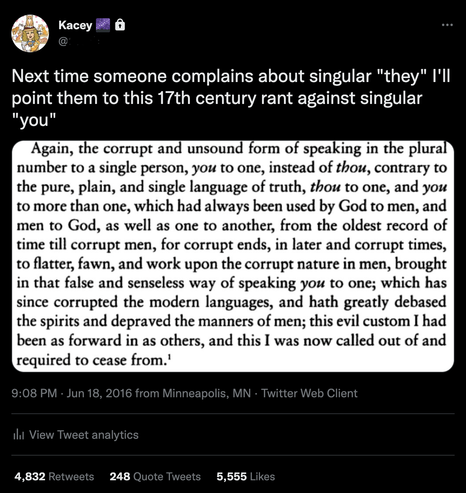
Next time someone complains about singular "they" I'll point them to this 17th century rant against singular "you"
(Basically my only tweet that ever "did numbers". Screenshot here for posterity.)
The best thing about this tweet is it always gets me lots of new non-binary moots. I hope they appreciate my content, which is almost strictly cats and baduk.
@kacey Cats and baduk are two of my favorites.

@kacey

Source: The History of Thomas Elwood, written by Himself, London, 1885, pp. 32-34, https://www.gutenberg.org/ebooks/6925

Discovered from cite in "The Varieties of Religious Experience," by William James, 1902.

https://en.wikisource.org/wiki/Page:The_varieties_of_religious_experience,_a_study_in_human_nature.djvu/310

The History of Thomas Ellwood Written By Himself by Thomas Ellwood

Free kindle book and epub digitized and proofread by volunteers.

Project Gutenberg
@mwl Thank you for sourcing this! I was about to ask if it was George Fox or someone else among the valiant sixty.

@arkiuat @mwl Fox (et al.) wrote an entire book on the subject! (Text available online at the link. The title is far too long to be contained in a toot.)

https://quod.lib.umich.edu/e/eebo/A40123.0001.001

A battle-door for teachers & professors to learn singular & plural you to many, and thou to one, singular one, thou, plural many, you : wherein is shewed ... how several nations and people have made a distinction between singular and plural, and first, in the former part of this book, called The English battle-door, may be seen how several people have spoken singular and plural...: also in this book is set forth examples of the singular and plural about thou, and you, in several languages, divided into distinct Battle-Doors, or formes, or examples; English Latine, Italian, Greek, Hebrew, Chaldee, Syriack, Arabick ... and how emperors and others have used the singular word to one, and how the word you came first from the Pope, likewise some examples, in the Polonian, Lithuanian, Irish and East-Indian, together with ... Swedish, Turkish ... tongues : in the latter part of this book are contained severall bad unsavory words, gathered forth of certain school-books, which have been taught boyes in Enland ... / George Fox, John Stubs, Benjamin Farley.

@kacey for a second i thought you meant the queer icon, the babadook
@kacey yes #enby here who also likes #baduk !
(I'll filter the cats)
@kacey following for cats and baduk
@kacey NUMBERS FOR THE NUMBERS GOD! POSTERITIES FOR THE POSTERITY QUEEN
@kacey
Roses are red,
violets are blue
singular “they” is older
than singular “you”
@kacey hmmm you think maybe hes saying langauge has been corrupted?
@kacey im abit confused tho. Is thou pronounced thoo or is you pronounce yow?
@0ddj0bb @kacey "Thou" is pronounced like "how", "cow", and not like "flow" or "though" or "thoo". English... is ridiculous. :D
@cassolotl @kacey well the point if my reply was to illustrate the silliness of the statement about language corruption.
@kacey @0ddj0bb and here, I learned something about the term thou. I always just thought it was an old form of you.
@kacey Yeah, this is some Quaker shit. I recognize the sentiment b/c I'm a Quaker. I don't use thee and thou.
@urbanhiker @kacey Aah, that explains it. From memory, I believe singular “you” is much older than 1600, possibly being imported grammatically from Norman French “vous” (vs “tu” for “thou”). People would have been using singular “you” for centuries (like singular “they” now), except Quakers, who I guess made a point of not making a T-V distinction.

@mudri @urbanhiker @kacey I'm pretty sure the word for singular you is from Old Norse. They used the word þu.

You still have "du" in the Scandinavian languages meaning singular you.

Plural you is harder trace down, and the Old Norse dictionary I was looking at doesn't even list a word for it.

It is possible that French "vous" is somehow cognate with English "you", which would tie nicely into your hypothesis of influence from latin languages.

@loke @urbanhiker @kacey I should clarify that when I say “imported grammatically”, I mean that the English words “thou” and “you” already existed to mean singular and plural 2nd person, respectively, but the practice of the plural one also being used to signify respect may have been calqued from Norman usage of “vous”.
@kacey how did they address their triune god? :-)

@kacey To be honest, it all started to go wrong when those crazy kids stopped using proper Anglo-Saxon dual pronouns....

https://oldenglish.info/pro3.html

Old English Online - Pronouns

An online educational resource for learning Old English

@hengymrohebwlad @kacey

But does “us two” include the speaker and the person being addressed, or the speaker and one other who is not the person being addressed??

@donaghy @kacey No idea. Perhaps the confusion was why the use of these pronouns died out!

@hengymrohebwlad @kacey

We have this in English, but I have a sneaking suspicion that there are languages where there are two "we" pronouns, one of reach of those.

I'm actually a thouist myself - I spend way too much time saying "you - I mean all of you, not just you..." and other stuff that adds meaning to the vague "you" that we currently use!

@donaghy @kacey Yes, this seems to be a feature of some indigenous North American languages e.g. Cree and Inuktitut:

https://ecampusontario.pressbooks.pub/essentialsoflinguistics/chapter/6-6-inflectional-morphology-in-some-indigenous-languages/

I wouldn't be surprised if this also happens in Australian Aboriginal languages, which often encode incredibly complex and subtle information about relationships and kinship.

6.5 Inflectional Morphology in Some Indigenous Languages – Essentials of Linguistics

@hengymrohebwlad @kacey

Doesn’t the dual persist in English a tiny little bit? Isn’t “oxen” originally a dual? And although “shoon” is archaic, I think even that persists as a brand name for a shoe shop.

@donaghy @kacey Not sure about oxen. Could just be similar plural suffix to "children". English plurals are a mess because of mixed origins, loss of older endings, generalising one example to others, simplification of using "-s" as suffix etc. Some Germanic plurals based on vowel change (umlaut) e.g. goose/geese or mouse/mice. Sometimes no suffix e.g. fish, sheep.

Mind you, Welsh plurals are even worse - different suffixes, umlaut, "singulative" endings etc. Great fun!

@donaghy BTW the formal/informal "you" (using plural form) distinction is very common in Indo-European languages:

https://www.babbel.com/en/magazine/formal-and-informal-languages

It's known as the T-V (from Latin tu-vos) distinction, and supposedly derives from the days when there were 2 Roman emperors:

https://en.m.wikipedia.org/wiki/T%E2%80%93V_distinction

These days the formal aspect seems to be fading in some languages e.g. I think Swedish now seems to use "du" generally for singular "you", and even German seems to be relaxing a bit here.

Why Do Some Languages Have A Formal ‘You’?

In Spanish it's 'tú' and 'usted,' in French 'tu' and 'vous,' and that's just the start. Why do some languages have both formal and informal 'you's?

Babbel Magazine
@kacey @otfrom I always found this resistance to "pronouns" in English hilarious. All my lecturers at college, most of the academic literature we read, generally formal English used "they/them" all the time. There is nothing particularly new about it. If there is resistance, it's not premised on linguistics, it's premised on politics.

@acousticmirror @kacey @otfrom I think there's a linguistic argument to be made for a third-person singular pronoun that stays conjugation-consistent with he/she/it. Take the following for example: "Andrea is going for a walk and they are bringing their dogs." The conjugation changes number despite referring to the same subject, creating extra ambiguity/confusion.

Unfortunately English just doesn't have a standardized number-disambiguated pronoun for this purpose, even despite the efforts of many neopronoun inventors. (Though I'm partial to "ey/em/eir/emself", perhaps with a starting apostrophe.)
One common idea is he/she, but as @djsumdog mentioned, this is annoying to use, and also doesn't accommodate non-binary people. So it's common to just default to the already-existent "they", despite its flaws.

Meanwhile, I would LOVE to have number disambiguation for second person. I use "y'all" regularly for precisely this reason.

@acousticmirror @kacey @otfrom excessive gendering in speech is a unique trait of the boomer generations speech patterns in England, the literary rule is once a gender is established further genderibgnis needless and rude, so "she went to the market and she had a good time" is incorrect English it should be "she went to the market and they had a good time" by original English language rules.
@acousticmirror @kacey @otfrom another odd trait of the boomer generation is excessive use of a person's name in speech, which is also seen as rude by the generations before.
@kacey of course on the West Coast of Scotland, Gaelic speakers moving to English needed a plural form of you, so they devised youse. And in the US both youse and y’all may be heard as plural forms to fill the gap caused by using you as a singular.
So we have gone full circle.
@kacey ps. In some rural areas of England, thou is still in use. Quite correct!
@peterbrown @kacey Thou came with a lot of irregular verb forms so the result has simplified the language somewhat. "You guys" also gets used as if it were a plural you. Possibly that's northern US. To me it sounds gender specific but I don't think its common usage is.
@okapi I've known others take umbrage with the phrase "you guys" and gendering, which is why I tend to opt for writing it with the homonym: "you guise" which eliminates the gender concerns, and emphasizes the etymology of persona (mask); I am most certainly, an outlier with this usage, but I am an outlier with most things, and totally OK with that. @peterbrown @kacey
@kacey People don't seem to realise that the singular use of they has been around for ages. I remember coming across it first writing university essays in the 60s. It is a very useful device.
@kacey I'm having trouble reading that. It seems to be somehow corrupt.
@kacey that's awesome, do you have a source? (Not adversarially, just curious)
@kacey @kat oh wow, “you” was the Holy Y’all

@kacey
my favourite thing birdsite has taught me is that singular "they" is so old that the first known written instance is spelled with a þorn.

https://nitter.net/Swilua/status/1436095859012288513

🌈Dr. Frizzle @[email protected] (@Swilua)

The first use of “they” is so old, it predates the letter combination “th” in favor of the thorn, “Þ” When William and the Werewolf, in 1375 CE, used the singular “they” as a pronoun, it was spelled “Þei”

Nitter