
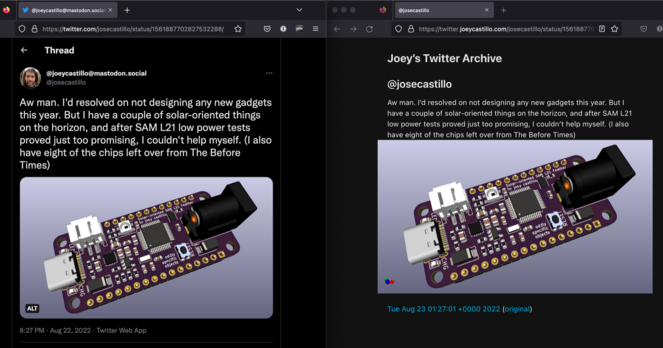
spent some time last night putting my twitter archive online, because I think the site could evaporate, and a lot of my process of making is tied up there. the gist: take any tweet of mine, replace the twitter . com with twitter.joeycastillo.com and you get the archived version.

@joeycastillo Did you just put the archived dump online as a static resource, or did you modify it?

Did you do anything to get other user names in context into it?

@mcdanlj Static resource, nothing pulled in from outside of the downloaded archive, which is just the raw tweet text and media from my side. Means I can probably salvage self-reply threads, but any back-and-forth conversations are going to become islands (and necessarily so, since I don't think I have the right to host other people's tweets).
@joeycastillo Yeah, I was mostly wondering about resolving names from IDs, so that you can figure out who you were responding to. ☺ Thanks for clarifying that!
@mcdanlj interestingly for replies, the archive includes the relevant usernames in the text of the tweet, even when it would push the length over 280 characters: https://twitter.joeycastillo.com/josecastillo/status/1587978317428400130/
And it includes the username and at least _part_ of the text of a retweet for retweets, in old-school RT style: https://twitter.joeycastillo.com/josecastillo/status/1588705498647625728/
@josecastillo

@mcdanlj oh LOL. I get it now. The retweet code must be legacy to when the limit was was 140 characters: if the tweet you're retweeting (plus the "RT" and the username) fits in 140 characters, the whole retweet is included in the archive, plus media! https://twitter.joeycastillo.com/josecastillo/status/1586507526949851137/
@josecastillo