 Ruth Carden 🦴
....horse, which was dated to the Middle Bronze Age (c.3,020 yrsBP) - that's the earliest date post-IceAge yet ... horses will be explored with @StillJustRena on the #IrishCaveBones project. This will be exciting as we will research and investigate horses through time, from pre-IceAge/LGM all the way through to Medieval period!! 🐎 🐴
The pig/wild boar bone was dated to Middle Bronze Age too (c.3,285 yrsBP), along with cattle around similar time. This is not unexpected.
Pine marten bone was dated to Late Bronze Age (c.2,716yrsBP), a species' history which needs to be explored further in Ireland.
We also have Early Medieval badger and cat (c.955 -1,064 yrsBP) & some interesting Early Neolithic & Early Bronze Age dogs, which we will be exploring their genetic history with Pontus Skoglund in the Francis Crick Institute, UK and Greger Larson in University of Oxford - this will be exciting as these are some of Ireland's oldest dogs, identified to date (we may find older ones in other cave assemblages!!) as part of the #IrishCaveBones project.
The Killuragh cave faunal remains, as Peter and I said we would, will be investigated more in what secrets they can tell us. And while in my head Peter is very much still with us on the #IrishCaveBones project, sadly he passed away unexpectedly in early 2017, two days before ...
his untimely death, I was chatting excitedly on the phone as we were arranging to meet face to face at the end of the week so I could say to his face my new news on some cave bones. Sadly I could never tell him, but he knows. Killuragh cave also has a species... #IrishCaveBones
...which was a suprising find, weasel bones! Ireland has stoat bones from the Late Glacial period at least, but it's smaller relative, found in Britain, wasn't in Ireland. There are some vague reports of weasel bone in Medieval castles here, but not earlier. #IrishCaveBones
We need to radiocarbon date these weasel bones (positively weasel, as checked again reference material from National Museums of Scotland), to see more of their story in Ireland. Or was it a 'pet' (good mousers and ratters) of one of the humans who used the cave? #IrishCaveBones
or could it be a recent introduction to Ireland? Though we would expect to find more of them or reports of them by now if a population was here? Until it's dated we can't even begin to tell its story.
So the weasel shall remain a mystery until it's radiocarbon dated, hopefully in the near future and as part of the #IrishCaveBones project (more on that later in the week). The importance of dating is essential to the when part of our questions in Ireland's past.
Killuragh Cave has so much to offer still, there are many species' stories in that one cave still to be told &Peter's spirit will come with us. But interestingly, this cave has post-LGM fauna, whether dating more bones changes that remains to be seen.
But Killuragh Cave faunal remains will help us discover more secrets about Ireland's faunal species and their interactions with humans. And so, another cave assemblage was assessed, identified, catalogued.
More about Peter and mine collaborations tomorrow evening...which changes Irish faunal history yet again from previous knowledge! I'll try to be earlier tomorrow evening with the next installament of the long running #IrishCaveBones project - thanks for reading!
If you're still reading daily, thanks for your interest. This thread will finish up on Friday evening, just FYI.
There was more to be told than I anticipated at the start...but I guess this project has been running since 2007!
And we are back for the next installment on the evolution of the #IrishCaveBones project. Hope ye have a suitable beverage (or two!) to hand.
There are gaps of my time on this project, since apart from 2010 for 3 months, this project has been unfunded. Thus my other contracts ...
..kept me, at times, for long periods (2.5 years at one time) and many months away from getting on with the research element and working on the various cave bones. If I/we had gotten funding, we would be very much advanced in our knowledge of Ireland's past by now. #IrishCaveBones
We go back to the years following Killuragh Cave and I'm still conducting research with the late Prof. Peter Woodman on caves and their faunal remains. Around 2016, Peter asked me to collaborate with him on another piece of work.. #IrishCaveBones
This new piece of research also teamed up with Prof. Tom Higham @tommyhigham
(then Oxford ORAU, now at Univ. of Vienna, Austria).
The background was the large paper by Peter (Woodman et al., 1997 https://sciencedirect.com/science/article/abs/pii/S0277379196000376) 'The Irish Quaternary Fauna Project'
In this paper, Peter et al., radiocarbon dated 100 different animals bones, majority of which were from Irish caves. But this was in the early 1990s, when radiocarbon dating did not use ultrafiltration methods to rid samples of contamination (which alters results)
Although this paper was a phenomenal amount of work (and costly), and at the time provided the first important step, at a relatively large scale, of the 'when' part of the Irish faunal story....sadly as we found out, the results were severely flawed.
In our new collaboration from c.2016, we subjected the same bones (or their left over samples from previous early 1990s) to the standard radiocarbone dating method using ultrafiltration, removing contaminates. As we got the results we realised all those dates in..
...the 1997 paper must be written off and ignored going forward. Those dates, were sadly, wrong and should not be used or cited. We started drafting the early part of the first draft late 2016, but sadly Peter passed away in late Jan. 2017.
But Peter knew the enormous consequences of the new dates and we continued to write the paper, Covid delaying things slightly and also I did not want to diservice Peter with a substandard paper. It was published in Boreas in 2020 ....
(https://onlinelibrary.wiley.com/doi/epdf/10.1111/bor.12451)
So.... what we found from four caves with selected bones used for redating (where original bones/samples were available), the 1997 published dates were not accurate. There are questions of the extent of the Last Glacial Maximum ice sheet (Ice Age) across Ireland.
We have new dates of the original species' bones from Castlepook cave (Co. Cork), Shandon cave, Ballynamintra cave & Foley cave (Co. Waterford). In Castlepook cave, firstly, we have 14 new dates from reindeer, fox sp., giant deer, brown bear, wolf, woolly mammoth ...
& spotted hyena (the only cave in Ireland where this species been found, so far) & Arctic lemming. Some substainally & some got younger (note calibrated ages used in figure below, which are not same as years BP)
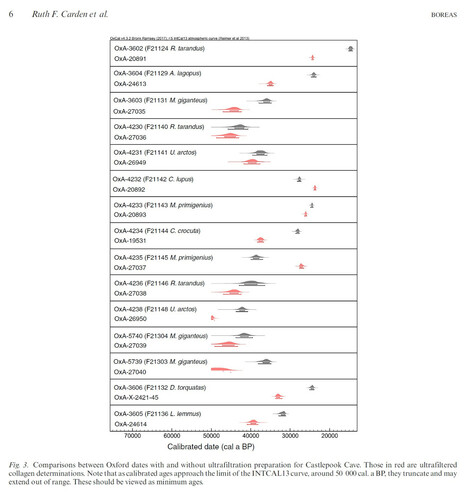
In terms of the wolf and the woolly mammoth, both these got younger new dates than previous, 'moving' them through time to when the whole of Ireland was covered by the large ice sheet during the LGM or the Ice Age.... 🤔
We also have a reindeer than moved through time from c. 12,500 yrs BP to c.20,200 yrs BP (these are not calibrated years)....again when Ireland is meant to have been covered entirely by the icesheet - So 3 different species ... refugium is a possible in this area
Giant deer bones found in Castlepook cave dated between c.32,000 to c.45,000 yrs BP & seemed to have disappeared from Ireland around the 32,000 yrs point, which may time with the ice sheet in it's early days of extension from the North. Story for next year.
Spotted hyena dated from c.45,000 yrs BP to c.33,200 yrs BP. Another interesting timing of the colder weather coming with the extension of the Ice Sheet ... another story for next year :) (think of these research papers as stepping stones across a wide river)
That wolf which moved from c.23,400 yrs BP to c.19,600 yrs BP, may have either been a survivor in a refugium (which evidence is mounting for), or at least the first of (many?) species reaching Ireland after the icesheet retreated but prior to island formation?
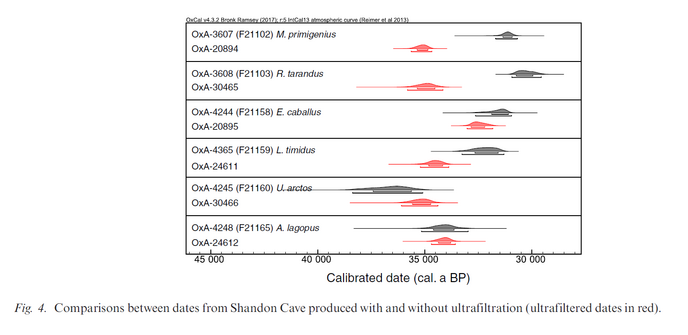
Shandon cave new dates, resulted in woolly mammoth, reindeer, horse, hare, brown bear moving to older dates approximately a few 1,000 yrs before the Ice Sheet extended from North & Ireland became to inhabitable. One exception is fox sp. that remained approx same.
whoops forgot to attach the Shandon figure from the paper showing the new and old calibrated radiocarbon dates. See Alt text for more info :)
Foley cave gave a new hare result of greater than 45,000yrs BP - has been in Ireland a long time & through thick and thin has stuck with us all the way to present day. This is interesting and shows species highly adaptability in various climates and environments.
Foley cave also gave us a reindeer tooth at about 31,000yrs BP ... Ballynamintra cave has reindeer at c.35,000yrs BP too.... so reindeer were here pre- and post-LGM (Ice Age) too... again refugium survivor? earlier recoloniser after LGM?
So many questions to be researched and investigated further, which we are currently doing, more on this on Friday when we finish this long thread (longer than I thought it would be). This 2020 paper is really important with it's new dates.
on many levels, the 1997 paper is gone, written off, torn up, burning in the ancient fires. The 2020 paper sets the start of the 'new' story for Ireland's fauna and their 'whens' on our island. It also presents evidence to question the icesheet models for Ireland
which we will go deeper into next year with more published research on the #IrishCaveBones project sorry you have to be patient :) But the fauna found in these caves shown some co-occurence but with different species 'sets' at various times, or ecosystems in tune with climate.
But there is lots of food for thought in this 2020 paper and we are barely scratching the surface of what was there and when. Dating is crucial to the basics of ecosystem functioning and what our island fauna/flora were present.
But there is still very limited research on our fauna and flora from pre- and post-LGM/Ice Age, that we cannot answer certain questions as yet. But this 2020 paper gives massive hints and will be explored further on the ongoing #IrishCaveBones project. And caves only provide ...
a snapshot, limited snapshot, of what species was present (or their absence) here. Something we must always remember. We will continue tomorrow evening with some of our more recent research & finish up on Friday evening. Thanks for reading & I'm sure lots of Qs!
More tomorrow night. If you have gotten this far, thank you for taking time to read the journey, and origins story of this project.
Thurs. eve - how time flies by!!
The year 2020, brought yet another huge loss in terms of a great supporter of my/our cave research, loss of knowledge and invaulable regular discussions, the sudden passing of the geologist, Dr Matthew Parkes of the National Museum of Ireland.
Matthew was always so interested & willingly to help in any way he could. Great to have that backbone of support in the Museum. A huge loss to the community & I will miss his prank scares of me in the stores,in one sense,always ended in laughter shared between us.
Meanwhile, in the pandemic time, my research physically on the bones ceased but not on the paper research end of things, or the thinking, teasing out, reviewing the work I had already achieved. I reached out to Helen Lewis again in UCD and much chats were had.
I also had continued my collaborative research with Richard Jennings in Liverpool John Moores University, along with Allan McDevitt. Allan and I had devised a piece of research back in 2017 and things were moving along, slowly, but moving. The only funding we ...
we got for this new piece of exciting research was 7 radiocarbon dates from the Royal Irish Academy & the Irish Quaternary Association and that's it, yet again research on a shoe string, but that shoe string turned out to be VERY significant. Because both Allan and I were working full time ...
in other jobs at the time, the research and what was needed to eventually form a strong paper for submission to a suitable international journal, things moved slowly. Always in the right direction but given lack of dedicated funding we could only do so much.
To address other lines of supporting evidence we invited certain colleagues for specific jobs onto this peice of work. Things were moving very nicely and in good time up to early 2020 (then Covid hit and we were stalled at cruical times). But in Winter 2019,
I had taken part in a Irish TV documentary series by Katrina Costello of Silver Branch Films, and thought there was loads of time prior to airing in April 2021, so finish the research, and submit the paper and have it published for all to see. Then the pandemic hit - hard stop!
As Ireland-based viewers (and indeed some based in America who have watched it on PBS) know, the wonderful Heart of Stone 2 part TV series was aired in April 2021 and a small, but significant part of our research was aired. As was then, and still now, I did not do any interviews, as it's not right before the paper has been published. So I'm going to leave this massive cliffhanger here and deflect any questions asked.
#IrishCaveBones
#IrishCaveBones
Next year this paper will shine in all its glory and I'd love to discuss it then :)
So, the people I have been working with closely, Allan, Richard, Helen on the #IrishCaveBones project, we have others we collaborate and work with too - an extended network of people, including ancient geneticists - Prof. Dan Bradley in Trinity College Dublin, Ireland and others
Dan is involved in the previous research that must not be named as yet, as is Patrick Randolph-Quinney et al., which will complete that research that got severely delayed due to COVID.
Another really cool collaboration was with Pontus Skoglund
and Anders Bergstrom
and others, where Richard and I contributed knowledge and samples towards a wolf-dog project - this was published this year in a fantastic Nature paper led by Anders. Albeit we had small parts ...
to play in this, Irish samples were included. As Ireland is situated on the far edge of NW Europe and became a island shortly after the Ice Sheet and LGM ended, we are an important area for how species adapt and survive. It all ties in and it's great to still be collaborating ...
with Pontus and his team on many levels using wolves and dogs from the caves and elsewhere. The Nature wolf - dog paper is below, and with 100,000 years of genomic ancient DNA shows dual ancestry in dogs from wolves.

So where does this leave us now on #IrishCaveBones, we are nearly up to date... almost .... we have learnt so much to date, and yet the more we learn the more unknowns there are and more knowledge gaps. But we are persisting ... just like some Irish species persisted thru time.
Now we are in the realm of recent and ongoing active research including fieldwork in Irish caves. Richard, Helen and I co-applied to the @RIAdawson
for archaeological excavating funding in 2021, and we were successful.
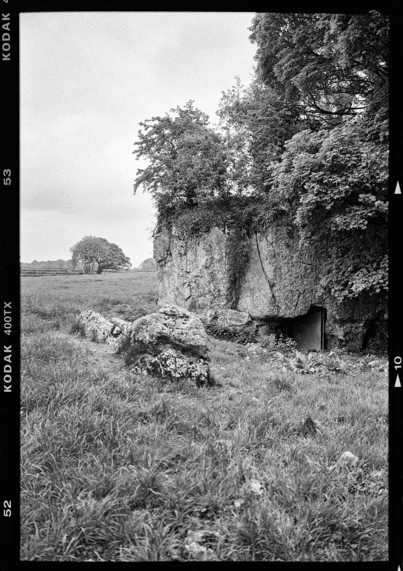
In early summer 2022, we followed in RJ Ussher's footsteps in Castlepook cave, Co. Cork and started our first season of a research archaeological excavation at the cave.
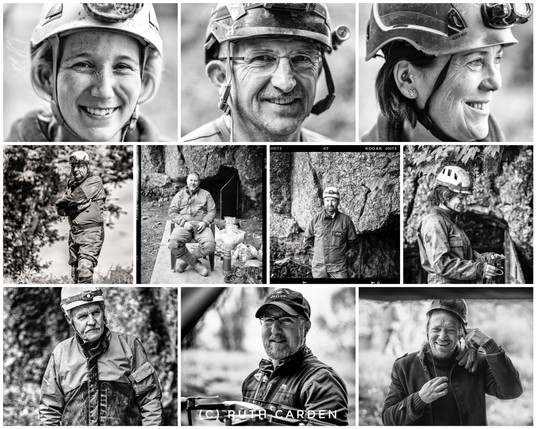
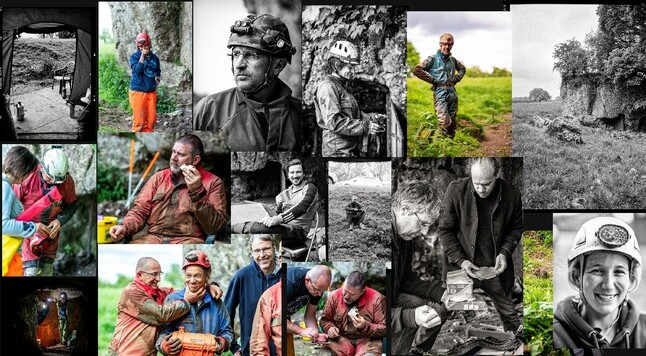
We had/have an amazing team of people we are working with on this project - we are working in conjunction with the Cork Speological Group who volunteer their time with us, to make the cave safe for our brilliant cave archaeologists to work in & are on hand.
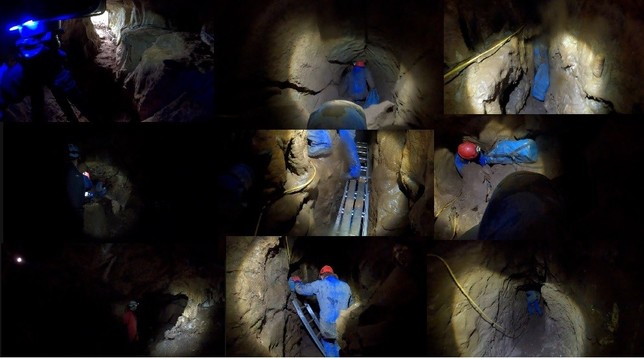
To give an idea of conditions inside Castlepook cave where our cave archaeologists had to work, and the assists at very tricky/difficult points provided by the Cork Speological Group which we are extremely grateful for, see the photos... our cave archaeologists were very brave!
Our analysis on samples obtained from our first season is ongoing. Pleistocene and Holocene animal species' bones were found and identified - spot the Arctic lemming tooth in the cave sieved sediment sample - (Hint: it's near the middle of the photo)
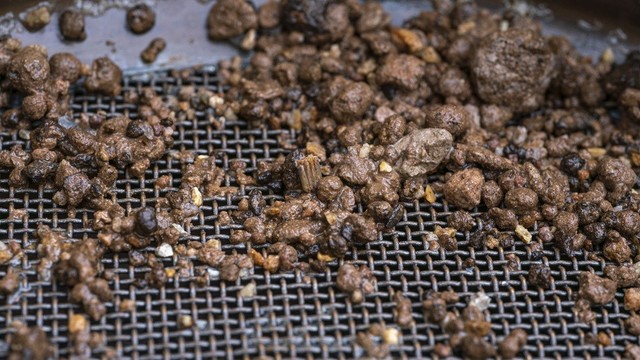
We took soil/sediment micromorphology samples, sediment for ancient DNA analysis, excavated animal bones (select few will be subjected to radiocarbon dating), we also laser mapped the cave interior, and photogrammetry of the exterior. All analysis should be ...
completed by first quarter of 2023 and we are planning our next field season at Castlepook cave already.
Tomorrow I shall finish up this story, but it's not the end. If you have kept up this week, I thank you for your interest in our research. See ye tomor eve!
Friday evening - last part of this massive thread, which I didn't think would turn out so long. Thank you, if you are still here reading this. Knowing this research excites you as much as it does me, really means a lot. Together, we are time travellers! #IrishCaveBones
I have a nice warm 3-mint tea to accompany me on this last part of the origins story of #IrishCaveBones. I hope you too, have a nice suitable beverage.