 Ruth Carden 🦴
Since it's #ScienceWeek 2022 in Ireland, here's a thread for the next 7 days on the untold Origins Story of the #IrishCaveBones project which I started back in 2007 as a personal project. The origins story starts in 2007 to current day with the milestones and some signfiicant Irish discoveries on the way. As you will find out the #IrishCaveBones project originated out of curiosity and a quest for knowledge on my part and it continued to present day & into the future. #isci #SciComm #SciCommIE
Back in 2007/8, during research access to the National Museum of Ireland collections for the origins of Irish red deer project (published Carden et al., 2012 bit.ly/3g2CRhm), to the antiquarian archived animal bones excavation from many different Irish caves which were excavated during late 1800s to mid-1900s, I saw mis-identified red deer bones. These were labelled as pig, sheep, horse and reindeer bones. #IrishCaveBones #iSciComm #SciCommIE #iSci
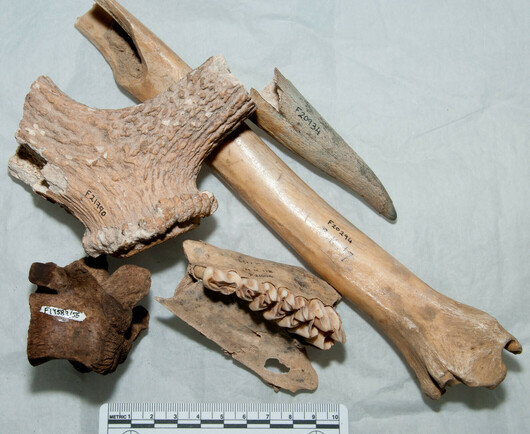
I asked and was given permission by the Museum staff, to start a full reassessment and (re)identification of all caves’ bones using up to date zooarchaeological recording techniques and creating a unique catalogue of all the bones. And so, the #IrishCaveBones project began… from just a few empty tables in the museum’s stores to tables filled with bones and fragments. #IrishCaveBones #iSciComm #SciCommIE #iSci .... more tomorrow :) (or later today... my natural night owl is showing!)
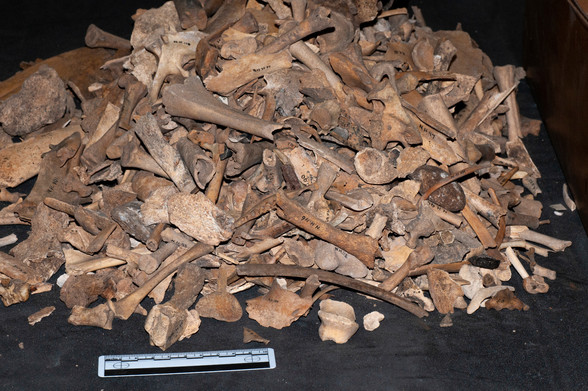
Back in early years of the #IrishCaveBones project, I was interested in knowing what faunal species were here in Quaternary Ireland, & by knowing the dates/when, we could piece together past ecosystems & investigate why some species survived whilst others didn’t.
But also how and when faunal species got to Ireland - the colonisation of our island in the past in terms of animals and plants. #IrishCaveBones #SciCommIE #iSciComm
And this mutual interest was developed in chats with Allan McDevitt (now ATU), whom had worked with me on the Irish red deer paper. So a long collaboration involving many projects started with Allan McDevitt (now ATU) began and still continues to this day. As we still try to answer the colonisation of Ireland many questions, but we have some! We became very good friends too.
#IrishCaveBones #SciCommIE #iSciComm
#IrishCaveBones #SciCommIE #iSciComm
But I jumped forward a few years and digressed a little, only due to mention of the red deer origins paper… but first a need for some coffee to get my brain cells in order to tell you about the next milestone of this untold origins story of #IrishCaveBones project.
In 2009/10, I got into conversations with a recent appointment lecturer to the Sch. of Archaeology, University College Dublin, and now Assoc. Prof., Helen Lewis.
Helen is involved with archaeological cave research in the Philippines, but very interested in Irish caves and what we can learn of their past, how sediments were laid down and their faunal histories - caves provide us with a secret window into the past, snap shots in time.
Our skill sets & interests complemented each other and Helen& I started to work together.
We applied for different funding and were succesful on a small grant with The Heritage Council, Ireland in 2010. This allowed me to work fulltime for 3 mths, to start with Co. Clare cave complex, where all the bones were mixed together, so not only did I use traditional zooarchaeological analysis and techinques, I also had to do basic sorting cave by cave, species by species
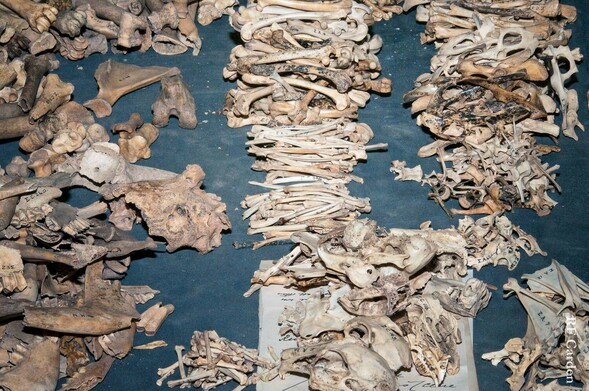
The Co.Clare cave complex consists of 5 caves worth of bones, all mixed together & with an est. count of c.20,000 bone fragments. First excavated by RJ Ussher and his team in 1902-04. What secrets do they hold?
Listen to their whispers ... I did!
The Clare cave complex or Edenvale Cave complex (just outside Ennis) holds a diverse species mix of pre-Ice Age and post-Ice Age (or LGM).
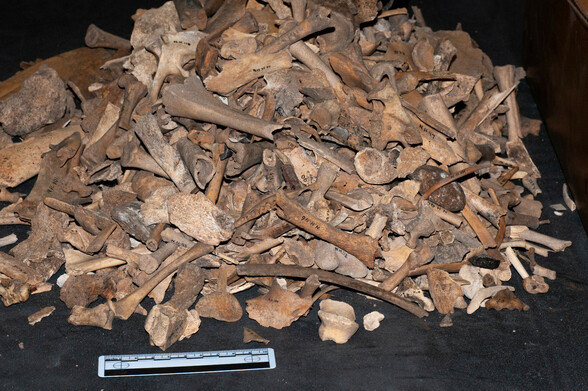
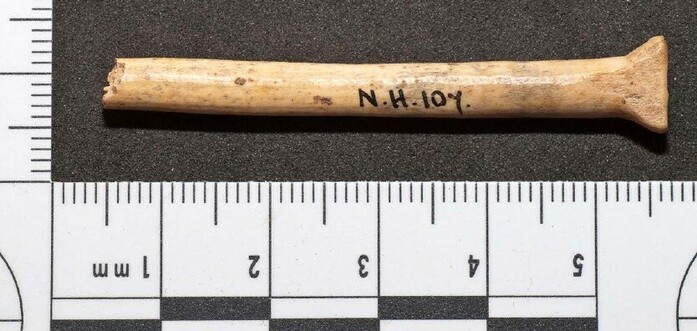
There were some worked bone artefacts like the bone pin below found amongst the bones. Don't forget these bones had not be looked at in years at any length, not since their original excavation in the early 1900s.
All in over that 3 month period funded by The Heritage Council, I handled, sorted, measured, recorded some of the Edenvale Cave complex bones (c.11,700 bone fragments), and corrected the mis-identifications made in the past by Scharff et al. (1906).
And then the funding ran out. Helen and I applied for more grants but were unsuccessful and I just continued on in my spare time and on holidays where I could - sorting, recording, measuring, identifying. Listening to the bones whispering their secrets to me over many long days.
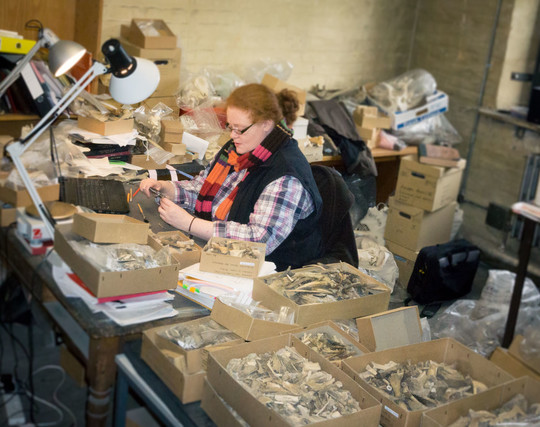
Helen Lewis (UCD) & I remained in contact, still eager to continue our collaboration on what Ireland's past through the use of the caves' and their faunal remains could tell us.
But who cared for a pile of old bones sitting forgotten in the stores?
Time passed on, I continued coming back to the stores to continue the work but could only do so much per year given other (paid) work commitments.
But what I found in this box below in 2015, changed my thinking of Ireland's fuanal past. :)
Cliffhanger, more tomorrow!
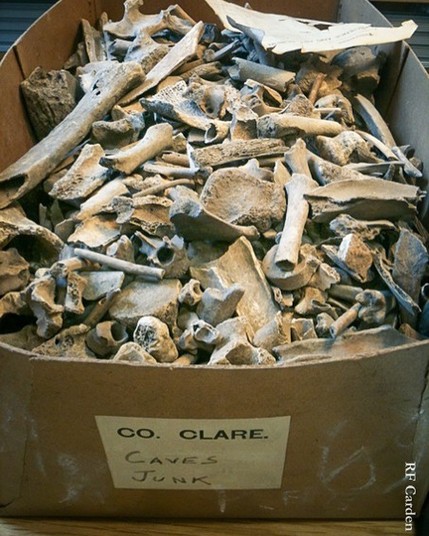
Now where was I...ah yes, a certain bone from this box told me their special secrets which changed Irish archaeology and made me dismantle any boxes in my thinking about Ireland and its colonisation of animals and humans ... it was ...
this bone, 👇 I identified as an adult male brown bear patella, or knee cap, that show (eroded bone and) human modified cut marks. I got the cut marks independently verified by Emeritus Prof. Terry O'Connor
& Prof. Alice Choyke 🥳
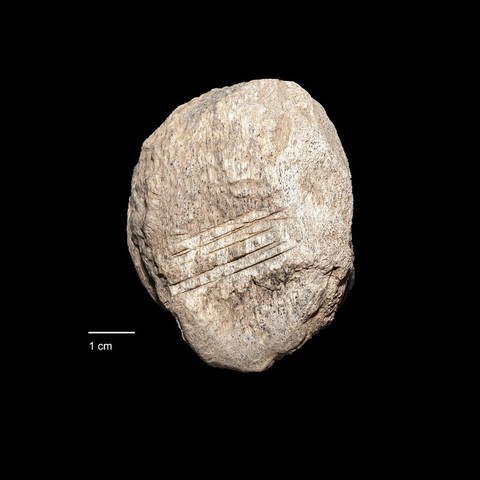
I was eager to have this brown bear knee cap bone radiocarbon dated, because the cut marks were made on fresh 'green' bone, shortly after the death of the bear, then the date might be hugely important. #IrishCaveBones #SciCommIE
We know, with evidence to date, the brown bears exist into the Bronze Age in Ireland, and brown bears have been dated to before and after the Last Ice Age (LGM) ... so the game was afoot! #IrishCaveBones #SciCommIE
The returned radiocarbon date from14CHRONO radiocarbon dating lab in Queen's University Belfast, was AMAZING!!!! One minute Irish Archaeology started in the early Mesolithic and then after reading the results, Irish Archaeology had a Upper Palaeolithic human presence, in c.10,800yrsBP! #IrishCaveBones #SciCommIE
So, I dismantled all the boxes in my head, the saying 'to think outside the box' is very apt...I now ask 'What box?' This new Upper Palaeolithic date shows us humans were in Ireland hunting brown bears...a large adult male brown bear. #IrishCaveBones #SciCommIE
During the later stages of the brief mini cold snap, Younger Dryas, effecting Ireland that seemingly caused the giant deer extirpation on our island. Or now we have human presence, did humans hunt giant deer too? #IrishCaveBones #SciCommIE
This amazing and very surprising discovery changed how we looked at Ireland. Discussions with Allan McDevitt and Daniel Buckley, long time friends and colleagues with mutual interests, and others changed dramatically!! What else was happening at that time? We now have to think about knock on effects on fauna/flora. #IrishCaveBones #SciCommIE
Also during 2015, I had finished a full reassessment and identification of the cave bones of Ballynamintra Cave, Co. Waterford and Dr Richard Jennings (Liverpool John Moores University, UK) extended invite to collaborate on this cave. #IrishCaveBones #SciCommIE
And so another cave collaboration was developed with a team of excellent researchers. Richard succesfully obtained 3 years worth of funding from the Royal Irish Academy, to conduct new excavations at the cave. And Ballynamintra cave has it's own secrets ... #IrishCaveBones #SciCommIE
to give up in due time. Full paper is nearly ready of all of our combined efforts and contributions and there are possiblilities there too..... but I won't spoil them here....yet
Tune in tomorrow evening for more on origins story of the #IrishCaveBones project. I saw this view across from the desk in the Museum stores for many many years - beautiful in late afternoon golden light - where the magic happened & the bones told me their secrets!

Right, apologies this is a bit later. I have my coffee in hand, so lets go back to 2011-the timeline jumps a bit but such is the nature of the work :) The late Prof. Peter Woodman (UCC) got in touch with me & we set up our first F2F meet in Dublin.
Peter &I hit it off from the getgo in our mutual interests & quests for knowledge in how Ireland got it's fauna/flora, when& the human interactions. We had many more meetings &our friendship grew, along with mutual respect. #IrishCaveBones
Many long chats over coffee over the years both in Dublin and Cork city. I can't state enough how refreshing and exciting it is to talk about your interest subject with someone who also has that excitment and thirst for it, as well as knowledge level.
Peter asked me to collaborate with him on many projects, including the faunal assemblage of Killuragh Cave, Co. Limerick - a cave on the banks of the Mulkear River.
Peter excavated this cave himself in the 1990s. It's a multiperiod site ranging from c. Late Glacial period (some 11,000 years ago) to historical times. The 14 dates from the human bones - min. 6 individuals (3 adults, 2 juv & 1 infant)... ..showed human presence (based on 229 human bone fragments) & use of the cave from the Early Mesolithic to Middle Bronze Age.
The faunal remains consisted of 10,615 bones and bone fragments. Including many many wood mouse and Arctic lemming teeth and bones...
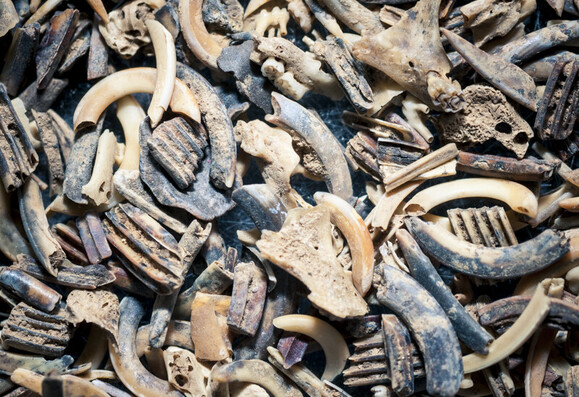
The stratigraphy of Killuragh Cave is difficult due to the influx of water flooding events and disturbance by rabbits and badgers (bones of both species identified among the assemblage). Also the lack of radiocarbon dates on the remains is an issue. But there were some usual suspects identified - giant deer (dated c.11,598 yrs BP), red deer, pig/wild boar, and ...
....horse, which was dated to the Middle Bronze Age (c.3,020 yrsBP) - that's the earliest date post-IceAge yet ... horses will be explored with @StillJustRena on the #IrishCaveBones project. This will be exciting as we will research and investigate horses through time, from pre-IceAge/LGM all the way through to Medieval period!! 🐎 🐴
The pig/wild boar bone was dated to Middle Bronze Age too (c.3,285 yrsBP), along with cattle around similar time. This is not unexpected.
Pine marten bone was dated to Late Bronze Age (c.2,716yrsBP), a species' history which needs to be explored further in Ireland.
We also have Early Medieval badger and cat (c.955 -1,064 yrsBP) & some interesting Early Neolithic & Early Bronze Age dogs, which we will be exploring their genetic history with Pontus Skoglund in the Francis Crick Institute, UK and Greger Larson in University of Oxford - this will be exciting as these are some of Ireland's oldest dogs, identified to date (we may find older ones in other cave assemblages!!) as part of the #IrishCaveBones project.
The Killuragh cave faunal remains, as Peter and I said we would, will be investigated more in what secrets they can tell us. And while in my head Peter is very much still with us on the #IrishCaveBones project, sadly he passed away unexpectedly in early 2017, two days before ...
his untimely death, I was chatting excitedly on the phone as we were arranging to meet face to face at the end of the week so I could say to his face my new news on some cave bones. Sadly I could never tell him, but he knows. Killuragh cave also has a species... #IrishCaveBones
...which was a suprising find, weasel bones! Ireland has stoat bones from the Late Glacial period at least, but it's smaller relative, found in Britain, wasn't in Ireland. There are some vague reports of weasel bone in Medieval castles here, but not earlier. #IrishCaveBones
We need to radiocarbon date these weasel bones (positively weasel, as checked again reference material from National Museums of Scotland), to see more of their story in Ireland. Or was it a 'pet' (good mousers and ratters) of one of the humans who used the cave? #IrishCaveBones
or could it be a recent introduction to Ireland? Though we would expect to find more of them or reports of them by now if a population was here? Until it's dated we can't even begin to tell its story.
So the weasel shall remain a mystery until it's radiocarbon dated, hopefully in the near future and as part of the #IrishCaveBones project (more on that later in the week). The importance of dating is essential to the when part of our questions in Ireland's past.
Killuragh Cave has so much to offer still, there are many species' stories in that one cave still to be told &Peter's spirit will come with us. But interestingly, this cave has post-LGM fauna, whether dating more bones changes that remains to be seen.
But Killuragh Cave faunal remains will help us discover more secrets about Ireland's faunal species and their interactions with humans. And so, another cave assemblage was assessed, identified, catalogued.
More about Peter and mine collaborations tomorrow evening...which changes Irish faunal history yet again from previous knowledge! I'll try to be earlier tomorrow evening with the next installament of the long running #IrishCaveBones project - thanks for reading!
If you're still reading daily, thanks for your interest. This thread will finish up on Friday evening, just FYI.
There was more to be told than I anticipated at the start...but I guess this project has been running since 2007!
And we are back for the next installment on the evolution of the #IrishCaveBones project. Hope ye have a suitable beverage (or two!) to hand.
There are gaps of my time on this project, since apart from 2010 for 3 months, this project has been unfunded. Thus my other contracts ...
..kept me, at times, for long periods (2.5 years at one time) and many months away from getting on with the research element and working on the various cave bones. If I/we had gotten funding, we would be very much advanced in our knowledge of Ireland's past by now. #IrishCaveBones
We go back to the years following Killuragh Cave and I'm still conducting research with the late Prof. Peter Woodman on caves and their faunal remains. Around 2016, Peter asked me to collaborate with him on another piece of work.. #IrishCaveBones
This new piece of research also teamed up with Prof. Tom Higham @tommyhigham
(then Oxford ORAU, now at Univ. of Vienna, Austria).
The background was the large paper by Peter (Woodman et al., 1997 https://sciencedirect.com/science/article/abs/pii/S0277379196000376) 'The Irish Quaternary Fauna Project'
In this paper, Peter et al., radiocarbon dated 100 different animals bones, majority of which were from Irish caves. But this was in the early 1990s, when radiocarbon dating did not use ultrafiltration methods to rid samples of contamination (which alters results)
Although this paper was a phenomenal amount of work (and costly), and at the time provided the first important step, at a relatively large scale, of the 'when' part of the Irish faunal story....sadly as we found out, the results were severely flawed.
In our new collaboration from c.2016, we subjected the same bones (or their left over samples from previous early 1990s) to the standard radiocarbone dating method using ultrafiltration, removing contaminates. As we got the results we realised all those dates in..
...the 1997 paper must be written off and ignored going forward. Those dates, were sadly, wrong and should not be used or cited. We started drafting the early part of the first draft late 2016, but sadly Peter passed away in late Jan. 2017.