 Daniel Mclaughlan (He/Him)
We are now live!
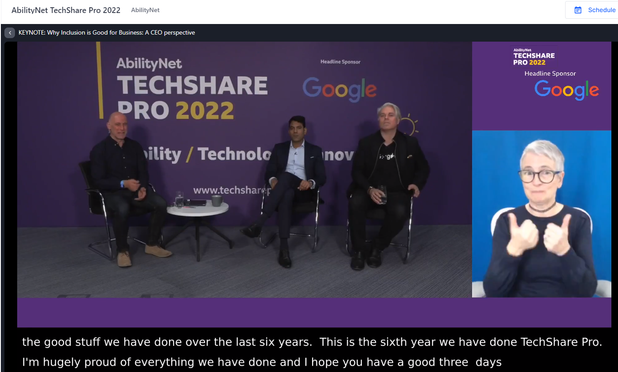
We are now live!
#TechSharePro2022 keynote discussion:
Alex Mahon, CEO Channel 4 (paraphrased):
"[on recruitment] Adjust preconceptions. Strengthen the portrayal of disabled people on screen..
..having disabled actors in disabled roles. But well-rounded characters. Moving away from the character being their disability."
"4% tv adverts have disabled actors, but only 1% in a lead role"
"Tell a story - disabled people are valuable - this often melts the ice to bring someone in as a leader." 👍
#TechSharePro2022 keynote discussion:
Caroline Casey, Valuable 500 founder:
"We are now in the rooms - some of the rooms.."
[on report produced with Tortoise]:
"A third of FTSE100 companies do not have an accessible website. No senior managers identifying as having a disability."
"Why are we having cultures where disability is covered and hidden? What is hidden is not dealt with."
Report here:
https://www.thevaluable500.com/wp-content/uploads/2021/07/Tortoise-Disability-100-Report-Valuable500-accessible.pdf
Lunch and Learn: Captions and Windows 11
Ben Watt, Microsoft, demonstrating new and updated Accessibility features (formerly Ease of Access) in Windows 11 including Live Captions, Focus Mode and Dictation and (preview) Voice Access.
Nice to see a built in captions option that can not only caption video audio, but also microphone audio - and with options to customise the display - bearing in mind the caveats of automated accuracy.
#TechSharePro2022 Lunch and Learn: Designing accessibility for AAA games: God of War Ragnorok with Mila Pavlin, Sony
Describing barriers:
Situational barriers - playing with the sound off at night with a puzzle requiring you to follow a sound
More "elusive barriers" such as subject matter and social barriers that keep players playing.
Mila Pavlin, Sony, quoting the ESA statistics:
"29% of gamers are over the age of 50"
"43% of gamers use features exclusive to the accessibility menu"
https://www.theesa.com/resource/2022-essential-facts-about-the-video-game-industry/

This year's 2021 Essential Facts About the Video Game Industry confirms that, in the last year during the global pandemic, people from all walks of life reached for video games to find joy, connection and a sense of belonging.
Mila Pavlin, Sony, outlining God of War Ragnarok #a11y features for motor access needs:
* auto traversal
* context sensitive auto pickup
* recenter on attack
ROI and Inclusion session with Kush Kanodia, Cathy Holloway, Nir Koren, Lucy Ruck, Bernard Chiira and Eric Lipp.
"How do we persuade people of the return on investment?"
Kush: Using the media. Described a successful media campaign to abolish disabled parking at NHS trust hospitals.
"As a disabled person, if I can access healthcare, then I can access education and employment. That's the most important ROI for me"
https://www.disabilityrightsuk.org/policy-campaigns/campaigns/nhs-disabled-parking
"How do we persuade people of the return on investment?"
Cathy Holloway, Global Disability Innovation Hub:
"Social and economic benefits. Not just for the individual - which we can measure - but the wider community"
"How do we persuade people of the return on investment?"
Lucy Ruck, Business Disability Forum:
"Think about stories... The story of the individual. Treating people as human beings and with the respect they deserve."
"Remembering that 83% of individuals acquire disabilities during their working life. You don't want to lose that talent."
"How do we persuade people of the return on investment?"
Eric Lipp, Open Doors Organisation, discussing the ROI for the travel industry:
ROI of $29Bn from disabled travellers and their families.
76% disabled people look for travel needs online.
95% eat out in restaurants when travelling.
"People with disabilities are booking online at a higher rate. If your app or website are not 110% accessible.. then we're not going to do it."
"Do we need numbers to prove ROI?"
Cathy Holloway, Global Disability Innovation Hub:
"Everybody is a valid human beign. They have a human right to expect things like AT or access to healthcare or equal access to a building or a piece of software."
"Numbers shouldn't be needed, but are needed - for example when pushing universal healthcare - to help make the argument. You need a two-punch approach(!) with some ministers"
"What works with companies who want a business case for accessibility?"
Lucy Ruck, Business Disability Forum:
(paraphrased) "It's a combination. There's not one thing that just works. In the UK there is a legal requirement, also if you build stuff with inclusivity in mind, it might not cost you any more - or when procuring new systems - it can avoid headaches later."
"Ask the questions, probe them, signpost them to stuff that would be useful."
"What works with companies who want a business case for accessibility?"
Nir Koren, Buildinn:
"Doing the connection between baseline and sustainability.. but also building the value for your clients."
"Fail very fast, and very cheap, and show some kind of proof of concept.. to show what value it creates [for the client]."
Bernard Chiira:
"We have to learn how to talk the language of investment. Unfortunately the people who make the investment, need to justify this to others"
"One is medical language. Two is the rights language. We are now beginning to learn how to communicate with business leaders"
[history of the touch screen]
"Innovating for persons with disabilities, we have to find a way of communicating this is going to advance humanity. We push boundaries."
"Do we need to place more focus on accessibility in education to improve accessibility in industry?"
Cathy Holloway, GDI Hub:
(paraphrased) "We've seen accessibility built in to procurement [for the olympics/paralympics] so why not for accreditation?"
"For example, becoming an accountant or a doctor requiring some awareness of accessibility"
"If everybody understood how their sector or their profession could make the world a fairer place, we'd have fewer problems"
Media Representation of Disability
Nicole Steven, Channel 4 [video] and Shani Dhanda, giving an overview of the Disability Code of Portrayal.
A set of prompts, actions and techniques to increase disability representation with nuanced and intersectional approaches.
Shani:
"We miss opportunities to challenge outdated perceptions. We miss really interesting stories."
"We need much more incidental representation. We have to stop pigeonholing"
The Channel 4 Disability Code of Portrayal includes a commitment at the programme level to include a range of incidental, intergrated (disability present) and core (driving the story line) disabled voices.
Nicole:
"There's an explicit commitment to include at least one disabled performer, guest, presenter or contributor (with the intention for more)"
Media Representation of Disability
Jo Crawford, Times Radio, talking about the power of leveraging multiple formats - particularly on social media - to enable access for neurodivergent audiences:
"You can have one story but tell it in a million different ways. If you do it like that you're going to appeal to a wider audience."
Media Representation of Disability
Dom Hyams, Purple Goat:
"Playbooks are useful, but as one tool.
We need a holistic educational layer around disability that comes from all aspects of life. We just need to have that mind of making people feel comfortable confident.
We want to give that safe space to release the shackles of everything they've learnt about disability.
For style guides to be implemented, you want to ensure everyone is comfortable and confident"
Media Representation of Disability
Shani Dhanda:
"Whether purposely or accidentally we have historically excluded people. When we talk about inclusion, you have to be intentional about it."
Fairytales and Disability
Francesca Martinez:
"People would look at me with an expression that I later learned was pity.
As a very young child I decided that the best way to get out of this 'pity bubble' was to be funny. I felt that my humour transcended my wobbliness and made people see who I was behind my wobbles.
It quickly made me realise that i'd been born into a world that had very strong assumptions about disability."
Francesca Martinez:
"I loved the fact that I could very quickly release the tension in the room and deal with prejudices and assumptions.
Instead of trying to challenge people's views one person at a time, comedy allowed me to do it hundreds of thousands of people.
It allowed me to humanise a scary label. There is so much fear still around difference, even though it is a normal part of humanity. Disability has always existed and it always will exist."
Francesca Martinez:
"[Fairytales] end up confirming very lazy prejudices about disability. I love fairytales, I loved stories.. but i did feel remarkably invisible from those worlds."
"Theres a deep assumption that disabled people crave to be normal."
"Many of these messages are not healthy. They're looking at me as a faulty product. That's a very narrow way of way of looking at a human being. I found it a very disempowering way and a very negative way."
