 CosmicRami
Here's a really nice introduction article to the #astronomy field of research I am currently working in.
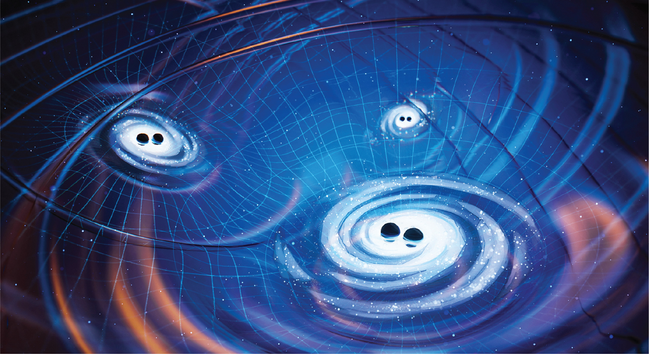
You've heard of Gravitational Waves (GWs) - but did you also know there is a GW spectrum - and much like the EM spectrum, different sources produce different frequencies of GWs.
The GWs we've so far discovered are generated by stellar mass black holes and neutron stars, but the research I am involved with is searching for GWs generated by supermassive black holes (SMBHs) - found in the hearts of galaxies. These SMBHs give off their gravitational radiation as galaxies merge and collide.
Though these are nanohertz frequencies and have wave periods lasting not seconds, but decades! So, we can't use terrestrial detectors to discover them. Instead, we use pulsars located around the Galaxy - each as an analogue to a giant interferometer arm.
This Thursday I am submitting my Master's Thesis on this very topic! For the last 12 months I have assessed 10 new millisecond pulsars to see how they improve the Parkes Pulsar Timing Array's sensitivity to detecting these GWs.
https://www.science.org/doi/10.1126/science.abq1187#.Y21aFzFt8P0.twitter
📸 Olena Shmahalo for NANOGrav

 GalaxyRise aka Dustin A Ruoff