 Wolfgang Blau
I‘m looking for early examples of public broadcasters (NPR, KQED, BBC, CBC, ARD, tagesschau, abcnews AU, francetele, NRK etc.) setting up their own Mastodon servers for their editorial brands. Because they should.
 Steffen Voß

 Sam Bosbach
@wblau If they can manage to finance hyper-local instances as well, this could help solve the local news desert that’s occurred since the collapse of the local newspaper.
 Felix Reutter
@s_bosbach @wblau could even be a win-win for journalists and local audience if they can engage with each other directly
 Dan Kennedy
@x1l3f @s_bosbach @wblau What are you all thinking this looks like? Hyperlocal journos have been telling me for years that their communities never even moved to Twitter. They’re on Facebook. Mastodon seems like quite a stretch.
@dankennedy_nu @x1l3f @wblau I’m sure I don’t know and I’m not an industry voice. You’re probably right. Facebook just seems like such a dead end. I’d imagine local journos are there because that’s where the Boomers are. We’re in a sticky situation where young people have been brought up in a world without robust local journalism. It’s not even on their radar much of the time.
@s_bosbach @x1l3f @wblau My own view, based on what I've seen successful news entrepreneurs do: promote relentlessly. Hit every farmers market and community event. And get people to subscribe to your newsletter.
@s_bosbach @dankennedy_nu @wblau This! Boomers are not the future. The millenials have become financially independent and certainly have an interest in local journalism. The same will be true for generation z.
@dankennedy_nu @x1l3f @wblau Thinking about this a bit more... one of the big problems with current hyperlocal journalism is the profit problems. I guess what I was thinking is that the big non-profs could use local instances as incubators for local journalism. But you're right that hardly anyone uses Mastodon, so maybe I'm just in the "new adopter" mindset where the platform I just joined is going to be the center of everything lol.
 John Abbe (aka Slow)
@s_bosbach @dankennedy_nu @x1l3f @wblau Just a question of timing. Larger publishers could invest the marginal funding to put up local servers when there is also funding and local partners to help local journalists gain the benefits of using a more open, #commons based medium.
 feliundedi= fedi
 Helen Shaw (Athena Media )
 anneeroper
@wblau Ha! I meant 'sign-offs', though sing-offs might work faster! 😂
 Craig Saila
@anneeroper @wblau This. Very much this.
@saila Additionally, I do love a robust font...
@anneeroper Combining topics, here’s a variable one Canada’s public broadcaster commissioned the re-developed and released as open source recently (which was successful because it flew under the radar) https://fonts.google.com/specimen/Radio+Canada

@saila Thank you! Very robust indeed. I was at an #INPUT (public service TV) conference in #Halifax many moons ago. And another time in #Whitehorse in Yukon filming. Canada also does robust aerial views, moose herds and snowy evergreen trees tops...😍
@anneeroper Yukon is still on my wish list!
 Daren Chandisingh 🌱🚴
@anneeroper sing-offs would make those boring decision-making meetings far more entertaining!
 Dry as toast
@wblau honestly, I’m not very enthusiastic about it. I think part of the problem is that big companies come in and then try to find a way to monetize things. I would much rather have a Mastodon not become exactly like Twitter because media corporations need somewhere to disinform citizens
@toast yes, I am sure the time will come when there will be a commercial eco system around Mastodon (ad agencies, analytics companies, paid influencers etc.) as there are already commercial app developers. I still think this shift to a more decentralised ‚social web layer‘ is inherently good, even if it comes at the cost of some of the damages you mention. (and I don‘t share that all corporate media or all corporations are in the business of disinformation)
 ianhillmedia
@wblau News orgs - public and otherwise - should pause and think hard before taking this step. The audience is not here and won’t be for some time, and creating and maintaining a server is an ongoing tax on already limited resources. There’s no ROI yet. Plus, there are several privacy, legal and data security concerns to be discussed. Right now, Mastodon is a great place for journos to chat. Servers? Maybe in the future.
@wblau some of the replies in this thread are terrifying lol
@wblau As someone who works in audience, I’m no longer kidding - the posts on this topic have gotten terrifying. How many news orgs are effectively using YouTube, where 80% of the audience lives? How many are generating revenue through YouTube membership and SuperChat? Or the Instagram Creators Fund? How many have an effective strategy for TikTok, which 30% of Americans now visit daily? Put your resources there first.
@ianhillmedia I don‘t see M as the next audience or monetisation opportunity. You‘re right, that would be silly. But there is a function of public broadcasters (and other publicly financed entities) to also ensure the functioning of public communication backbones. Twitter has taken on such a function and - to its credit - has taught the world about the value of such a service.
@wblau Where I think we’re aligned is in the belief that news orgs have a responsibility to deliver news to the public. Right now, there are many avenues for that, and resources are limited. We need to focus on the platforms on which we can be most effective, and Mastodon isn’t on that list - yet.
@ianhillmedia major public broadcasters are also hosting significant distribution infrastructure, i.e. they don‘t just disseminate content. But, sure, let‘s look at the question from the other side: By whom/how else can such a critical piece of distributed/federated global communication infrastructure be maintained in a way that ensures technical stability and capacity as well as content moderation?
@wblau FWIW, your post caught my attention because I worked at one of the pubmedia orgs you named; I’ve been in commercial broadcast for the past several years. We maintain our websites and transmitters, sure. But again, that’s because that infrastructure allows us to serve the largest audience with existing resources. We manage accounts and such on other services with a priority on maximizing resources to serve as many local residents as possible.
@wblau Part of the Original Sin was in not understanding that the audience and the platform are separate, and thinking we had a responsibility to maintain the third-party platform for the audience. We should have understood that the platform was a product run by a multi-billion-dollar corporation for the benefit of its shareholders. Mastodon is not Facebook, but we have to keep the lessons we learned in mind.
@wblau But to circle back to my original point: our primary responsibility is to serve our communities. To do that, we have to put our resources into managing presences on platforms where we can reach the biggest audience. Mastodon is not that - yet.
 Peter Whisker 🇪🇺🇮🇪 aul segotia
@wblau So we don't have to join them and thereby demonstrate how important we really think they are?? ;-)
 bart brouwers
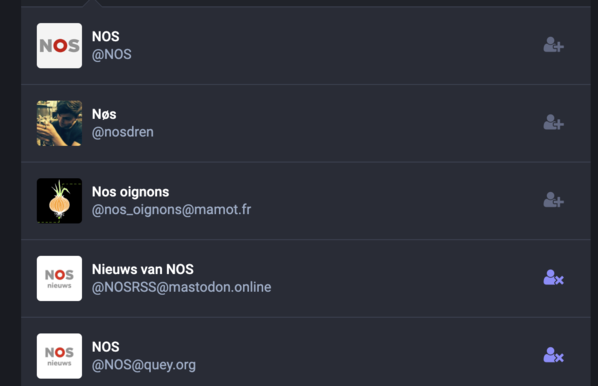
@wblau it seems that the Dutch public news broadcaster @NOS set up an account in 2016, but isn't using it at this moment. Another one (@[email protected]) stopped producing news in 2020. A third one (@NOSrss) seems to be set up by a third party.
 blaine
@wblau it's a shame we never managed to properly chat; I tried in various configurations to do this at Condé for four years. 😅 Turns out it's not the easiest place to do stuff bottom-up, lol.
 Richard K
@wblau I searched for the radio stations I listen to most. I found ~8 accounts named variations of NPR (such as NPR Education), but I'm not sure any of them really are the NPR I listen to.
 Don Aristarco
@wblau at least social.ard.de is existing, but forwarding to https://www.ard.de/social for now :-)

 Martin Urschel
@wblau They definitely should. It's a bit embarrassing that they haven't yet, while they still keep feeding Mr Musk's personal vanity project.
Also, most of the best international journalists and writers are here already
@tazgetroete is a pioneer on here. I'd also suggest that the EU and German government instances can serve as a model for media looking to set up shop here
 Kaito Cross
 Boris Müller
@wblau
Not a broadcaster - but I was really surprised that the german government seems to be an early adopter:
https://social.bund.de/explore
(via @getflourish)
 Chicago Mädel (she/her)
 Diane Freeland
 Lorne Barry
@wblau it was the first thing I did when I subscribed, search for a multitude of news agencies with almost zero luck beyond a few bots here and there. I'm not a tech guy but as some have posted a critical mass needs to be achieved before many of them consider directing funds and resources to Mastodon. We can keep hoping
 Rodanodon


 MimzyDub🇨🇦😻
 Rick Ellis - AllYourScreens
@wblau I was writing about this a lot this week, albeit more about TV networks and streamers. Setting up a presence on Mastodon is tricky. Especially for brands who are used to the forced viral nature of Twitter.
 Mark Vanderbeeken
@wblau Some comments confuse accounts with instances. Here in Italy no such instances yet, which means that their journalists are all over the place.
 Nicolas Pettiaux