@Crazypedia I acquired "Planetary Magic" first, and that "IV" on the spine was driving me nuts for a bit, because it WASN'T originally published as a part of the series that it's now being included in. And the other three volumes were originally published as FIVE volumes. So it took a bit of research to make sure I had the complete set. Even the person at Llewellyn who responded to my inquiry got the list incorrect.
I'd never heard of Denning & Phillips before, but their approach to ceremonial magic feels very grounded and sane to me. It leans really heavily into the theurgy end of the theurgy/thaumaturgy spectrum, and favors a Jungian paradigm as the explanation for "why this stuff works".
I've looked around online for groups working with this material and have found a few. Interestingly, it seems like people have found some value in using the material in either pagan or Abrahamic frameworks. Most of the rituals included in the books include alternate versions so that use can Hebrew, Greek, or Enochian naming as you see fit.
In comparison to, say, Golden Dawn or Thelemic material that I've looked at over the years, there are two things that stand out about the exposition in these books. First, the authors are pretty up front that a practitioner is sooner than later going to be confronted with a need to do a bit of improvising with their ritual work. It's less didactic in that way. Second, their grasp of history as a scholarly discipline seems a bit stronger than many texts, although they still engage in a fair bit of reconstructive myth-making.
I'd actually be really interested to know what people working inside a more nature-oriented tradition would make of this stuff. The books struck me as potentially a useful starting point as a bridge for communication between the two communities.
I'm planning to begin working the material the very minute I get my working space back into suitable condition...currently it's a bit cluttered.


 🌬️
🌬️
 📚 🔖
📚 🔖  ✨
✨ 
 William Carmichael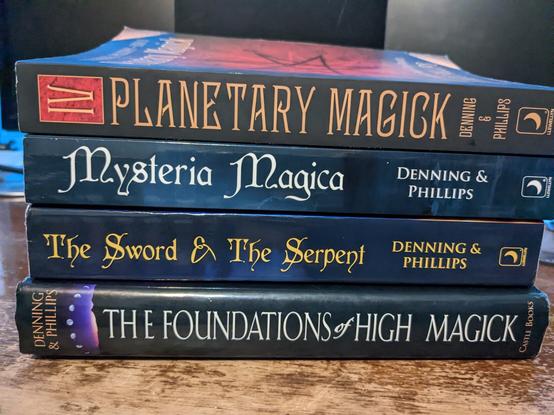
 Reverend Erik
 elizadys