 Flint Dibble 🍖🏺📖
Whether you’re waiting in line to vote or waiting online for the results…
It’s a good time for a #thread about the #Archaeology of Athenian Democracy
/1
Whether you’re waiting in line to vote or waiting online for the results…
It’s a good time for a #thread about the #Archaeology of Athenian Democracy
/1
The version of the Athenian democracy taught to us as kids in school paints a golden aged rosy picture of it
Athenian democracy was messy af
There was little trust in the vote
Politicians were “cancelled”
Crude parody & was legal
/2
The democracy (“demokratia”) claimed to rule (“kratia”) for the people (the “demos”)
But the “people” was not what we’d consider an inclusive group. Only male citizens who owned land
No women, enslaved people, foreigners, or poor people were allowed to participate
/3
Even in a world without TV or social media, misinformation (aka “rumors”) were rampant
As Thucydides put it, most people “will not take trouble in finding out the truth, but are much more inclined to accept the first story they hear.” (Thuc. 1.20 transl. Reeve 2011).
/4
Just like we see today, ancient political actors intentionally spread false news – disinformation – in order to sway foreign political policy
The decision to undertake the Sicilian expedition, a major disaster for Athens during the Peloponnesian Wars, is a good example
/5
The Athenian people knew that their votes were not safe. They could be tricked by powerful interests
So, they tried to build in some safeguards to their democracy to weaken the powerful and their influence over votes
/9
Athenian cancel culture or “ostracism” is certainly famous today
The rules were simple. A vote was held once a year over whether there would be an ostracism vote.
If yes, then people returned with a potsherd (“ostraka”) on which they scratched name of a hated politician
/10
If 6,000 people showed up & voted, the politician with the most votes was exiled
Many famous & powerful Athenian politicians were ostracized. Their Assembly speeches were persuasive and led major policy votes; however, that power was a double edged sword during ostracism
/11
Fortunately, scratched potsherds survive for us today, and archaeologists have excavated over 11,000 of these “ostraka” that give us an inside look at this practice
The large numbers let us find some patterns
/12
There’s clearly some sort of organization to the production and even the deposition of these ostraka
4,000 ostraka voting for Megacles (ostracized 486 BCE) were found in a group. All dumped together. Archaeologists would call that a “structured deposit”
/13
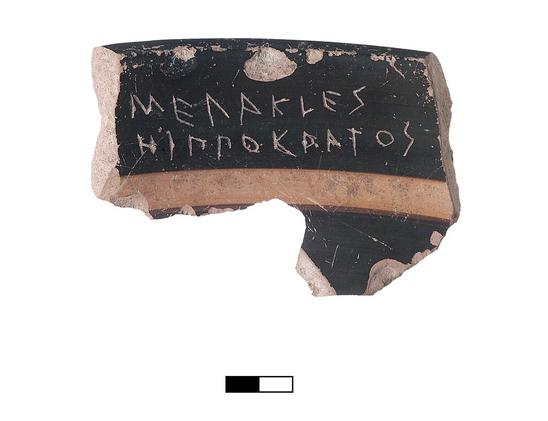
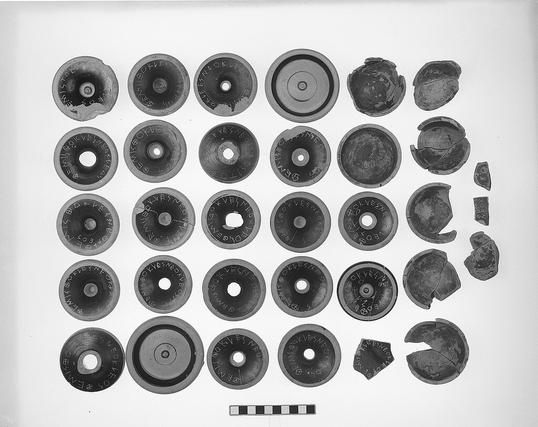
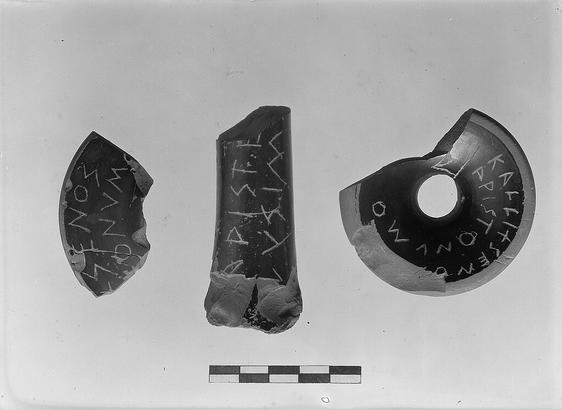
In another instance, 190 ostraka were all found together on the slope of the Acropolis that named Themistokles (the politician who led the Athenians against the Persians)
They’re produced identically: on the round feet of drinking cups
/14

A close look at handwriting shows that the 190 ostraka naming Themistokles were written by only 14 different people
Ostracism was an imperfect solution to protecting the vote, because it was a vote that could be influenced by the powerful
/15
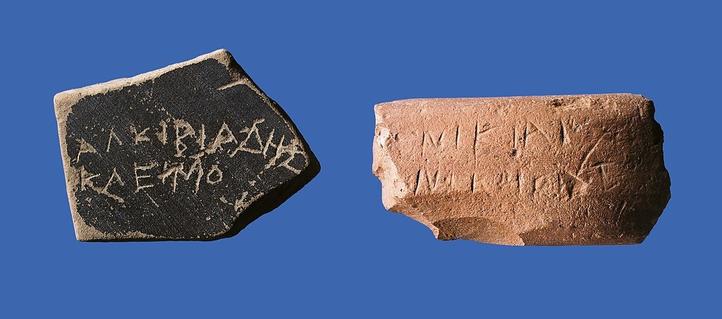
The Athenians recognized this. Ostracisms were only common during the 480s and afterwards were rare
The last was held in 417 BCE where the two most powerful politicians (Alkibiades and Nikias) allied at the last minute. To protect themselves, they united against Hyperbolus
/16
The Athenians realized that the only way to protect democracy from voting was to ensure that not everything came down to a vote
In fact, how the Athenians chose their “Council” is downright strange by our own notions of democracy
/17
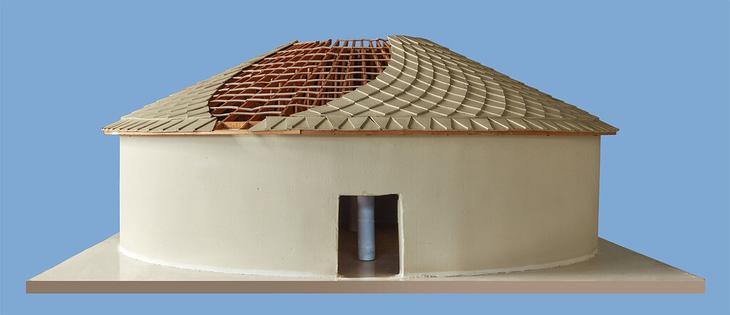
The Council (“Boule”) was the most important political chamber in Athens. Like the US Senate
Its members weren’t elected. They were selected by a machine
The fairest way to protect Athenians from casting influenced votes was to select political representatives randomly
/18
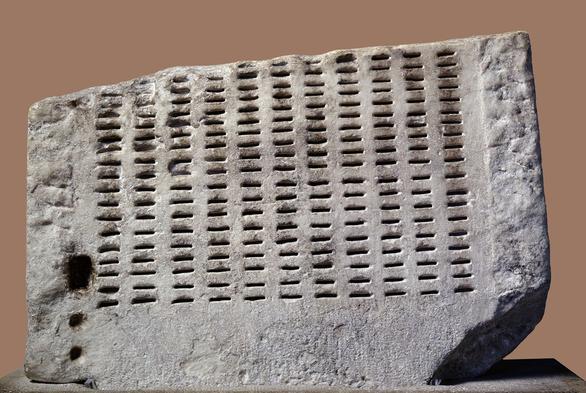
Imagine it
Selection Day 2022. You get the phone call. Your number came up. You’ll be a US Senator for the next year. You’ll be paid well and wined and dined. Make important decisions and schmooze with Perikles
/19
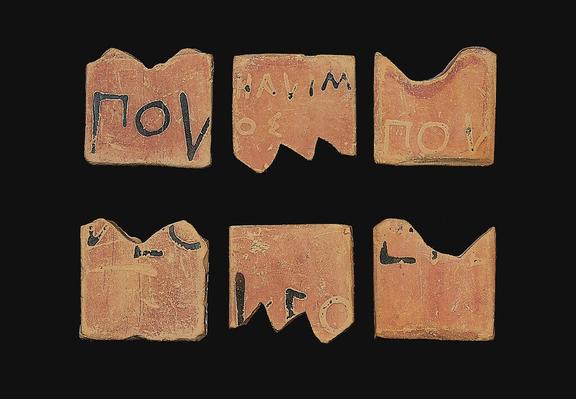
We look back at ancient democracy and like to see something akin to ours, as if we’re part of a tradition moving from Solon through George Washington to our “I voted” stickers
But, in reality. We do what we do, and we need to protect our vote if we want to keep it
/20

If you want to read more about the Archaeology of Athenian Democracy, check out http://agathe.gr
Most photos here come from http://ascsa.net (the archive of
@ASCSAthens
Athenian Agora Excavations)
Go Vote! I'll be handing out potsherds near the polls
/end
Oh and if anyone has suggestions on cross posting threads between Twitter and Mastodon, that'd be useful
This attempt failed (using the cross posting tool) and I had to do it manually. While I think my interactions should be platform specific, I'd like my curated #archaeogy threads to easily post on both
@FlintDibble The crossposting tool I use seems to work for basic threading:
https://crossposter.masto.donte.com.br/
I can't get it to post using the proper etiquette for threads on here (which I think is public first post followed by unlisted replies) but it posts them!
I've seen it mentioned in a lot of "hey new users from twitter, here's the etiquette here on mastodon" style posts and since I'm new here myself I've been trying to follow it!
This thread has been the most commonly cited explanation I've seen:
Attached: 1 image · Content warning: How to do threads...

 Gavin
Gavin Megalithic Portal (Andy B)
 Sara Hjelm
 Chapps