I thought I'd share a few of my recent publications, to continue my #introduction to @fediscience.org

My research is on how family diversity and social policy affect poverty and economic inequality. Typically, my research is country-comparative and has a gender perspective. My recent focus was on single-parent families, how women’s earnings affect inequality between households, and family policy outcomes.

A short thread.
One of my intellectual "homes" is the European Network for Social Policy Analysis (https://espanet.org). To celebrate 20 years of ESPAnet, I co-edited with Kenneth Nelson and Mara Yerkes the book Social Policy in Changing European Societies.

This book provides an in-depth account of social policy research today, how we got here, and where future research should be headed.

The book came out this year, and is available open access:

https://www.elgaronline.com/view/book/9781802201710/9781802201710.xml

Two other edited books focus a bit more specifically on my areas of research interest.

The "Palgrave Handbook of Family Policy" (2020, with @wvlancker) provides a multilevel view on family policies, combining insights on family policy outcomes at different levels of policymaking: supra-national organizations, national states, sub-national or regional levels, and finally smaller organizations and employers.

It's available open access:
https://link.springer.com/book/10.1007/978-3-030-54618-2

The "Triple Bind of Single-Parent Families" (2018, with Laurie Maldonado) examines the risks and issues faced by single parent-families and their children such as poverty, wealth/asset accumulation, health, well-being and combinative development, bringing together scholars from diverse social science backgrounds, including sociology, economics, political science, and social work.

And, you guessed it, it's available open access:

https://library.oapen.org/handle/20.500.12657/30531

In this study I tried to examine the ways in which active labour market policies (ALMP) and work-family reconciliation policies (ECEC) have combined effects.

I found that these policies have diminishing returns. In other words, the highest rates of women's employment, and the lowest rates of unemployment and inactivity, are found in countries with large investments in both ALMP and ECEC, but such higher investments are associated with diminishing returns.

https://onlinelibrary.wiley.com/doi/10.1111/spol.12806

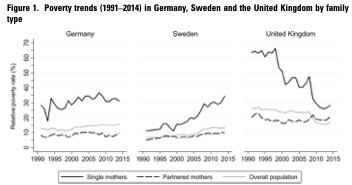
Hannah Zagel, Sabine Hübgen, and I argue that demography can only effectively be invoked as explanation of trends in poverty with a distinction between the composition of risk factors and their associated penalties for poverty.

We apply this insight to explain the unexpected and diverging trends in single-mother poverty in Germany, Sweden, and the United Kingdom.

https://academic.oup.com/sf/article/101/2/606/6454233?login=false

Diverging Trends in Single-Mother Poverty across Germany, Sweden, and the United Kingdom: Toward a Comprehensive Explanatory Framework

Abstract. To explain single-mother poverty, existing research has either emphasized individualistic, or contextual explanations. Building on the prevalences and

OUP Academic

And finally, I recently dipped my toe in housing studies, with two papers as the result.

With Hannah Zagel, we examined the housing conditions of single mothers in Europe, with attention to the role of housing policies and other contextual conditions.

https://www.tandfonline.com/doi/10.1080/14616696.2022.2117835

With Kenneth Nelson, Ida Borg and Susanne Alm, we studied the political determinants of housing benefits.

https://academic.oup.com/esr/advance-article/doi/10.1093/esr/jcac042/6754369?searchresult=1

Housing conditions of single mothers in Europe: the role of housing policies

This study investigates housing conditions of single mothers in the context of housing policies. We study single mothers’ probability to experience housing deprivation, overcrowded housing, overbur...

Taylor & Francis