You may be aware that there is something called the #Fediverse.

But do you know about all the different types of applications that run on the Fediverse?

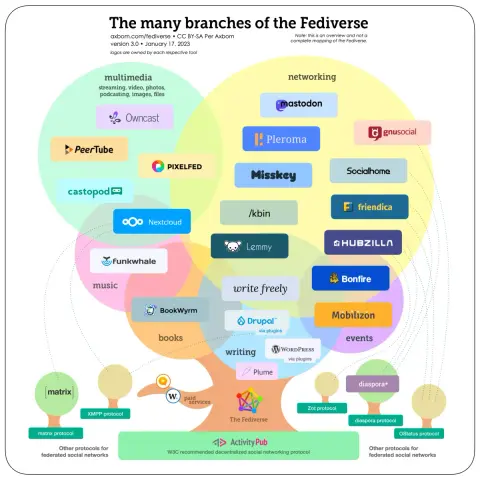
I made this visual to give myself and others something to point at when explaining "the big picture".

You may be surprised by how many services beyond Mastodon there are to explore.

Download it for free here and use as you please:
https://axbom.com/fediverse/

That post also has links to all the different applications.
#FediTips

The many branches of the Fediverse

As more and more people are asking me about Mastodon I felt a need for a picture to point at, showcasing how the software known as Mastodon fits into the much larger concept of the Fediverse. I made this infographic to help myself and others explain the many different use-cases
Axbom • My Next Heartbeat

I have version 1.1 of "The many branches of the Fediverse" ready for you. 😄

Thank you to everyone who pitched in with suggestions of improvement (all visible in the thread).

You can download PNG and PDF versions on my blog post, which also has a bit more info and links to the applications.

Download for free and use as you please. Preferably to spread the word about the benefits of federated publishing and local instances. 😊

https://axbom.com/fediverse/

#FediTips

The many branches of the Fediverse

As more and more people are asking me about Mastodon I felt a need for a picture to point at, showcasing how the software known as Mastodon fits into the much larger concept of the Fediverse. I made this infographic to help myself and others explain the many different use-cases

Axbom • My Next Heartbeat

@axbom wonderful! Thank you for your work on this.

However... would you be open to a conversation about the license?

I've done some copyright trainings in the past, and based on my and others' experience I believe that -NC is problematic. And that for most people and works, -SA would be more effective in achieving what they are often trying to achieve through -NC.

@rysiek definitely open to that conversation! Thanks for bringing it to my attention. Honestly I was probably a bit too quick when typing that license on the image. I usually have SA I realised!

But I also usually have NC in combination with this. You would suggest not having NC at all? My though when adding this for my blogs is to avoid people making books to sell with my content.

@axbom right. Thank you for being open to this. Also, I want to very clearly recognize this is of course your art and your decision, and I have no business telling you how to license things! I hope that's obvious, but I feel it needs to be said.  

The problem with NC is that it is vague and undefined. For example: can Wikipedia use an NC-licensed work? Wikipedia is supported by donations, and one *could* argue their use is therefore "commercial" in some sense. So Wikipedia avoids NC.

@axbom but can I use your NC work on my blog? I blog for fun, and have no money in the game, so this sounds safe. But I also use my blog to promote myself, and sometimes I might get hired to do something based on the contents of it. Is that "commercial"? I don't know.

Imagine an NGO that got grant money to promote the Fediverse. Can they use your fantastic work (with attribution, of course!)? NC does not make it clear, and if I were running that project, I would probably decide not to risk it.

@rysiek Valid points. My take was always that it's about the artefact itself. So okay to showcase in commercial settings but not to sell on its own as the reason for charging money. But I see where it can make people hesitate. I'll have a think about it.

@axbom right. So that's the biggest downside for me. NC makes the work risky to use, and thus it will not be used by projects and in contexts that you might presumably want the work to be used in.

SA solves this better in some ways. For example, no Big Corp would ever take an SA-licensed work and use it in an ad campaign or a product, film, etc, because they would have to release the whole thing under SA. Not gonna happen.

I totally get your "I don't want people to make books with my content"…

@axbom …but the way I see it (and I do have an SA-licensed blog), if somebody finds a way to monetize my SA-licensed content before I do, good on them!

And there is a reasonable chance they will pay me anyway, so that I produce more of new juicy content for them to publish.

That's obviously a very personal take, but I think it's worth considering.

@rysiek @axbom

The owner of a work can dual-licensed their original work; or give a separate license for another entity or individual; as long as the license of the original work is retained.

Say a school wants to get a license to include the Fediverse Tree in their text-book, they can close a deal. The original NC licensed work is retained; and only this school, granted with a separate license, can print it for commercial purposes.

@youronlyone yes, as has already been noted elsewhere in this thread, CC licenses are non-exclusive.

But that's *still* plenty friction and potential risk for whoever wants to use the work.

Instead of just using the work to teach the kids, the teacher must now *first* reach out to the author and receive a specific license. They also must *know* this is an option. They also must know how to do get in touch with the author. They also must wait for the response (unclear how long).

@axbom

@rysiek @axbom Correct. But that's how #Copyright works. We really have to know these things (which, unfortunately, is not taught in schools); and have to wait.

The best re-users can do is to ask for permission/license (if the license isn't clear). As long as Copyright laws exist, it is unavoidable. It's not ideal.

I have CCBYSA and PD/CC0 works. But I also release a few under ND and NC. Some "All Rights Reserved" (usually photography) for stock sites selling (they don't like CC).

@youronlyone
> But that's how #Copyright works. We really have to know these things (which, unfortunately, is not taught in schools); and have to wait.

My whole point is that in a lot of cases, demanding this kind of knowledge and patience of people who might want to use one's work (say, by using -NC) is unreasonable, and actually goes *against* what the author actually wants to achieve with that license.

And that -SA largely avoids that.

@axbom

@rysiek @axbom Ahh, I think that's where we differ in how we see it.

Whenever I use NC and/or ND, as the creator, my intention was to protect my work.

If my intention is to have it distributed and re-used as wide as possible, then I use SA or PD.

For example, in my country, Copyright infringement is sadly a thing, even in the corporate world. I prefer to protect some of my work first before I worry about how many would reuse it.

Ironically, for SA/PD works, those are the ones I get requests.

@youronlyone

> in my country, Copyright infringement is sadly a thing, even in the corporate world. I prefer to protect some of my work first before I worry about how many would reuse it.

I find it interesting that you acknowledge that copyright infringement is wide-spread ("even in the corporate world"), and then conclude you will protect your work by using NC or ND. I think it's safe to assume copyright infringers will ignore these terms just like they ignore other licensing terms.

@axbom

@rysiek

> and then conclude you will protect your work by using NC or ND. I think it's safe to assume copyright infringers will ignore these terms just like they ignore other licensing terms.

And that's where the license comes in, protection. They can freely re-share, re-distribute, as long as it is NC. In the case of ND, as long as it is not a derivative. Compared to “All Rights Reserved”, I'm practically saying, “no, you can not re-share, re-distribute, no matter what”.

@axbom

@youronlyone wait, either I am reading this wrong, or that does not make any sense.

> Compared to “All Rights Reserved”, I'm practically saying, “no, you can not re-share, re-distribute, no matter what”.

"All rights reserved" is *by definition* more strict than any CC license, even CC By NC ND. Are you saying that with NC or ND you "protect" your work more than if you released it under "All rights reserved"?

@axbom

@rysiek

(1/n) No, no. It is about being able to grant the Right to share and re-distribute the work without granting the Right to use it for commercial purposes or to create a derivative work.

All Rights Reserved = you can't do all of it.

NC = you can re-share / re-distribute except for commercial purposes.

ND = you can re-share / re-distribute except for creating a derivative.

NC or ND gives you more protection than Copyleft CC-licenses.

@axbom

@youronlyone @axbom right, okay, thanks for clarifying. I thought I am losing my mind. 😉

@rysiek

(2/n) Example, personal photos. I use ND for photos of myself (that I took, of course), so give a stronger legal ground if someone misused it, while at the same time those with legitimate purposes doesn't have to bother me with permissions.

In many Asian countries, we don't have a "Fair Use" policy as is known in the US. Some have something similar which no one tested, some just doesn't have anything.

@axbom

@rysiek

(3/3) We do have to ask for permission when using someone else's photo of themselves. Otherwise, they're opening themselves up for legal trouble.

By using, for example, ND, they don't have to ask me for permission, and at the same time, I also give them the guarantee I will not go after them… as long as it is not a derivative.

@axbom

@youronlyone yes, that's understood.

The problem with ND is: there's a bunch of copyright exceptions that make ND moot in a lot of cases. I will still be able to use your photos in a parody, for example.

More importantly, people who you *really* want to stop from "modifying" your work (or, well, creating derivatives), will almost certainly just ignore the license anyway.

So my next question is: what *exactly* are you trying to protect your work from, by using ND?

@axbom

@rysiek

(1/2) It's true, they will ignore the license anyway, but if they do, since I released it as ND, I can go after them.

I'll use an example for the other question. I know someone who used to support CC, that he released all his photos under CC-BY-SA.

One day, someone re-used his photo (photo of photographer/himself) and created all derivatives that may, or may not, suggest sexual innuendo.

@rysiek

(2/3) IIRC, his attorney advised not to sue because the way the derivates were made can be interpreted in various ways, not to mention the license was CC-BY-SA. It was also not easy to prove that it was an attack.

In the end, this person denounced all CC licenses because of this experience. Not just for his photos, but also for his other works. A lot of people using CC licenses back then, also did the same. Only few CC / Free Culture supporters remained.

@rysiek

(3/3) While yes, photos of people used in a way that is demeaning to them or implies they're endorsing a product, may be a violation, it is untested in courts (at least locally).

So, for me, at least in local context, it's better to restrict it to ND for that extra legal basis if something similar happens to me.

@youronlyone ah, that's fair. I think the crucial thing here is the fact that the photographer themselves (or people close to them) were on these photos. I can see how ND-as-an-insurance-policy-against-that-kind-of-abuse *can* make some sense.

That's a very specific, limited scope. But it's an important one nonetheless.

I kinda feel this is something that privacy-related laws should handle, but we're obviously not there yet.  

Thanks for the food for thought!

@rysiek Yep. And when it comes to privacy, many politicians are only paying a lip service. Or, new laws that doesn't do much at all.

Still a long way to go. Though I think the EU is leaps ahead?

It's also sad that when it comes to court cases, it's either there was precedent already (and it's in your favor), or, you have the money and time to spend.

@rysiek @axbom

It's an interesting view. I haven't looked at NC as something that can be 'against' the purpose of the creator.

@youronlyone unintended consequences are real, copyright law is complicated, intentions often do not match the outcome.

This is particularly stark with ND. I honestly believe there is zero reason to use it, ever:
https://rys.io/en/101.html

It's basically completely ineffective in what people using it think it achieves.

It's a bit less stark with NC, but it's still there, mainly due to the ambiguity of "non-commercial". Everyone understands this term differently.

@axbom

Why I find -ND unnecessary and harmful

’UPDATE: highlighted the harmfulness of incompatibility of “no derivatives” licenses with libre licenses (including other CC-licenses); heartfelt thanks to Carlos Solís for the Spanish translation. ¡G

Songs on the Security of Networks

@rysiek

Great article. ND is the less used of CC licenses. I only use it for specific cases, like I mentioned earlier, photos of me. And yes, I did come across uses of ND that did not make sense, at least as far as the author's “explanation” or purpose is concerned.

@axbom

@youronlyone thanks!

And just to be clear, I am not trying to convince you to stop using ND on your photos. It's none of my business and it's obviously only your decision.

Just enjoying our conversation, trying to understand how and why people use NC and ND.

@axbom

@rysiek

> Just enjoying our conversation, trying to understand how and why people use NC and ND.

No worries. I enjoy the exchange too. This type of discourse is rare in Twitter and Facebook, you usually end up with trolls and people who are easily offended.

^_^

@axbom

@youronlyone haha, makes sense! My experience here (over the last ~5y) has been pretty great in that department. People don't seem to be easily offended (most of the time, there are always outliers), and are in for a conversation, not for a shouting match.

Best social network money can't buy.

@axbom

@rysiek @youronlyone @axbom If they don't know how copyright works, why do you expect them to know how CC works. Surely, they have to put the effort in to find out either. I don't believe non-commercial is problematic if people put the work in to understand what they are doing.

@nzlemming
> If they don't know how copyright works, why do you expect them to know how CC works.

I don't. CC By-SA makes very few demands on the person using a particular piece. A tiny bit more than CC By, granted, but it is still leaps and bounds clearer and easier to figure out than NC.

It also creates way fewer situations where somebody might need to contact the author and ask for a separate license. While offering meaningful protection from corporate appropriation.

@youronlyone @axbom

@rysiek @axbom Does SA apply to the whole work? I'll have to read it again (or listen to myself read it 😃).

I've always had the impression that it binds more like a weak copyleft and that media content in general is treated more like e.g. a film or a book with pictures is an aggregation of things that go into it.

@rysiek In this particular case I'm also truly myself of the conviction that people can use it when consulting, to show the concept of the Fediverse. Just not print and sell copies of it.

Thinking like that it makes sense to drop the NC :)

@axbom right? 🙂

Plus, some people *will* print and sell it anyway, regardless of the license. These people will just ignore the terms anyway, be it NC or SA or whatever else.

Finally, all CC licenses allow you to be very clear how the attribution needs to look. You can be very specific about how it needs to be placed, etc, on a printed rendition, for example. Perhaps that's a way to deal with that issue as well, while switching to SA:
https://creativecommons.org/licenses/by-sa/4.0/legalcode#s3a

Creative Commons — Attribution-ShareAlike 4.0 International — CC BY-SA 4.0

@rysiek @axbom Remember an author retains the right to change the licence s/he has put her/his work under. Even with an -nc licence, the NGO of your example can still contact the author to get an explicit authorization to use her/his work and create derivate works.

@agarwaen @axbom absolutely, all of these licenses are non-exclusive.

That said, that *is* another step to take, and there *is* a (perceived) chance the author says "no". So it *is* a risk, still.

@rysiek @agarwaen @axbom finding the author's contact, writing them, and then *waiting for the answer* is prohibitive in many, especially precarious/non-profit creative processes.

*could* i have asked xkcd to drop the nc from their battery-horse-staple comic to include it in some educational material that was printed and given away for donations? _very_ theoretically 😅😅😅

@rysiek @agarwaen @axbom on the other hand *no one* took my excellent cc-zero or cc-by-sa materials to extract the maximum profit, which is a little bit insulting to be quite honest 😑

@rysiek @axbom

A tricky one. IIRC, Creative Commons itself consider "commercial" as referring to selling the work by itself; or if in a collection, part of the price includes said work. (If the work is part of a collection but the price does not include the NC work, it's fine too… but tricky to prove.)

Websites, blogs, which contain advertisements, are not considered "commercial". Although there are entities and individuals who do.

Best would be to ask, like you did.

Again, iirc. ^_^

@youronlyone yeah, that's precisely my point: it is unclear, and the assumptions of the author and whoever is considering to use the work will almost certainly not match 100%.

@axbom