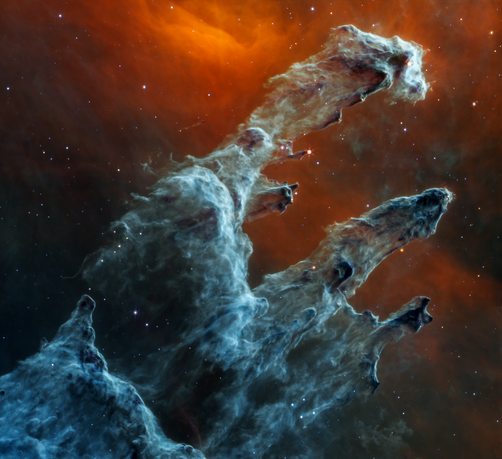
Just in time for spooky season -- here's a newly released JWST MIRI image of the Pillars of Creation!

This false-color image shows gas and dust in a star forming region at mid-infrared wavelengths of 7.7, 10, and 15 microns!

Check it out here: https://webbtelescope.org/contents/news-releases/2022/news-2022-053
#astronomy #astrodon #jwst

Haunting Portrait: NASA’s Webb Reveals Dust, Structure in Pillars of Creation

WebbTelescope.org
@jwuphysics I just went down a rabbit hole via that link and NASA.gov to try to figure out what a false-color image is. My average human brain seems to understand that it is because the dust otherwise blocks the stars, so they need to use more than visible light to see everything. If one were to take a natural color image of this, would it just be dark with bits of stars visible here and there, but without all of this fantastic detail?

@OrangeJuliusCaesar By false-color image we really mean that the colors aren't the same colors (or wavelengths) that human eyes can perceive. Human vision operates in the "visible" wavelengths (< 1 micron), and indeed some telescopes observe around these wavelengths. They also produce false-color images, too, because their "greens" and "blues" and "reds" are still a bit different from what the human eye can see!

Here is another comparison between visible and near-IR!

https://webbtelescope.org/contents/media/images/2022/052/01GF44EV0PPW2BHJS9HMA1AGEK

Pillars of Creation (MIRI Image)

WebbTelescope.org

@mikael @jwuphysics

If I remember right (someone correct me if I'm not?), that's typical of MIRI images since it's a lower-resolution instrument. The really high-resolution stuff that grabs all the headlines has been NIRCam imagery, like the ginormous shot of the Pillars that came out a couple of weeks ago.

@pstewart @jwuphysics Ah, thanks for the explanation!
@pstewart yes you're absolutely correct!