 Sebastian Lasse, redaktor.me
Same like with the strange “activities” table but now worse!
They "gave" us google captcha [facepalm emoji]
See IRC social
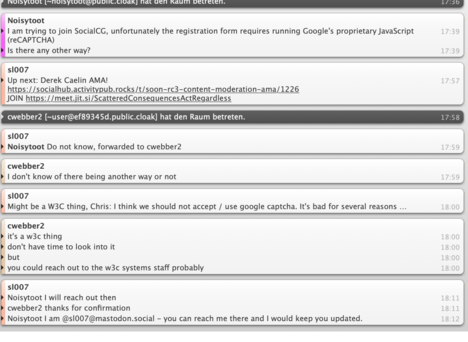
Same like with the strange “activities” table but now worse!
They "gave" us google captcha [facepalm emoji]
See IRC social
^
Google Captcha = DEATH of #a11y !
https://freeradical.zone/@koherecoWatchdog/105458795504714448
https://freeradical.zone/@koherecoWatchdog/105458706983333623

@[email protected] Not my problem. As an end user, I know that there's usually a competing site that figured out how to avoid #CAPTCHA as abusive & obnoxious as reCAPTCHA & hCAPTCHA. Those sites win my business/interaction. Some of them use a simple math or text CAPTCHA, which is relatively tolerable. Some web admins are clever enough to isolate the CAPTCHA just to form submissions, in which case I just don't use the forms. @[email protected]
I can reach out to w3c systems staff too! But I don't know to whom.
But sorry, this is inacceptable …
@noisytoot
Yes, this is why I wrote to
@rhiaro
She got direct contact,
btw see their mission statement here :)
@noisytoot
just in case this got lost https://toot.cat/@rhiaro/105459216919890753 and will keep you updated then.
Thank you for bringing this to our attention!
/ @rhiaro

@[email protected] I just contact them in the #sysreq channel on irc.w3.org. I'll send a message about the captcha - agree, that's bad - but will wait until after the this holiday period if that's okay, w3c sys team gotta rest too
Off course!
Thank you so much. I am sorry, but google+captcha is at least 1 trigger word too much.
I do not care so much if we help them to build selfdriving monopolies by identifying hydrants (I mean if the cars should drive self shouldn't they be able to think self, strange world) but:
It really destroys accessibility in the web and I am a bit shocked about such ignorance.
No, I mean general access, sorry yesterday was so busy (and nice) at #rC3 that I saved every letter.
I mean exactly this
https://chaos.social/@kernpanik/105425539670654048
and my *personal* 2 cents:
ActivityPub should not support the monopolies to build their products.
It is always a bad sign to say
“Hey, but we need google to know if you are a human”
You can write down my phone number on the page and I try to talk to them and do trick questions and tell if they are a bot.
WE ARE HUMAN !

Dear web developers and admins, please stop embedding Google's hideous #ReCaptcha into your websites. Its algorithm is faulty, forcing regular users to click dozens or even hundreds of fire hydrants, bicycles, or traffic lights each day. It puts a 'suspicious activity' flag on users who won't obey to Google's business model - such as people who don't sign into Chrome, use anonymity VPNs, or use browser extensions to suppress common tracking mechanisms. Enough is enough. Stop it.
This is linked in the end of the TAG issue
https://www.w3.org/TR/turingtest/
It names alternatives.
If at least it would not be google.
But do we need Captchas at all?
What if (I know I'm a dreamer) the people could join the Social CG via fediverse?
Or it could be a simple button where they leave any fedi handle and someone checks once a month.
(How many bots did want to join Social CG yet?).
Bots can use browser extensions ;) https://chrome.google.com/webstore/detail/buster-captcha-solver-for/mpbjkejclgfgadiemmefgebjfooflfhl
For AP Conf I had “traps” in the form.
Various approaches have been employed over many years to distinguish human users of web sites from robots. The traditional CAPTCHA approach asking users to identify obscured text in an image remains common, but other approaches have emerged. All interactive approaches require users to perform a task believed to be relatively easy for humans but difficult for robots. Unfortunately the very nature of the interactive task inherently excludes many people with disabilities, resulting in a denial of service to these users. Research findings also indicate that many popular CAPTCHA techniques are no longer particularly effective or secure, further complicating the challenge of providing services secured from robotic intrusion yet accessible to people with disabilities. This document examines a number of approaches that allow systems to test for human users and the extent to which these approaches adequately accommodate people with disabilities, including recent non-interactive and tokenized approaches. We have grouped these approaches by two category classifications: Stand-Alone Approaches that can be deployed on a web host without engaging the services of unrelated third parties and Multi-Party Approaches that engage the services of an unrelated third party.
 Ron Nazarov
 https://rhiaro.co.uk/