 Scott Jenson
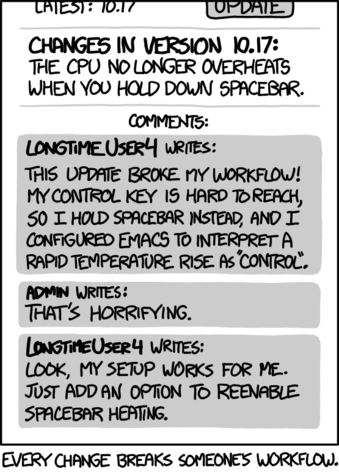
"User Feedback" is rarely done with any concept of magnitude. So often it's a tiny minority of users that have an outsized voice
https://xkcd.com/1172/
https://xkcd.com/1172/
@ondra @scottjenson The problem Scott's pointing out is that most users who will stop using a product *won't* tell you. And for that matter a lot of the feature terrorists, ie "if you don't make it work exactly how I like it, I'll abandon it!" are bluffing anyway.
If you have a business/UX background you take this for granted: don't let the loud people control the product because their preferences are often non-representative.
But most FOSS devs don't get this.
@ondra @scottjenson I've grappled with this running a small business.
It's clearly a big part of why open source software often appeals to more niche geek groups and struggles to meet wider user appeal. Part obviously is that as a coder it's often more fun to fork or start a whole new project than contribute to an old one where design decisions are never how you'd have done it.
But if you listen to the loudest voices and they're all geeks, your UX gets very skewed.

 Ondřej Pokorný
 бyron
бyron