
Let's talk about bronze disease!

Bronze disease is a type of corrosion which can happen to any object made of bronze, or any other kind of copper containing alloy. It's irreversible and very difficult to stop. It's what causes old pennies to get that green fuzzy coating.

It's also not really a disease, but people used to think it was caused by bacteria.
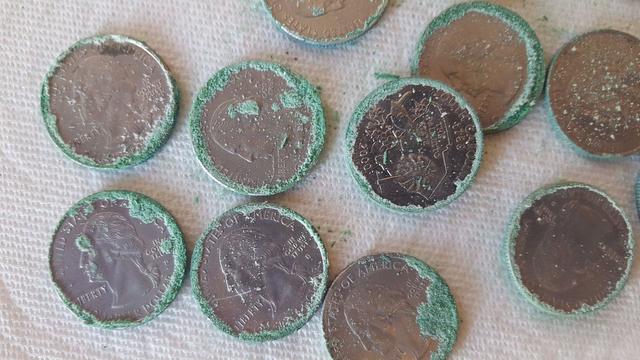
Bronze disease is a big headache for archeologists, historians, and museum curators. Bronze is an alloy made from copper and tin. It's one of the oldest alloys known to humans, and as a result, lots of ancient artefacts are made from bronze.

Because the corrosion is irreversible, it means a lot of ancient artefacts have been destroyed by bronze disease, and many more need to be carefully preserved to prevent damage.

Bronze disease is caused by a combination of water, atmospheric oxygen, and chloride. These three things make an environment which will ultimately wreck any copper objects.

It works in a cyclic process:
• Oxygen oxidises the copper
• Copper forms copper (I) chloride CuCl
• That CuCl reacts with water, making a mixture of copper (II) chloride CuCl2, copper hydroxide Cu(OH)2, and hydrochloric acid

In air, the copper continues to oxidise, and form more hydrochloric acid, and so the process continues.

@InvaderXan I wonder if this is related to how copper chloride PCB etchant works.
-F