Let's talk about bronze disease!

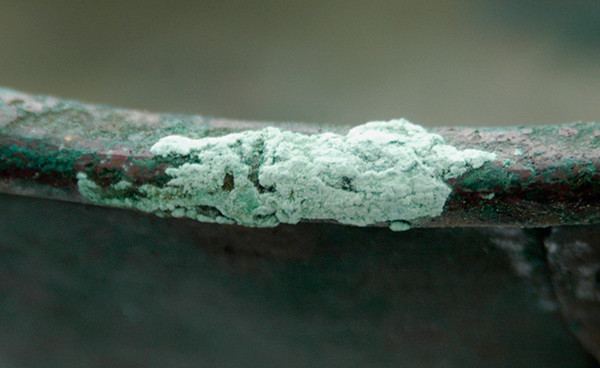
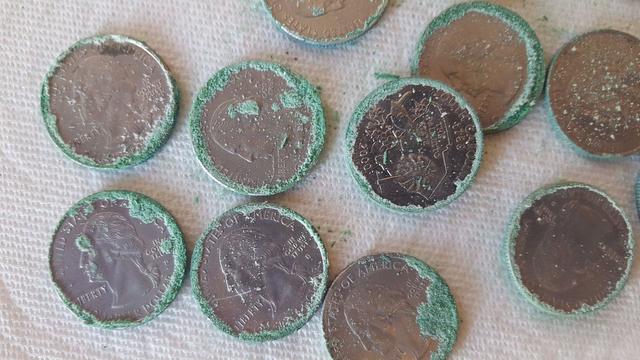
Bronze disease is a type of corrosion which can happen to any object made of bronze, or any other kind of copper containing alloy. It's irreversible and very difficult to stop. It's what causes old pennies to get that green fuzzy coating.

It's also not really a disease, but people used to think it was caused by bacteria.
Bronze disease is a big headache for archeologists, historians, and museum curators. Bronze is an alloy made from copper and tin. It's one of the oldest alloys known to humans, and as a result, lots of ancient artefacts are made from bronze.

Because the corrosion is irreversible, it means a lot of ancient artefacts have been destroyed by bronze disease, and many more need to be carefully preserved to prevent damage.

Bronze disease is caused by a combination of water, atmospheric oxygen, and chloride. These three things make an environment which will ultimately wreck any copper objects.

It works in a cyclic process:
• Oxygen oxidises the copper
• Copper forms copper (I) chloride CuCl
• That CuCl reacts with water, making a mixture of copper (II) chloride CuCl2, copper hydroxide Cu(OH)2, and hydrochloric acid

In air, the copper continues to oxidise, and form more hydrochloric acid, and so the process continues.

This means that big copper-based objects near the sea, like the Statue of Liberty are probably doomed.

The only way to stop the process is to remove one of the three things, chloride, water, or oxygen.

Keeping things in dry conditions will pause the process, but just a little moisture can set it off again.

Removing the chloride is more difficult. If you're lucky, it can be polished away. If you're less lucky, you need to use chemical treatments to remove it. And those aren't always possible

Because bronze disease is a mixture of copper chloride and copper hydroxide, it usually has a mottled green and white colour. The fuzzy look to it is due to the crystals of those two chemicals which form on the surface.

This is also why museums don't like you to touch the exhibits. Even the sweat from your fingers can spread chloride to objects.

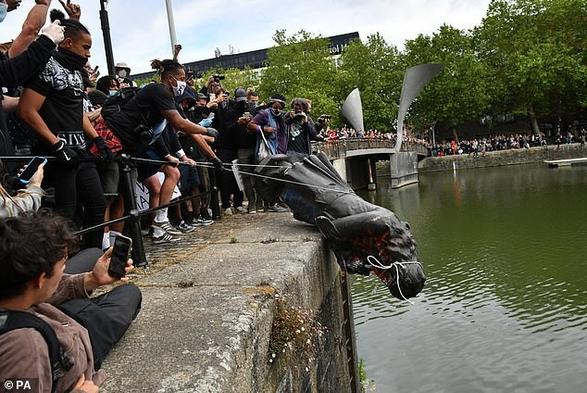
This also means that statues of old racist white men which have been thrown into the sea will be ruined forever OH NO HOW TERRIBLE

I'm posting all this in solidarity with a museum curator in the UK who recently dealt with a shitstorm for pointing out that it would be terrible if bronze statues of racists SOMEHOW got saltwater on them, because then they'd eventually be ruined forever. Which would be terrible. Obviously.

https://www.theartnewspaper.com/news/curator-investigated-for-tweets-on-damaging-bronze-statues

Museum world rallies behind curator investigated for tweets on how to damage bronze statues

UK arts professionals express support for Madeline Odent whose comments prompted a backlash on Twitter

Oh look, it’s an old thread I wrote about bronze disease, and how salt water can permanently destroy bronze statues.

On a TOTALLY UNRELATED note, I’m pretty sure there’s some other guy who people made bronze statues of in America. Can’t remember who. There is no particular reason why I’m mentioning this on October 12th.

@InvaderXan i think my sweaty palms corroded my grinder lmao
(from few months i see green-ish stuff under it)
@baerd Very likely, I'm afraid. It's hard to avoid with bronze objects which you handle often.
@InvaderXan I wonder if the Statue of Liberty would actually survive long enough for it's appearance in Planet of the Apes, since it was still near the sea.
@InvaderXan When I was a kid in the 80s, the Statue of Liberty was covered in scaffolding and the arm was closed off. It was getting a major renovation because it was rusting out and the arm wasn't safe anymore. My godfather was on the construction crew, so we got to ride the elevator in the center of the spiral staircase to the top and cut most of the line. LMAO.
@starcake Oh, that’s pretty cool!
@InvaderXan I thought so too. The people we stepped in front of weren't so keen on the idea.
@InvaderXan I wonder if this is related to how copper chloride PCB etchant works.
-F
@InvaderXan I ignored that people used to think it was caused by a bacteria.
Do you think the fact that bronze was a pretty generic term and can be used for different alloys could explain why some artefacts may be more easily corroded than others, well preserved? Or is it mostly because the conditions of exposition to water?

@baerd I'm pretty sure all bronze is some combination of copper and tin. But things from dry places are always better preserved. That's why we still have more ancient artefacts from Ancient Egypt than we do from the Indus Valley. The low humidity helps to slow the corrosion process.

Though I'd guess that anything with more copper would corrode faster too

@InvaderXan
My bad, in french bronze used to mean "any alloy with copper" but today restrained to tin+copper(+sometimes others), but this two meanings don't seem to exist in english :P
@baerd Huh. I didn't realise that. Probably a good thing I don't work in metallurgy! Yeah, it only has the one meaning in English.
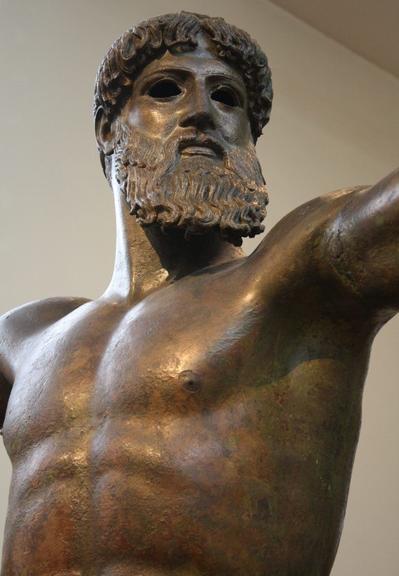
@InvaderXan I mean that dude looks mighty healthy tho
@ljwrites Yeah, that particular statute is rather well preserved. Not all of them are quite so fortunate!
@InvaderXan and not all of them should be 
@ljwrites Indeed. Besides, it’s just a natural process of corrosion. Who are we to go against nature? 😇
@InvaderXan Statues aren't natural. Seawater is. Just sayin'.
@InvaderXan Couldn't you stop it by adding sodium hydrogen carbonate (to convert the CuCl / CuCl₂ to copper hydroxide), cleaning it with water (to remove salts) and then brushing off the remaining copper hydroxide?
Or dissolving the hydroxide with HCl and then cleaning it with lots of water (and maybe electropolishing it), since that's how PCBs are often made and they don't corrode either.
@x44203 If it was that simple, historians and museum curators would not cite this as a major problem in the preservation of ancient artefacts.
@InvaderXan Hm yes maybe there is other problems, like that there is now a rough hole and maybe the alloy used also reacts differently and gets porous or so (for example when the tin or zinc dissolves but the copper does not)...