
https://algonoise.social/attachment/2969 I'm reading _How Equal Temperament Ruined Harmony (and Why You Should Care) _. I'm only 35 pages in. It's readable and does a fair job explaining how tuning systems work. Oddly, it seems to be aimed at non-musicians. It's also, like all books on tuning, slightly reactionary. Although it's much less ranty than Harry Partch.

Here's an experiment you can try at home: Use MIDI to send a major third to your sine tone generator. The first time I tried this, I thought my synthesiser was broken.

Computer/electronic music is not actually limited by the constraints of trying to get a keyboard to sound right, and yet we often use #12TET (keyboard tuning) without thinking about it.  What's your preferred approach to #tuning?

#JI #ET #JustIntonation #EqualTemprerament #Meantone #xenharmonic #microtone
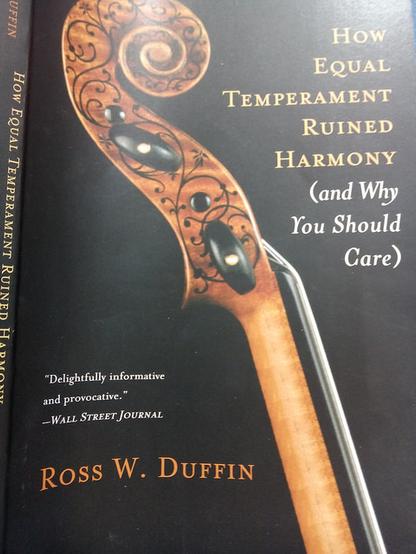
As the book goes on, the author seems to realise that mostly people who know a bit about notes will be most interested. It's a good introduction to what terms like 'comma', 'meantone' and 'temperament' actually mean. I'm enjoying it more than I thought I would.
I'm still reading _How Equal Temperament Ruined Harmony (and why you should care)_. It's got that weird leap, so common in texts from absolute beginner level to expert level over the course of a chapter, so I'm not following it 100%. The author doesn't introduce the term 'cents' until he gets to the historical part of the narrative where somebody invented the term. Before that, he talks about commas, a term he does define, but as commas are variable sizes, I don't always follow.
(It would be a nice companion for this book to have some pieces and scales in all the temperaments he mentions and maybe this exists? Doing a MIDI realisation is not 100% straight ahead as A♯ and B♭ were not the same note prior to equal temperament, except on keyboard instruments.)
Despite my confusion regarding terminology I find unclear, it is interesting to learn different methods of scale division.
As far as utility to electronic composers, MIDI-influenced systems still imagine notes as #12TET (the chromatic scale in equal temperament), where each of the 12 notes has a whole number identifier. If C is 1, C♯ and D♭ are 2, an D is 3. This won't work.

If I've understood correctly, there was a popular #temperament of 31TET, where not every division is used, but C♯ and D♭ are adjacent steps, rather than the same step. (I'd heard rumours there was a 31TET #organ in Holland somewhere and I wonder if this is what was meant.) It might be really groovy to use this for some pieces, but doing this in #SuperCollider might be a bit fiddly - I can't think of any digital platform that differentiates between sharps and flats.

@celesteh 12TET is kind of necessary for the music I write and enjoy to actually...function.

In all seriousness, you should probably interrogate the author's intentions here, because the wandering key centers of, say, John Coltrane, are simply not possible in antiquated tuning systems.

@ratttz This is also what I assumed before I started reading the book. I'm not at all sure of this any more. Especially since players lip notes up and down all the time for reasons of harmony. 12TET was invented ages ago, but not in common use, even in pianos, until the 20th century. For wind instruments, the adjustments required for 19th C temperament systems would not interfere with jazz key changes.
Coltrane certainly knew if he was playing an A sharp or a B flat and could adjust accordingly

@celesteh I'm still skeptical, especially since a lot of jazz harmony is carried by the piano and not the sax, and, frankly, a music tradition premised on total enharmonicity is fundamentally different from one with (limited) microtonality.

For what it's worth, I dig microtonal traditions, but they're also Not Mine.

@ratttz It would be nice if pianos had split black keys, but since they don't, this does require some compromise.

Historic temperaments are not microtonal, they just treat sharps and flats as different notes. FWIW, when I was an undergraduate in the late 1990s, I was told that spelling of these notes did matter, especially for violinists fingerings, which, again, does suggest ET is not entirely as universal as advertised.