How DAMAC Islands Broke the AED 10 Billion Sales Record in Just 10 Hours
DAMAC Islands made history by surpassing AED 10 billion in sales within only 10 hours. Explore the key strategies, investor behaviour, market trends, and unique offerings that turned this project into Dubai’s most talked-about real estate success story. https://www.propzilla.ae/en/property/damac-islands-in-dubailand

#DAMACIslands, #DubaiRealEstate, #LuxuryLivingDubai, #RealEstateInvestment, #WaterfrontProperties

Whitten Architects places single-storey Maine home on stilts to "evoke a treehouse"

Whitten Architects clad this Maine retreat with Eastern cedar and placed it on stilts on a steep site so that the single-storey structure would seem like a treehouse.

The property, dubbed Caterpillar Hill, is located on a remote lot on Maine's rugged coast overlooking the Penobscot Bay. Whitten Architects, a firm based in nearby Portland, completed the project for a family with ties to the area that wanted to settle down in Maine.

Caterpillar Hill is located on Maine's rugged coast

"Swimming in its lush landscape, the site is surrounded by wood, water, and rocks," said Whitten Architects.

The architects said that the home was designed "to evoke the feeling of a treehouse that would stand the test of time."

Located near the town of Sedgwick, the building is sited on a relatively steep slope, and the entrance is positioned only a few steps up from the driveway. This was an important consideration for the clients, whose goals include being able to use the home as their mobility eventually declines.

Whitten Architects designed the project to be treehouse-like

"When you enter the home you’re entering at grade, but by the time you’ve made it to the other side of the narrow building, you’re six to eight feet above grade," Whitten Architects explained. The elevated views over the surrounding trees and water give that feeling of being in a treehouse.

The living spaces are organised linearly. A central foyer divides the private and public areas, with three bedrooms laid out along a corridor to one side, and the living, dining room, and kitchen off to the other.

The living room has a sloped ceiling with exposed structural beams.

Three bedrooms feature in the house

"Looking up and out, the linear scheme of the home takes advantage of the stunning views while also providing a single-level floor plan," Whitten Architects explained. "Throughout the living spaces, there’s an open airiness with lots of glass."

A deck at the back of the home offers residents a place to relax in the summertime. At the end of the property, the architects also included a screened porch with a tall ceiling.

[

Read:

Matthew Baird's Somes Sound House in Maine "sits lightly on the ground"

](https://www.dezeen.com/2018/06/20/matthew-baird-somes-sound-house-holiday-home-cedar-shingles-maine/)

"It was important to us to implement specified local materials wherever possible, keeping the house true to its land," said the architects.

"We used local eastern white cedar for the exterior siding, and red birch for flooring and countertops throughout the interior," they added.

Eastern white cedar was used for exterior siding

On the interiors, the design gives off the sensibility of a classic coastal home. Rather than using drywall, several of the interior surfaces, such as the exposed pitched ceilings, are finished with white-painted wooden planks.

Other homes in Maine include a contemporary home on a sprawling estate that once belonged to US socialite Brooke Astor, and a cedar-clad home on Vinalhaven island that was self-built by an architect couple from New York City.

The photography is byTrent Bell.

**Project credits:
**
Principals: Rob Whitten, Russ Tyson
Project architects: Will Fellis and Russ Tyson
Builder: Jon D Woodward & Sons, Inc.
Interior designer: Krista Stokes
Engineering: Albert Putnam Associates
Landscape architect: Atlantic Landscape Construction

The post Whitten Architects places single-storey Maine home on stilts to "evoke a treehouse" appeared first on Dezeen.

#all #residential #architecture #instagram #usa #treehouses #houses #designfortheelderly #americanhouses #woodenarchitecture #maine #waterfrontproperties #designforageing

Woven perches Sakinaw Lake House on rocky hillside in British Columbia

Canadian studio Woven Architecture and Design has created a long and narrow holiday home for a challenging site in British Columbia where "there wasn't much space for a home".

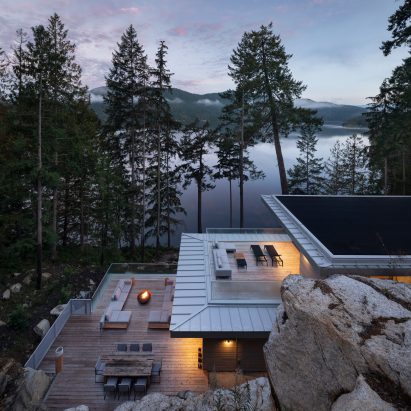
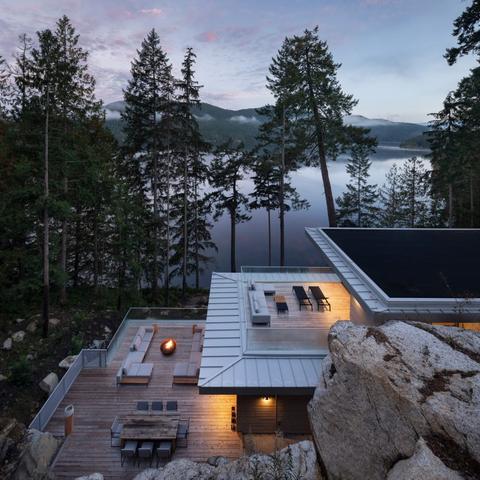
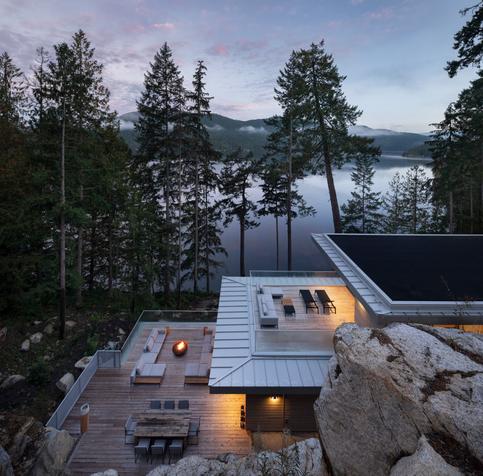
The Sakinaw Lake House – named for the body of water it overlooks – is located in the Sunshine Coast, a scenic region northwest of Vancouver. The home is anchored to a steep, rocky site that overlooks the lake.

The Sakinaw Lake House sits overlooking the Canadian lake

The 3,060-square-foot (284-square-metre) vacation dwelling was designed for a couple with a baby girl and two older boys. One of the parents spent a lot of time on the lake during her childhood.

The project's primary goals were to provide outdoor space, capitalise on views and ensure a connection between the different levels of the home. The greatest obstacle was the site conditions.

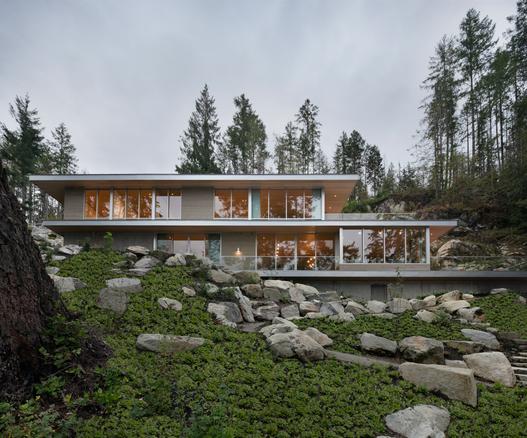
The house is composed of stacked bars

"It was a very challenging site, as there wasn't much space for a home, and there was a large rock wall to contend with," said Woven Architecture and Design, which is based in British Columbia's Salt Spring Island.

"The house is essentially built on the face of the rock wall, with very little depth for the home or outdoor space."

Inside, concrete floors are paired with ceilings clad in hemlock

The solution was to create a long and narrow, two-storey house composed of stacked bars. The top volume steps back, allowing for a terrace atop the bottom bar's roof. A terrace is also found on the lower level.

Exterior walls are clad in tight-knot, western red cedar – the same material used for outdoor decks. Metal was used for fascias, and vertical grain hemlock was used for the soffits. Large stretches of glass are partly shaded by overhanging roofs.

WOVEN placed bedrooms on the upper floor

The point of arrival is a detached carport at the top of the site. From here, an outdoor stair descends to the main entrance on the top level.

The bedrooms are located on the upper floor, and the communal areas are found below. The lower level also has a "flex room" that can serve as a guest bedroom.

Steel stringers and concrete treads define the staircase

The levels are connected by a staircase with steel stringers and concrete treads. The extensive glazing provides compelling views of the terrain.

"Floor-to-ceiling glass walls offer views of the lake on one side and a dramatic rock wall immediately behind the house on the other," the firm said.

[

Read:

Office of McFarlane Biggar Architects + Designers creates cedar-clad cabin in the woods

](https://www.dezeen.com/2021/01/21/office-of-mcfarlane-biggar-architects-designers-cedar-clad-cabin/)

Vancouver's Sophie Burke Design led the project's interior design. The palette of materials complements the home's natural setting, as do the neutral colours.

Concrete floors are paired with ceilings clad in hemlock. Rooms are filled with comfy, contemporary decor, including a number of pieces made of light-toned wood.

Black-painted steel frames the fireplace

In the living room, a fireplace is framed with black-painted steel and board-formed concrete.

In the kitchen, the team used "super white" quartzite for countertops and the backsplash. Cabinetry is made of European white oak.

The home's steep, rocky site can be seen through large windows

"Flush transitions with materials extending from inside to outside dissolve the division between interior and exterior," the team said.

Other residential projects in British Columbia include a mirrored addition designed by F2A Architecture for a home on a rocky ledge, and a concrete house on stilts by Hunter Office Architecture that has a layout influenced by a Hindu organizational system.

The photography is byEma Peter.

Project credits:

Architecture: WOVEN Architecture and Design
Interiors: Sophie Burke Design
Schematic design consultant: Phillip Van Horn

The post Woven perches Sakinaw Lake House on rocky hillside in British Columbia appeared first on Dezeen.

#all #residential #architecture #houses #canada #holidayhomes #canadianhouses #waterfrontproperties #britishcolumbia

Studio MK27 nests living areas under giant roof of Brazilian beach house

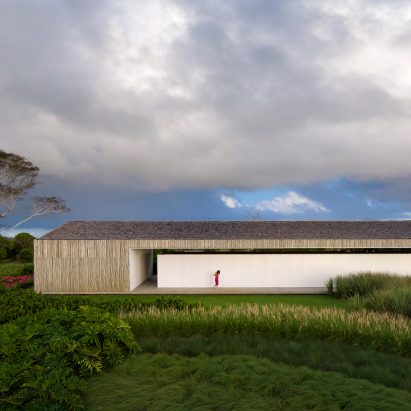
Studio MK27 has designed a Brazilian seaside villa with wide openings to frame views of the surrounding landscape "like a wide-angle camera".

Vista House is located in Trancoso, a tranquil seaside town in Brazil's Bahia province. Studio MK27, which is led by architect and filmmaker Marcio Kogan, completed the 8,343-square-metre home in early 2020.

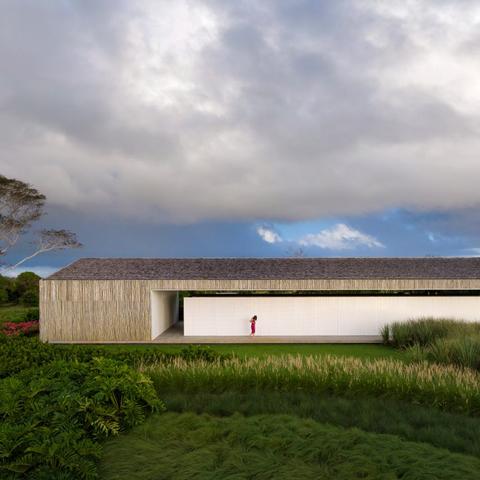
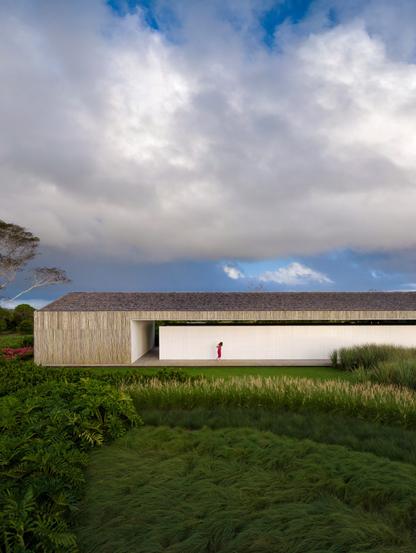
Studio MK27 designed Vista House with a smaller envelope nested under a long gabled roof

The residence home sits on top of a 46-metre-high cliff above Transco's sea escarpments, which are "sculpted by the lagging and constant action of Bahia's waters" according to the firm.

The position and view of the ocean heavily influenced the design, as did the material palette of the tropical environment.

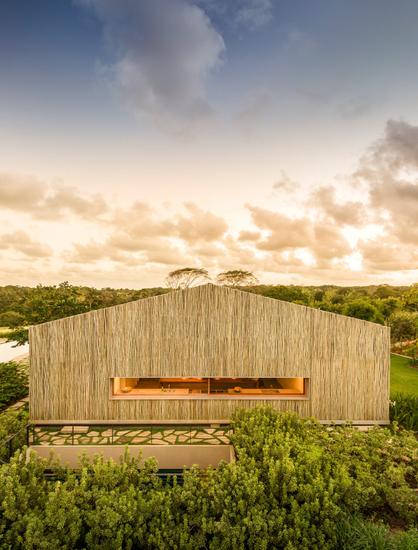
At one end of the long envelope is the kitchen

"From a bird's perspective, the elongated volume aims to frame the landscape like a wide-angle camera," said Studio MK27.

The home is made up of a low-slung, gabled roof that is roughly 15 metres wide, 3.5 metres tall, and 60 metres long.

The living areas of Vista House are left open to the environment

This impressive span is only enclosed at either end, where MK27 placed the kitchen and primary bedroom, respectively. The outside of the structure is wrapped in eucalyptus staves, while the roof is sheathed in hand-carved wooden shingles.

The remainder of the home is conceived as an indoor-outdoor living space.

The home frames the view of the sea like a wide-angle camera

"Its horizontal proportions are delineated by the extrusion of a cottage elemental section, which generates a 60-metre-long wooden roof," Studio MK27 explained.

"Rooted by closed volumes in its edges, which contains the master suite and the kitchen, the house opens itself to the colours surrounding through an immense wide-screen span overlooking the infinite blues," added the architects.

The living areas can be closed off with screens that extend from the ceiling

In addition to the primary bedroom, the home has four additional bedrooms contained within a smaller volume that is inset from the exterior walls.

The material used to build this the interior envelope is known as Viroc, which the architects explain is a wood-and-cement composite panel.

"Under the roof, an open-air veranda permeates the span, connecting the gardens on either sides and surrounding a white lower box," said Studio MK27. "Independent of the main structure, this inner house can open itself completely as the Viroc panels work as folding screens."

The interior envelope can be shuttered

The architects chose a restrained palette of creamy tones and wood for the interior walls and furniture.

These polished interiors contrast the softer, organic look of the exterior.

[

Read:

Bernardes Arquitetura tops Rio de Janeiro villa with wing-shaped roof

](https://www.dezeen.com/2021/08/08/bernardes-arquitetura-asa-house-curved-roof-rio-de-janeiro/)

The team also gave careful consideration to the interaction between Brazil's strong sunlight and the materials.

The use of the perforated Viroc and the spindly eucalyptus sections creates interesting shadow patterns throughout the home, and the expansive overhanging roof ensures that the residents can enjoy the outdoors in any weather condition.

The master bedroom is at the other end of the home

"The outside views swoop inside the interiors spaces through soulful textures that refract and reflect light, creating a dance of light and shadows on each surface, specially through the biriba slats and the Viroc perforated walls," said Studio MK27.

Other projects by the São Paulo-based firm include an off-grid residence in the rural region of Catuçaba, and an apartment in São Paulo for a family with three children that hosts guests frequently.

The photography is byFernando Guerra.

Project credits:

Architecture: Studio MK27 (Marcio Kogan, Samanta Cafardo, Beatriz Meyer)
Interior design: Diana Radomysler, Pedro Ribeiro
Project team: Carlos Costa, Giovanni Meirelles, Mariana Simas, Oswaldo Pessano
Landscape designer: Isabel Duprat
Structural engineer: Inner Engenharia
Electrical and plumbing: Zamaro
Acoustic consultant: Harmonia Acústica
Project management: SC Consult, Sergio Costa
Automation: GF Consultoria
Builder: Kross Engenharia

The post Studio MK27 nests living areas under giant roof of Brazilian beach house appeared first on Dezeen.

#all #architecture #residential #brazil #houses #studiomk27 #brazilianhouses #waterfrontproperties

Snow Kreilich completes holiday home overlooking Michigan's Lake Superior

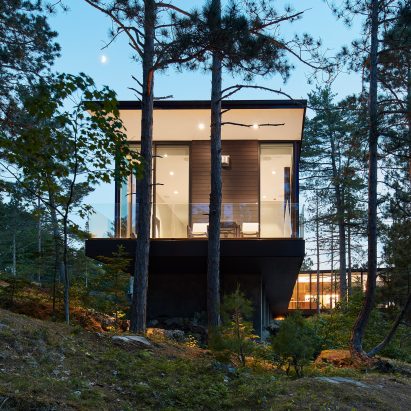
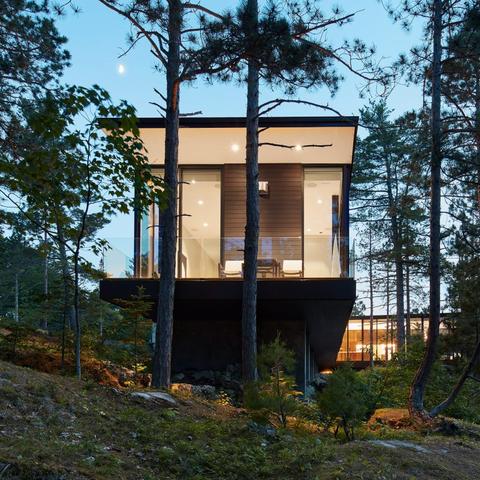
The two wings of this house on the shores of Michigan's Lake Superior intersect at an irregular angle, offering a variety of views of the surrounding forest and waterfront.

Named X-House after its layout, the home was conceived by Minneapolis-based firm Snow Kreilich as an isolated retreat for a large family that had been coming to a nearby property for several years.

The waterfront house overlooks Lake Superior

The site is perched on the shores of Lake Superior, near the city of Marquette, Michigan. "It is adjacent to a property that had been in their family for years, a multi-generational cabin along the south shore of Lake Superior, on Michigan’s Upper Peninsula," said Snow Kreilich.

"Remembering long summers spent on the shore, our clients wanted a legacy home for themselves and their children - similar to the family cabin, more comfortable and convenient, but just as enduring," the team added.

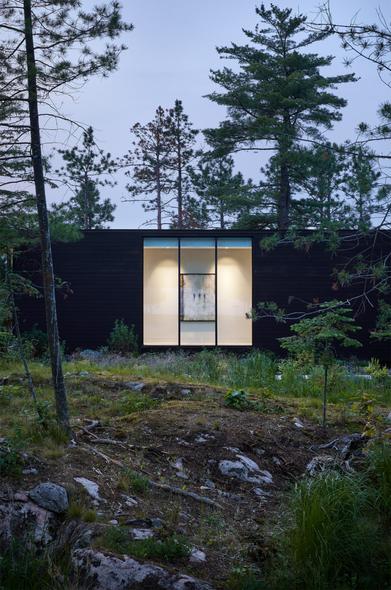
Snow Kreilich clad the house in blackened timber

The contemporary black cabin is laid out on a single level. This keeps the building's profile from protruding above the surrounding pine trees, while also considering the owner's future needs as their mobility diminishes.

One of the wings is for communal functions, while the other accommodates three bedrooms. The entrance is at the intersection of both volumes, and offers a glimpse of the expansive living area.

The open-concept kitchen, living and dining area is wrapped with full-height glass panels

"The house sits on a rocky promontory between two coves with sandy beaches," said Snow Kreilich.

"Two intersecting bars of the house balance on the promontory, cantilevering toward the water and into the forest, creating captured landscapes and embedding its occupants in the landscape," they added.

Living spaces overlook the rocky lakeside

The open-concept kitchen, living and dining area is wrapped with full-height glass panels on three sides. As the site slopes down towards the lake, the building becomes raised above the ground.

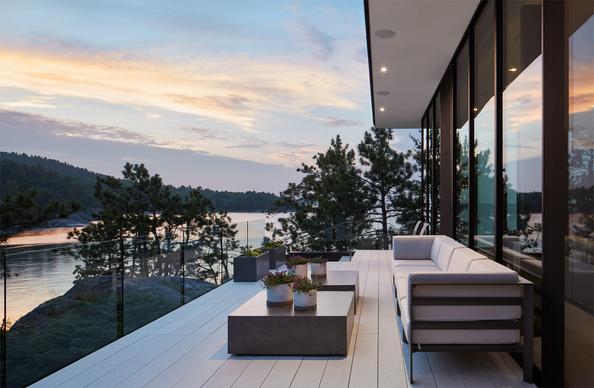
A terrace runs along this volume overlooking the lake and offering an outdoor lounge area that connects to the living room.

[

Read:

Elton Léniz perches Casa BB on hillside overlooking Chilean lake

](https://www.dezeen.com/2022/01/15/elton-leniz-casa-bb-hillside-chilean-lake/)

"Living spaces hover over the rocky point with large panels of glass connecting the family with the beach coves, forest and the expanses of Lake Superior," said the architects.

In keeping with their intention of providing a more contemporary setting for the residence, the architects kept to a restrained palette of white, grey and black finishes.

Stone accent walls feature inside

Many of these material selections — such as stone accent walls and blackened wood — are used both within the home and outside, lending an impression of continuity with the natural environment.

Within the primary bedroom, Snow Kreilich included a secondary terrace, which occupies the end of the sleeping wing.

The holiday home's wings intersect at an irregular angle

The architecture firm was founded by Julie Snow in 1995, and earned an AIA Honor Award in 2018 in recognition of its work in the US.

Other homes in Michigan include a waterfront home near is namesake lake by Wheeler Kearns Architects, and a secondary home for a Chicago family topped with deep wooden overhanging roofs.

The photography is byGaffer Photography.

Project credits:

Design team: Julie V Snow, lead designer & principal in charge; Matthew Kreilich, principal; Tyson McElvain, project architect; Carl Gauley, project designer & architect; Mary Springer, architect; Pauv Thouk, project manager
General contractor: Gregg H Seiple Construction (in collaboration with Hall Contracting)
Landscape architect: Flourishes
Structural engineer: Meyer Borgman Johnson
Consulting architect: James Larson

The post Snow Kreilich completes holiday home overlooking Michigan's Lake Superior appeared first on Dezeen.

#all #architecture #residential #usa #blackenedwood #houses #cantilevers #holidayhomes #michigan #blackhouses #americanhouses #waterfrontproperties

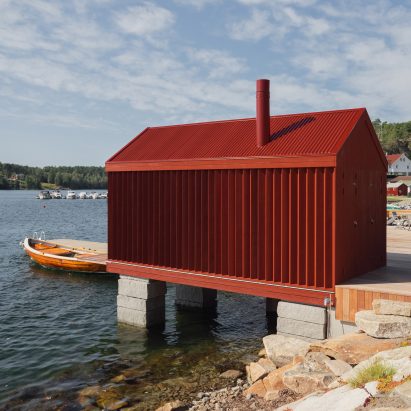
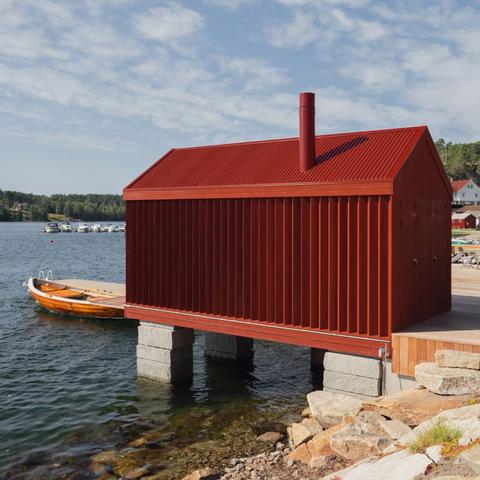
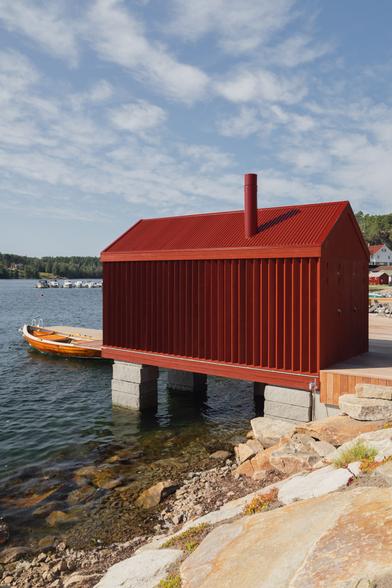
Handegård Arkitektur designs red cabin on Norwegian seafront

Norwegian practice Handegård Arkitektur has completed a bright red cabin on the seafront in Hankøsundet, Østfold, elevated above the water on piers of stacked granite.

Built for a client who lives near the coast, the design of the cabin – called the Bathhouse – was informed by the appearance of traditional Norwegian boathouses, in particular their red-painted finish.

Handegård Arkitektur has created a bright red cabin in Norway

To create a "modern reinterpretation" of these traditional structures, locally based Handegård Arkitektur has used contemporary materials and treatments to create a compact, bright living space for enjoying sea views.

"[The client] wanted to create a building that was both modern and traditional in its expression," founder Espen Handegård told Dezeen.

It is elevated on granite on the seafront in Hankøsundet

"The Bathhouse looks like a traditional Norwegian boathouse with red-painted cladding, a tin roof and granite columns in the water...but at the same time gives assumptions about a twist," he continued.

The cabin's glazed living space is surrounded by a second skin of thin timber planks angled at 45 degrees, which provide privacy to the building when viewed from the seafront and offer views out to water from inside.

The interior is lined with plywood

These red-painted boards form part of the cabin's structure, attached to the galvanised steel frame that sits on granite supports – allowing for an uninterrupted internal space.

"Several of the cladding boards are angled...they close the building towards the back and open it towards the front," explained the practice.

[

Read:

The Filmmaker's Hut is a "mystical" black cabin overlooking a Finnish lake

](https://www.dezeen.com/2021/11/06/the-filmmakers-hut-pirinen-salo-finland/)

"When you enter, you experience the purpose – you are sheltered at the same time as having a view of the entire sea," it continued.

Two large red doors, finished with the same angled wooden planks as the cabin, provide access to a separate bathroom block and the cabin from the small wooden dock, which extends out into the water with small jetties.

A small mezzanine space contains a bed

Inside, the plywood-lined living space features a wood burning stove and minibar at the rear, and an open area for sun loungers in the front.

Two full-height swing doors allow for the living space to be completely opened to the elements, with a simple wooden platform extending to the outside.

The timber cladding provides privacy

The form of the bathroom block sits slightly lower than the gabled ceiling, creating a small mezzanine space containing a bed that is accessed via a small metal ladder.

Elsewhere in Norway, architecture practice River & Drage also reinterpreted traditional structures with a contemporary take on a log cabin for the project Zieglers Nest, near the city of Molde.

The photography is byCarlos Rollan.

The post Handegård Arkitektur designs red cabin on Norwegian seafront appeared first on Dezeen.

#all #architecture #residential #norway #redbuildings #cabins #waterfrontproperties

Elton Léniz perches Casa BB on hillside overlooking Chilean lake

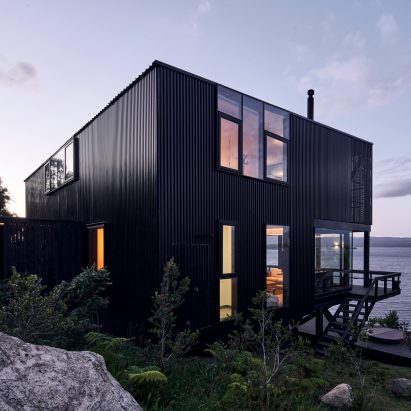
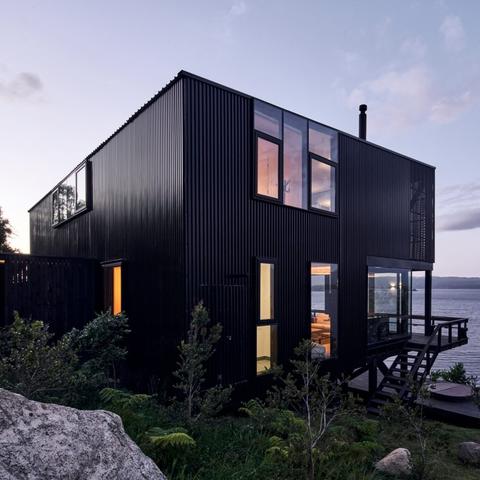
A black holiday home by Chilean architecture studio Elton Léniz is lifted off the ground by wooden stilts to help reduce the building's impact on the earth.

Casa BB rises up from a slender, wooded site along Lake Calafquén in southern Chile. Just beyond the lake is Villarrica, one of the country's most active volcanoes.

Elton Léniz designed the house on stilts to overlook a Chilean lake

The building serves as a vacation house for a couple with two children. Santiago-based Elton Léniz aimed to capitalise on the scenery while also providing a sense of privacy.

"The narrow proportion of the site suggested a small, vertical design that would maximise unobstructed views of the impressive geography while freeing up as much space as possible between neighbouring buildings," the team said.

A micro-perforated screen mitigates sun exposure

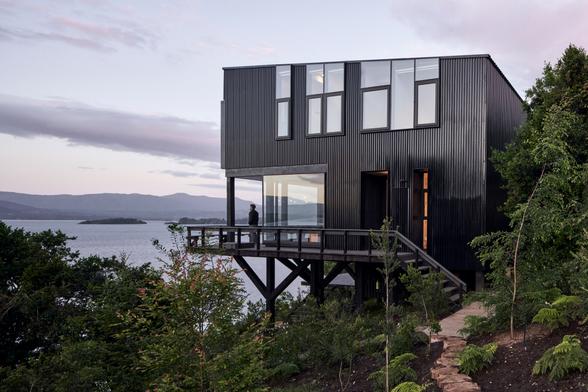
To reduce exposure to ground moisture and to minimise disturbance to the hillside, the team propped the house up on wooden supports.

"This compact house sits almost like a container on a wooden structure, with minimal intervention in the terrain and the slope," the team said.

Cuts and openings connect occupants to the outdoors

Facades are clad in Quadroline aluminium panels from Hunter Douglas – a low-maintenance material with simple, vertical lines.

The panels' black colour helps the home blend with the terrain.

The compact house resembles a container

On the north is a micro-perforated screen that mitigates sun exposure while preserving a visual connection with the landscape.

The home's entrance is on the south side, where a wooden walkway leads to the front door. The bottom level holds the kitchen, living room, dining area and a sheltered patio, along with a bedroom.

[

Read:

Casa S is an amoeba-shaped home on the coast of Chile

](https://www.dezeen.com/2021/12/26/casa-s-amoeba-shaped-home-chile-gubbins-polidura-mas-arquitectos/)

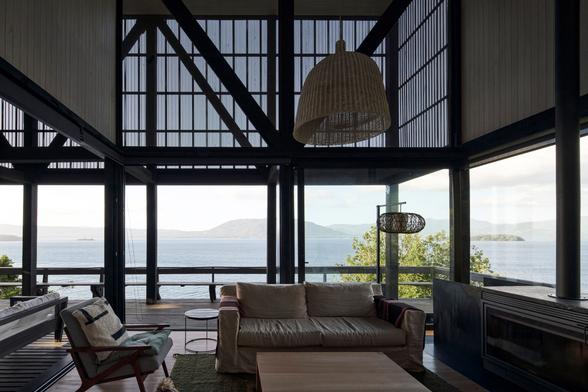
The social spaces are designed to flow into each other. "Living room, dining room, kitchen and barbecue-terrace are continuously articulated to allow simultaneous activities," the team said.

The main bedrooms are found on the upper level.

The house is entered via a wooden walkway

Rooms feature contemporary decor and ample use of earthy materials, including pine wood. Cuts and openings in the building enable occupants to feel connected to the outdoor setting.

"This allows one to silently confront geography and to discover new relations with the landscape from within the space," the team said.

Facades are clad in black Quadroline aluminium panels

Led by Mirene Elton and Mauricio Léniz, the firm Elton Léniz has designed a number of residential projects, including Casa El Pangue – a hillside house in Chile that offers panoramic views of the Pacific Ocean.

The photography is byCristobal Palma.

The post Elton Léniz perches Casa BB on hillside overlooking Chilean lake appeared first on Dezeen.

#residential #all #architecture #cristobalpalma #houses #stilts #aluminium #holidayhomes #chile #blackhouses #chileanhouses #waterfrontproperties

Elton Léniz perches Casa BB on hillside overlooking Chilean lake

A black holiday home by Chilean architecture studio Elton Léniz is lifted off the ground by wooden stilts to help reduce the building's impact on the earth.

Dezeen

Zozaya Arquitectos completes housing development beside Mexico's Lake Avándaro

Traditional construction materials are used in contemporary forms at this residential development by Zozaya Arquitectos in Valle de Bravo, Mexico.

Named after the nearby picturesque Lake Avándaro, two hour's drive west of Mexico City, the Avándaro 333 housing complex contains 27 residences spread out across nine smaller buildings.

The housing complex is near Mexico's Lake Avándaro

Even though each of these blocks contains several apartments, Zozaya Arquitectos designed them to resemble "a large residence immersed in the forest".

Features such as thick masonry walls and sloped clay roofs help to reinforce the appearance of these buildings as traditional homes.

Communal facilities at the complex include a lap pool

Zozaya Arquitectos contrasted these elements with contemporary additions, including wood-and-steel pergolas and full-height sliding glass doors.

"The result is contemporary architecture with awareness and memory, in synergy with the vernacular architecture of the region and integrating nature to the maximum," Zozaya Arquitectos explained.

Residents also have access to a clubhouse and a tennis court

On the ground floor of each building are a pair of three-bedroom apartments, with a symmetrical layout that includes an open-concept kitchen, living and dining room.

Sliding glass doors that leads onto a private terrace with a small pool.

Both communal areas and residences feature large stretches of glazing

All of the units have exterior spaces on at least two sides, "so that the user can enjoy the forest, the views and the proximity to the town," according to the architects.

The residences also benefit from a shared parking garage in the basement.

Stone was used to link the buildings to the local vernacular

An exterior flight of stairs leads to a larger, four-bedroom unit that occupies the entire floor.

The upstairs units are laid out with a curving corridor that separates the social spaces from the residents' quarters, offering more privacy.

Apartments are afforded modern finishes and lots of natural lighting

These units also benefit from a private deck, which wraps around a corner of the building to form more exterior space.

"The climate in the area is extremely pleasant, allowing the design of open spaces, with cross ventilation and great natural lighting," said Zozaya Arquitectos.

A private deck wraps around a corner of each residential building

Zozaya Arquitectos – based in the coastal city of Ixtapa, and led by Daniel and Enrique Zozaya – sought to reference local building traditions with their choices of materials.

Large stone walls appear to cut through the building, which helps delineate the terraces on the upper level. This creates opportunities for bedrooms to enjoy an exterior private space.

[

Read:

Glue-laminated timber structure forms San Crescente housing block in Santiago

](https://www.dezeen.com/2021/12/09/san-crescente-housing-block-santiago-glue-laminated-timber-structure/)

"To solve the roofs, pergolas and railings, a mixed structural system was chosen, in steel and laminated wood," the architects said.

"Building ceilings with wooden sections of greater dimensions and less repetition creates aesthetic, efficient and minimalist structures," they added.

The project was designed to blend with its surroundings

The complex encompasses 17,000 square metres, and also includes communal amenities such as a lap pool, clubhouse and tennis court.

The property treats its own wastewater onsite and has a rainwater retention system that is used for irrigation.

Zozaya Arquitectos aimed to blend traditional materials with contemporary forms

Zozaya Arquitectos has completed a variety of waterfront properties along Mexico's Pacific coast, including a home with a traditional palapa at its centre, and a residential development with curved walls to evoke the movement of waves.

The photography is byCesar Belio.

Project credits:

Project leaders: Daniel Zozaya and Enrique Zozaya
Project team: Angel Sotelo, José Antonio Vázquez, Ana Karen Cadena, Esthela Valenzuela, Ana Karen Cadena, Cesar Octavio, Jesus Lopez, Carlos Perezlara
Construction company: BAI
Construction team: Alberto Betancourt, Max Betancourt, Carlos Betancourt, Angel Sotelo
Structural design: Omar Hernández

The post Zozaya Arquitectos completes housing development beside Mexico's Lake Avándaro appeared first on Dezeen.

#residential #architecture #stone #mexico #housing #mexicanhouses #waterfrontproperties #zozayaarquitectos

Zozaya Arquitectos completes housing development beside Mexico's Lake Avándaro

Contemporary construction meets vernacular materials in this residential development by Zozaya Arquitectos in Valle de Bravo, Mexico.

Dezeen

Seibert Architects designs Florida home for indoor-outdoor living

A glazed courtyard occupies the centre of this Florida residence by Seibert Architects, bringing light to the interiors and organising the circulation around the building.

Completed earlier this year, the Schechter Residence is a low-slung home that offers its owners a beach-focused lifestyle in Sarasota, Florida.

The Schechter Residence was guided by the concept of indoor-outdoor living

Located just a few metres above from the shore, the 4,000-square-foot (372-square-metre) home enjoys a gently stepped-back garden leading down to the water.

"The pool area and waterfront yard are terraced to provide flat outdoor space for waterfront activities, children at play and to ease the transition down to the water," said Seibert Architects, which is also based in Sarasota.

Seibert Architects added vaulted ceilings to the design

The entry sequence into the home leads into a lush courtyard. This exterior space enclosed by glass walls brings light into the building and also offers a space for the owners children to play.

"The courtyard, surrounded by glass on three sides, enriches movement through the house and enhances the entry by bringing light, vegetation, and sky to these experiences," said Seibert Architects.

Inside, pops of vivid colour are set against white walls

The living spaces and primary bedroom are laid out as an enfilade of spaces facing the water. These rooms have much higher ceilings and are vaulted to make room for clerestory windows.

"These curved forms contrast with the more serious rectilinear nature of the design," said Seibert Architects. "Its inhabitants describe them as uplifting."

[

Read:

Lush courtyards punctuate Chilean retreat Casa Altos by Duque Motta & AA

](https://www.dezeen.com/2021/06/25/lush-courtyards-chilean-retreat-casa-altos-duque-motta-aa/)

Open shelving that separates these spaces helps to define each without completely enclosing them.

The western facade of the home is fronted by tall sliding glass doors that lead out to the pool deck.

The home's furnishings intend to reflect the Florida lifestyle

This outdoor space is sheltered by a large retractable awning and a screened enclosure to protect users from harsh direct sunlight and insects.

This offers a year-round connection between the inside spaces and the pool and backyard.

The home is located in Sarasota

The remainder of the bedrooms are located on the opposite side of the home, facing the street.

Two children's bedrooms share a common play area away from the living room, while the guest bedroom has its entrance closer to the foyer, for more privacy.

The Schechter Residence features a waterfront yard

The home's mostly white finishes reflect Florida's beach-oriented lifestyle. Seibert Architects provided pops of colour with bright furnishings, while the exposed wooden ceiling vaults add some warmth to the overall palette.

Other residences in Florida include an all-white home by Jeffrey Dungan that was completed in a range of different architectural styles, and a Miami Beach home for an art collector by Shulman + Associates.

The photography is byRyan Gamma.

Project credits:

Architectural firm: Seibert Architects
Architect of record: Samuel C Holladay
Project architect/designer: Michael Epstein
Structural engineer: Hees & Associates
Contractor: Yoder Homes

The post Seibert Architects designs Florida home for indoor-outdoor living appeared first on Dezeen.

#residential #all #architecture #usa #courtyards #houses #florida #swimmingpools #americanhouses #waterfrontproperties

Seibert Architects designs Florida home for indoor-outdoor living

A glazed courtyard occupies the centre of this Florida home by Seibert Architects, bringing light to the interiors and organising the occupant's circulation throughout the home.

Dezeen

Rough-sawn cedar clads Whidbey Dogtrot house in Washington by SHED

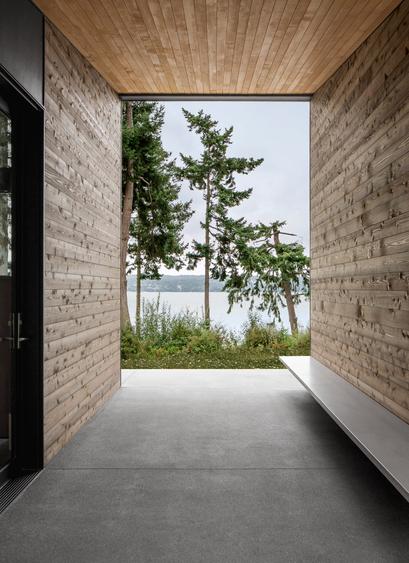
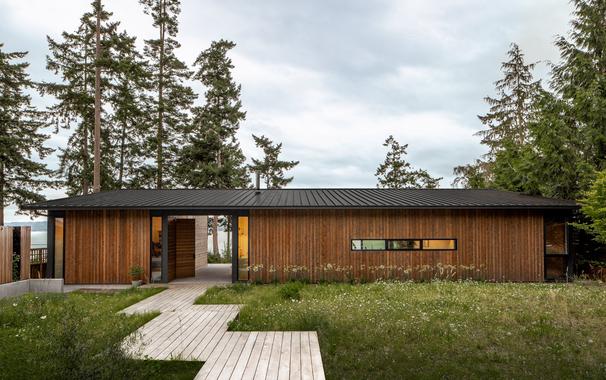
Cedar siding and a central breezeway feature in this compact home in the Pacific Northwest designed by US firm SHED for a couple who will soon retire.

The project, called Whidbey Dogtrot, is named after its location on Whidbey Island, which lies just north of Seattle. The single-storey dwelling is perched on a bluff overlooking the Puget Sound.

Whidbey Dogtrot overlooks the Puget Sound

The project was designed by Seattle's SHED Architecture and Design for a couple who are transitioning into retirement. They desired a compact, low-maintenance home that embraces its picturesque setting.

"In addition, the home needed space for guests, visits from adult children, hobbies, music and a home office," the team said.

The home was informed by traditional dogtrot-style houses

For inspiration, the architects looked to the dogtrot-style house, which features a central breezeway covered by a roof.

They conceived a low-lying home made up of two rectangular volumes flanking an open-ended passage, where the front door and a wooden bench are located. The building is topped with a black, standing-seam metal roof.

Living quarters include an open-plan kitchen and dining area

Exterior walls are clad in rough-cut, western red cedar with a semi-transparent black stain.

To ensure privacy, the team limited the amount of apertures on the front elevation, which faces west. The home opens up on the east, where large stretches of glass offer sweeping views of the landscape.

[

Read:

LaRue Architects incorporates breezeway into revamped cabin on Texas lake edge

](https://www.dezeen.com/2021/03/27/ski-slope-residence-larue-architects-britt-design-group/)

One side of the house contains the primary living quarters, which total 915 square feet (85 square metres). This area encompasses an open space for cooking, dining and lounging, along with a bedroom suite and reading nook.

The other side holds a 281-square-foot (26-square-metre) flex space and bathroom.

A bedroom suite features a reading nook with surrounding views

Throughout the dwelling, the team incorporated neutral colours and contemporary decor. Interior finishes include pale wooden cabinetry, creamy white walls and concrete flooring. Heat is provided by a hydronic system.

"The home is thoughtfully designed to make the most of its square footage," the architects said. "The result is a modest and functional dwelling strongly anchored to its site."

Western red cedar wraps the building

Other projects by SHED include a sustainable Seattle home that was influenced by circus tents and Japanese design, and the conversion of a horse stable into a studio and guesthouse.

The photography is byRafael Soldi.

The post Rough-sawn cedar clads Whidbey Dogtrot house in Washington by SHED appeared first on Dezeen.

#residential #all #architecture #instagram #usa #cedar #houses #washingtonstate #americanhouses #shedarchitectureanddesign #waterfrontproperties #dogtrothouses

Rough-sawn cedar clads Whidbey Dogtrot house in Washington by SHED

Cedar siding and a central breezeway feature in this compact home in the Pacific Northwest designed by US firm SHED for a couple who will soon retire.