Громче, ещё громче. Новые умные телевизоры Sber с голосовым управлением — технологией Farfield

Салют, Хабр! Сегодня мы представили новые умные телевизоры Sber

https://habr.com/ru/companies/sberdevices/articles/967878/

#vqe #json #звук #loopback #gigachat #farfield #умный_телевизор #устройства_sber #тв

Громче, ещё громче. Новые умные телевизоры Sber с голосовым управлением — технологией Farfield

Салют, Хабр! Сегодня мы представили новые умные телевизоры Sber серии 7000 с голосовым управлением без пульта, которое обеспечивает технология Farfield. Этим телевизорам достаточно дать голосовую...

Хабр

Posted today: strategies for how to go about optimising double-bracket #quantumAlgorithms
https://scirate.com/arxiv/2408.07431

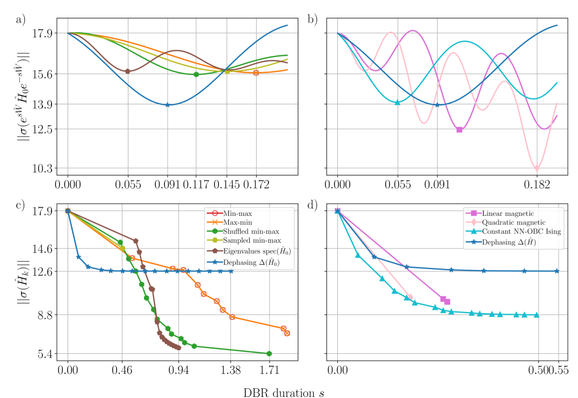
We compare with cases inspired by Brockett's #doubleBracketFlow which have rigorous global convergence guarantees and found that departing from them and at every step optimising the involved generators gives faster diagonalization.

This motivates our upcoming work on training our double-bracket circuits on single-shot samples: today we posted that 1) within the class of #doubleBracket #quantum algorithms it's worthwhile to variationally train the parametrisations at every step, last week we posted that 2) warm-starts from #VQE facilitate very high ground state preparation fidelity and so 3) training on shot-noise limited data will give an idea how to use our approach on future large-scale quantum hardware.

Strategies for optimizing double-bracket quantum algorithms

Recently double-bracket quantum algorithms have been proposed as a way to compile circuits for approximating eigenstates. Physically, they consist of appropriately composing evolutions under an input Hamiltonian together with diagonal evolutions. Here, we present strategies to optimize the choice of the double-bracket evolutions to enhance the diagonalization efficiency. This can be done by finding optimal generators and durations of the evolutions. We present numerical results regarding the preparation of double-bracket iterations, both in ideal cases where the algorithm's setup provides analytical convergence guarantees and in more heuristic cases, where we use an adaptive and variational approach to optimize the generators of the evolutions. As an example, we discuss the efficacy of these optimization strategies when considering a spin-chain Hamiltonian as the target. To propose algorithms that can be executed starting today, fully aware of the limitations of the quantum technologies at our disposal, we finally present a selection of diagonal evolution parametrizations that can be directly compiled into CNOTs and single-qubit rotation gates. We discuss the advantages and limitations of this compilation and propose a way to take advantage of this approach when used in synergy with other existing methods.

SciRate