Xinxiang Cultural Tourism Centre by Mathieu Forest Architecte resembles a stack of ice cubes

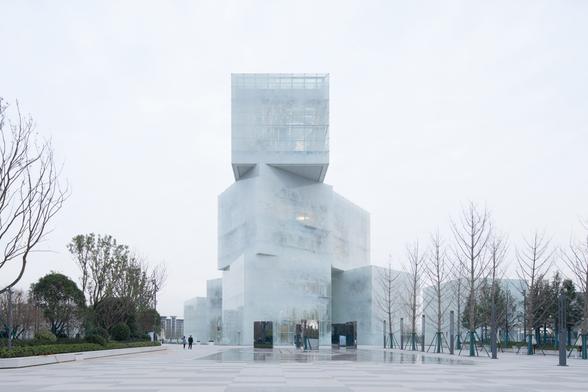
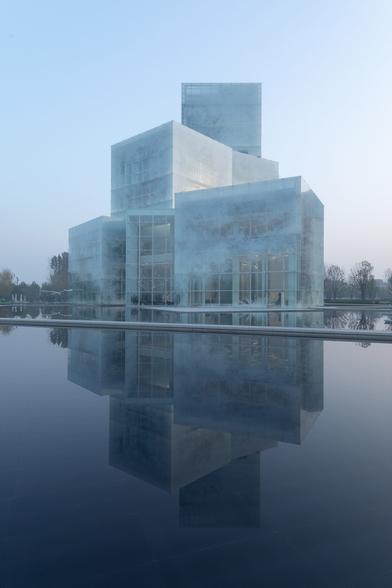
A stack of nine frosted glass "ice cubes" atop a pool of water houses this cultural centre in Xinxiang, China, designed by French practice Mathieu Forest Architecte.

The Xinxiang Cultural Tourism Centre was designed as a sculptural icon for a new winter sports tourism district in the city, which will in future include an indoor ski slope.

Mathieu Forest Architecte has created a stacked cultural centre in China

Inside the centre's nine cubes are a restaurant, cafe, shops, reading and children's spaces, with the stacked form used to create a series of open-air terraces that overlook the surrounding plaza and water pools.

"The ambition of the project is to create a strong urban indicator that unites the whole district," said Mathieu Forest Architecte.

It is designed to resemble a stack of ice cubes

"[It] does not look like a classic building – it is not possible to figure out the number of floors, it is a sculpture out of scale, a pure and monumental volume," it continued.

The ice-like appearance was achieved through the use of printed glass panels, which are attached to the concrete structures with minimal metal fixings to avoid the need for any frames.

The building sits beside a pool of water

During the day, the appearance of the glass panels changes depending on the light conditions, revealing certain areas of the interior and concealing others.

At night, illumination from the interior creates a glowing effect, turning the centre into a "lighthouse" for the district.

The ice-like appearance is achieved with patterned glass panels

"The texture of the glass facades is composed of a multitude of tangled translucent ice crystals that filter the light and the vision from the interior," said the practice.

"It is a question of hiding, whilst showing, to provoke mystery and the desire to approach," it continued.

[

Read:

Triptyque's marble and glass showroom was designed to "look like an ice cube"

](https://www.dezeen.com/2014/12/04/triptyque-groenlandia-building-marble-glass-ice-cube-sao-paulo-brazil/)

Each cube is stacked at a different angle, creating a variety of compositions depending on the direction of approach. Some cubes cantilever above the plaza and others are positioned to create small gaps to walk between.

In the central cluster of cubes, a double-height ground floor creates a large, open foyer, leading through to a reading room that opens onto a paved water terrace.

The panels are attached with minimal metal fixings

While this foyer merges the cubes into a single space at the ground floor level, their upper levels intersect and project out into it, creating balcony spaces supported by large white columns.

Two cubes sit away from the central area, connected via paved paths that cross the water pool and containing a shop and restaurant.

The glass facades glow at nighttime

The Beijing 2022 Winter Olympics has led to a booming interest in winter sports in China. See the buildings that were used to host the games in Dezeen's guide to the Winter Olympics' architecture.

The photography is byArchExist.

Project credits:

Architects: Zone of Utopia+Mathieu Forest Architecte
Client: Henan Rongshou Xinchuang Culture and Tourism Real Estate Co. Ltd.
Designers: Qiang Zou, Mathieu Forest
Design team: Zeng Teng, Wu Di, Wang Zhuang, Arnaud Mazza, Ma Jia, Xue Qixun
Local Design Architect: Henan Urban Planning Institute & Corporation
Structure: Arup Group Limited
Curtain wall: EDUTH
Landscape design: Hassell Shanghai
Landscape design construction: QIDI Shanghai
Lighting: PROL
Interior design: WU:Z DESIGN

The post Xinxiang Cultural Tourism Centre by Mathieu Forest Architecte resembles a stack of ice cubes appeared first on Dezeen.

#all #architecture #cultural #chinesearchitecture #china #glass #visitorcentres #culturalbuildings #irregularlystackedboxes #xinxiang

Levitt Bernstein and TKMT cover Neutron Research Centre in perforated metal fins

Perforated metal fins cover the facade of this new visitor centre designed by Levitt Bernstein and TKMT Architects for the Institut Laue-Langevin (ILL) science facility in Grenoble, France.

Won through an international competition in 2019, the project provides the world-leading neutron facility's campus with a range of new spaces for visiting researchers, as part of a pan-European initiative to provide neutrons to those carrying out molecular experiments.

The Neutron Research Centre is located in France and was designed by Levitt Bernstein and TKMT Architects

London and Manchester-based Levitt Bernstein teamed up with local architects TKMT to develop the design, which combines an exposed concrete structure with a lightweight metal skin.

One side of the building overlooks a car park, while the other connects to the Institut Laue-Langevin (ILL) campus via covered walkways.

The building has a lightweight metal exterior and concrete interiors

"The new building has a delicate and intricate appearance, underpinned by a solid, muscular structure," described Levitt Bernstein.

"Slender white perforated fins on the exterior modulate daylight and privacy and are arranged in a lenticular pattern inspired by the process of neutron diffraction," it continued.

"The fins alter the appearance of the facade, from morning to evening, during different weather conditions and when viewed from alternative angles."

One side of the site comprises covered white-painted walkways

A need for security in certain areas, combined with a desire for openness in the public spaces, saw the design divided into two public and private zones.

A double-height, glazed foyer space that welcomes visitors is centred around a helical, exposed concrete staircase and a circular cut-out in the first floor.

"The staircase becomes a sculptural object when viewed from the outside and reveals the life and activity within the building as people move through each level day and night," said the practice.

[

Read:

Foster + Partners wraps aluminium screens around university laboratory in Jerusalem

](https://www.dezeen.com/2021/08/13/edmond-and-lily-safra-center-for-brain-sciences-foster-partners/)

Interiors throughout have been kept simple and crisp, combining white-painted walls and exposed concrete with elements of exposed wood used in shelving and cupboards to create "moments of warmth and texture".

"With scientists forming the client group, even small changes could have a large impact on how the occupants could use various spaces," the practice continued.

Skylights and clerestory windows provide the interior with light and privacy

This extends to the fittings themselves, with spaces left simple, open and flexible, including moving walls in the events spaces that allow them to be subdivided.

A large, singular skylight along with strips of clerestory glazing continue the strategy of creating open, well-lit spaces while still maintaining a sense of privacy.

The interior boasts a minimal and clean look

Levitt Bernstein is a London and Manchester-based landscape and architecture practice that was founded in 1968.

Other recently completed science facilities include the Edmond and Lily Safra Centre for Brain Sciences in Jerusalem by architecture studio Foster + Partners, which features an exterior of decorative aluminium screens designed to evoke neurons.

Photography is by Benjamin Gremen.

The post Levitt Bernstein and TKMT cover Neutron Research Centre in perforated metal fins appeared first on Dezeen.

#all #architecture #industrial #france #laboratories #levittbernstein #visitorcentres #perforatedmetalfacades #perforatedmetal

Team BLDG conceals sports park facilities in China under an artificial hill

Shanghai-based studio Team BLDG has completed a series of visitor facilities for a sports park in Pazhou, Guangdong province, with spaces carved out of an artificial concrete-walled mound.

Located alongside a paved promenade on the Pearl River waterfront, "The Earth" project combines a visitor reception, rest room, changing spaces, equipment store and public toilets.

In contrast to the dense urban developments that overlook the site, Team BLDG wanted the centre to foster a closer relationship with the landscape and water, which informed the creation of an artificial mound concealing the new spaces.

The artificial mounds were designed by Team BLDG and contain facilities for a sports park

"Starting with the existing landscape movement line, our design intends to meet two types of crowd activity: around and through the architecture," explained the studio.

"Therefore, we 'piled up' a naturally raised green space on top of the original landscape, then 'cut' through it with paths shaped like a cross."

"With the earth-covered construction, the architecture blends itself into the nature and becomes part of the original landscape of the sports park in a simple manner," it continued.

Named The Earth, the project is located along the Pearl River waterfront

Spaces are organised around the deep, diagonal cut through the mound, which creates a courtyard and small garden area at its centre that is accessed by steps and a ramp.

These paved pathways act as an extension of the existing waterfront routes, leading to a park to the east and sports courts to the west.

Visitor and staff areas are hidden within the artificial mounds

Toilet blocks wrap the north, east and west edges of this courtyard, while a larger block to the south houses the reception room, viewing platform and staff areas.

The concrete walls of these spaces extend upwards to create sheltered spaces atop their green roofs, which provide a continuation of the surrounding parkland.

[

Read:

Team BLDG transforms factory bathhouse into skylit art gallery

](https://www.dezeen.com/2021/03/05/team-bldg-factory-bathhouse-art-studio-exhibition-space-the-field/)

"The built-in functions of reception, rest, changing rooms and toilets respond to the needs of users from a more daily perspective," said the practice.

The interior of this courtyard has been clad with white terrazzo slabs to contrast the green landscape, emphasising its "cut-out" nature.

A central courtyard was finished in white

Internally, exposed concrete and brushed stainless steel have been used to create quiet and "sedate" spaces, emphasising the feeling of being in the earth.

"When people walk in from the noisy and hot outdoors, it creates a visual cooling effect," said the practice.

Interior spaces were designed to look minimal

At night, the hidden nature of the new spaces is reversed, with illumination from within the centre highlighting the artificial hill's cut-outs.

Other recent projects by Team BLDG include the conversion of a factory bathhouse into a skylit gallery and art studio in Xiamen.

The photography is byJonathan Leijonhufvud.

The post Team BLDG conceals sports park facilities in China under an artificial hill appeared first on Dezeen.

#all #architecture #publicandleisure #highlights #instagram #china #visitorcentres #sportscentres

Loop Architects wedges Thy National Park visitor centre into dune landscape

Danish firm Loop Architects has completed a visitor centre for Thy National Park in Northern Jutland, Denmark, which has a concrete structure that is embedded in the coastal landscape.

The building was designed by Loop Architects for a site in the small coastal village of Nørre Vorupør, which is located at the heart of the 244-square-kilometre park.

Top image: Loop Architects has completed a visitor centre for Thy National Park. Above: it is embedded into the landscape

It is intended as a gateway attraction to encourage passersby to explore the area, which became Denmark's first national park in 2008.

"We won the architectural competition in 2019 with a building that met the client's ambition for a visitor centre whose architecture gently nudges its visitors to enter and explore the park," said Loop Architects' partner Morten Nymann.

Its roof is accessible to visitors

Loop Architects' design responds to criteria stipulated in the competition brief that the building should be integrated into the existing dune and heath landscape of Thy National Park.

The visitor centre features robust cast-in-situ concrete walls that emerge from the dunes and funnel visitors towards entrances from the adjacent road and car park.

The centre is surrounded by concrete walls and paving

The landscape design by studio SLA allows visitors to walk around, alongside and on top of the building, enabling them to experience views over the sea, the village and the national park.

Walls that extend out from the building create sheltered public spaces that also frame views toward the surroundings.

[

Read:

Dorte Mandrup completes visitor centre in Greenland

](https://www.dezeen.com/2021/09/10/ilulissat-icefjord-centre-dorte-mandrup-climate-research-centre-greenland/)

The concrete walls and pavement outside the building have a warm tone intended to reference the local sand. These surfaces continue into the interior to enhance the connection between outside and inside.

Externally, the concrete is complemented by galvanised window frames and seating made from sawn wooden blocks that emphasise the connection with the natural setting.

A large window frames outward views

Loop Architects chose a range of more refined materials for the building's interior, with wooden window frames and oak doors forming part of a neutral and natural palette.

The visitor centre's main space is an open central hall with entrances on two sides. A large window in the rear wall frames a view of the North Sea and the adjacent whitewashed fishermen's cottages.

Daylight pours into the space through the large opening, as well as through a skylight that spans the entire width of the rear wall and illuminates a display of the region's flora and fauna.

Wooden window frames and oak doors feature inside

Elsewhere, Dorte Mandrup is also designing a visitor centre that is partially embedded into its coastal surroundings. Named The Whale, it will be used as a viewpoint for whale watching in Norway.

On the island of Serifos, Mold Architects submerged a house into a rocky hillside and incorporated large glazed openings that look straight out to sea.

Photography is byRasmus Hjortshøj, COAST.

The post Loop Architects wedges Thy National Park visitor centre into dune landscape appeared first on Dezeen.

#publicandleisure #all #architecture #instagram #denmark #concrete #visitorcentres

Loop Architects wedges Thy National Park visitor centre into landscape

Loop Architects has completed a visitor centre for Thy National Park in Northern Jutland, which is embedded in the coastal landscape.