Xinxiang Cultural Tourism Centre by Mathieu Forest Architecte resembles a stack of ice cubes

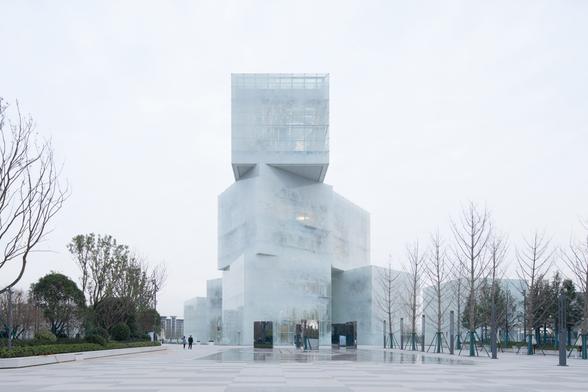
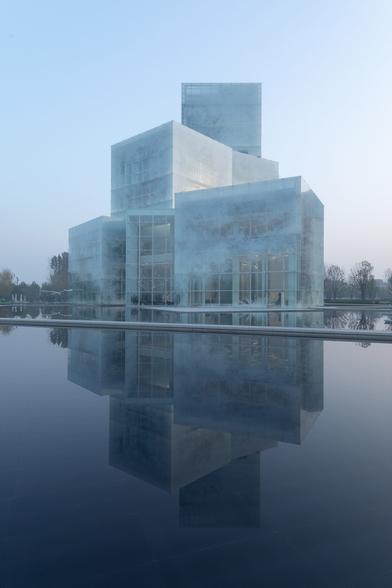
A stack of nine frosted glass "ice cubes" atop a pool of water houses this cultural centre in Xinxiang, China, designed by French practice Mathieu Forest Architecte.

The Xinxiang Cultural Tourism Centre was designed as a sculptural icon for a new winter sports tourism district in the city, which will in future include an indoor ski slope.

Mathieu Forest Architecte has created a stacked cultural centre in China

Inside the centre's nine cubes are a restaurant, cafe, shops, reading and children's spaces, with the stacked form used to create a series of open-air terraces that overlook the surrounding plaza and water pools.

"The ambition of the project is to create a strong urban indicator that unites the whole district," said Mathieu Forest Architecte.

It is designed to resemble a stack of ice cubes

"[It] does not look like a classic building – it is not possible to figure out the number of floors, it is a sculpture out of scale, a pure and monumental volume," it continued.

The ice-like appearance was achieved through the use of printed glass panels, which are attached to the concrete structures with minimal metal fixings to avoid the need for any frames.

The building sits beside a pool of water

During the day, the appearance of the glass panels changes depending on the light conditions, revealing certain areas of the interior and concealing others.

At night, illumination from the interior creates a glowing effect, turning the centre into a "lighthouse" for the district.

The ice-like appearance is achieved with patterned glass panels

"The texture of the glass facades is composed of a multitude of tangled translucent ice crystals that filter the light and the vision from the interior," said the practice.

"It is a question of hiding, whilst showing, to provoke mystery and the desire to approach," it continued.

[

Read:

Triptyque's marble and glass showroom was designed to "look like an ice cube"

](https://www.dezeen.com/2014/12/04/triptyque-groenlandia-building-marble-glass-ice-cube-sao-paulo-brazil/)

Each cube is stacked at a different angle, creating a variety of compositions depending on the direction of approach. Some cubes cantilever above the plaza and others are positioned to create small gaps to walk between.

In the central cluster of cubes, a double-height ground floor creates a large, open foyer, leading through to a reading room that opens onto a paved water terrace.

The panels are attached with minimal metal fixings

While this foyer merges the cubes into a single space at the ground floor level, their upper levels intersect and project out into it, creating balcony spaces supported by large white columns.

Two cubes sit away from the central area, connected via paved paths that cross the water pool and containing a shop and restaurant.

The glass facades glow at nighttime

The Beijing 2022 Winter Olympics has led to a booming interest in winter sports in China. See the buildings that were used to host the games in Dezeen's guide to the Winter Olympics' architecture.

The photography is byArchExist.

Project credits:

Architects: Zone of Utopia+Mathieu Forest Architecte
Client: Henan Rongshou Xinchuang Culture and Tourism Real Estate Co. Ltd.
Designers: Qiang Zou, Mathieu Forest
Design team: Zeng Teng, Wu Di, Wang Zhuang, Arnaud Mazza, Ma Jia, Xue Qixun
Local Design Architect: Henan Urban Planning Institute & Corporation
Structure: Arup Group Limited
Curtain wall: EDUTH
Landscape design: Hassell Shanghai
Landscape design construction: QIDI Shanghai
Lighting: PROL
Interior design: WU:Z DESIGN

The post Xinxiang Cultural Tourism Centre by Mathieu Forest Architecte resembles a stack of ice cubes appeared first on Dezeen.

#all #architecture #cultural #chinesearchitecture #china #glass #visitorcentres #culturalbuildings #irregularlystackedboxes #xinxiang

Ole Scheeren's Fifteen Fifteen skyscraper in Vancouver moves forward

Büro Ole Scheeren's residential Fifteen Fifteen skyscraper in Vancouver, which will have a distinctive form with numerous stacked boxy volumes, has taken a step closer to reality as apartment pre-sales begin.

Sales will open in November 2021 for apartments in the proposed 42-storey Fifteen Fifteen residential tower at 1515 Alberni Street in the Coal Harbour neighbourhood.

The Fifteen Fifteen tower is planned for Vancouver's Coal Harbour neighbourhood

Developers Bosa Properties and Kingswood Properties first unveiled the design in 2015, planned for the same site but with the address 1500 West Georgia Street.

It was approved by the city council in 2018 and is set to start construction in 2022.

The project is not to be confused with a pair of similar towers designed by Büro Ole Scheeren for the city's West End, revealed in 2018 by the same developer but still in application review stage.

Büro Ole Scheeren will also design the interiors to complement the architecture

Fifteen Fifteen will include 202 condominiums, ranging from studios to three-bedroom homes. Among these are 18 Observatory Residences located in the horizontally protruding portions of the building and four penthouse apartments.

The cantilevered sections of the Observatory Residences will be wrapped in floor-to-ceiling glass, intended to offer residents the sensation of floating above the city and landscape.

The building will include 18 Observatory Residences located in its cantilevered sections

"My vision for Fifteen Fifteen was to forge an immersive three-dimensional connection between nature, urban living and personal space," said studio founder Ole Scheeren.

"The building actively positions the individual within its distinct community and embraces Vancouver’s breathtaking landscape."

[

Read:

10 pixelated and Jenga-style buildings that tick all the boxes

](https://www.dezeen.com/2018/08/06/10-examples-pixelated-architecture-jenga-style-buildings-towers/)

The architect and his team will also design the interiors for the condos, complementing the architecture and engineering.

Among the selection of amenities will be a lounge spanning the 29th and 30th floors, with 270-degree views over Vancouver.

Glass will wrap the protruding volumes to offer uninterrupted views

Several buildings with stacked box-like elements have been proposed or completed over the past few years.

Perhaps the best known is Herzog & de Meuron's 56 Leonard skyscraper in Manhattan, with others including The Interlace housing development in Singapore and the proposed overhaul of a Frankfurt office tower, both also by Büro Ole Scheeren.

The building resembles an ongoing game of Jenga

The international firm's similarly playful skyscraper designs include the pixelated MahaNakhon tower in Bangkok and a pair of honeycomb-patterned buildings in Singapore – both of which completed in 2018.

The post Ole Scheeren's Fifteen Fifteen skyscraper in Vancouver moves forward appeared first on Dezeen.

#skyscrapers #all #architecture #news #residential #canada #vancouver #olescheeren #irregularlystackedboxes

Ole Scheeren's Fifteen Fifteen skyscraper in Vancouver moves forward

Büro Ole Scheeren's residential skyscraper with stacked protruding volumes in Vancouver is moving into sales phase.

Stacked exhibition spaces to form Rotterdam port visitor centre by MVRDV

Five irregularly stacked boxes wrapped by red staircases will form the Harbour Experience Centre, which MVRDV has designed for the Port of Rotterdam in the Netherlands.

The Harbour Experience Centre will open in 2024 at the port's westernmost point for use as an exhibition space and visitor centre for the site.

MVRDV has revealed its design for the Harbour Experience Centre

Its twisted, stacked form has been designed by MVRDV to stand out from its low-lying surroundings while offering visitors panoramic views of the coast and port.

It also nods to the "dramatic presence" and industrial heritage of the Port of Rotterdam and will be crafted with pared-back, low-cost and recycled materials.

It will be built on the west side of the Port of Rotterdam

"We think of the Harbour Experience Centre as a machine to reveal the incredible world of the port", said MVRDV founding partner Winy Maas.

"It's low-cost, it's stripped back, you can see some of the building's structure when you're inside. But it, therefore, does its job almost ruthlessly – just like the machinery of the port itself."

It takes the form of five staggered boxes

"Every part of the design is geared towards engaging people and then educating them about their surroundings," Maas added.

"In that way, it not only teaches people about the Port of Rotterdam but envelops them in the spirit of the port itself."

Red staircases will wrap around each floor

Harbour Experience Centre has been designed by MVRDV as the successor to FutureLand – a temporary information centre dedicated to the port that opened in the port in 2009.

The success of the centre prompted calls for a larger permanent centre on a more prominent site within the port.

It will be powered partly by a windmill on site

The twisted stacked form of the 3,500-square-metre building was informed by the activities that will take place both inside and out of the centre.

Each floor is square in plan and rotated to frame a specific view through a large window at one end. The cantilevered corners will be used as roof terraces.

A large atrium will run through the centre

All five floors will be connected by a large central atrium, which will double as a large exhibition space containing a suspended sculpture and model of the Port of Rotterdam.

This space will also become the entrance to the building, accessed through a rotating door that is designed to conceal the exhibits and scale of the atrium until entering.

Each floor will have a large panoramic window

A permanent exhibition for the centre is being created by Amsterdam design agency Kossmanndejong to occupy the three middle levels of the building.

Each level of the exhibition will explore a different theme and their large windows will each frame specific parts of the port that will "enhance the content".

Glimpses inside the exhibition spaces will be provided externally from the staircases that wrap around the building.

These stairs, which provide a route up to the rooftop terraces, will be free for the public to access in an effort to encourage people to go inside.

Solar panels will also help power the building

The structure for Harbour Experience Centre will be made from steel recovered from demolished structures, while the facade will be partly composed of recycled materials. Internal acoustic ceilings will be crafted from recycled paper pulp.

According to MVRDV, the design will also be fully demountable at the end of its useful life so that all elements can easily be reused.

The Harbour Experience Center is planned to be carbon-neutral in operation through a combination of efficient insulation and renewable energy sources including 266 solar panels and a windmill.

Roof terraces will be publicly accessible

MVRDV is an architecture studio founded in Rotterdam in 1991 by Maas with Jacob van Rijs and Nathalie de Vries. Other recent projects by the studio include the world's "first publicly accessible art depot" in Rotterdam and a proposal for an artificial hill alongside London's Marble Arch.

BIG also recently used a series of stacked boxes to create a white-brick and glass school in the USA, while OMA used three staggered triangular volumes to create RAI Hotel in Amsterdam.

The visuals are courtesy of MVRDV and Kossmanndejong.

Project credits:

Architect: MVRDV
Founding partner in charge: Winy Maas
Partner: Fokke Moerel
Design team: Arjen Ketting, Klaas Hofman, Pim Bangert, Jonathan Schuster, Samuel Delgado, Duong Hong Vu, Monica di Salvo, Efthymia Papadima, Luis Druschke and Maximilian Semmelrock
Strategy and development: Magdalena Dzambo
Exhibition designer: Kossmanndejong
Structural engineer: Van Rossum
MEP, building physics and environmental advisor: Nelissen
Cost calculation: Laysan

The post Stacked exhibition spaces to form Rotterdam port visitor centre by MVRDV appeared first on Dezeen.

#all #architecture #publicandleisure #news #mvrdv #netherlands #rotterdam #irregularlystackedboxes

Stacked exhibition spaces to form Rotterdam visitor centre by MVRDV

Five irregularly stacked boxes wrapped by red staircases will form the Harbour Experience Centre, which MVRDV has designed for the Port of Rotterdam in the Netherlands.