Later, I'll be giving a talk at #IANLS25 on some quantitative analyses of Latin book prodcution in Germany (and Italy in part) from 1500 through 1800. Slides, code and data can be found here: https://doi.org/10.5281/zenodo.15878272

I'm looking forward to the questions and the discussion!

#Neolatin @neolatin #VD16 #VD17 #VD18 #EDIT16

A Bird's-Eye View of Neo-Latin Literature. A Quantitative Look at Bibliographical Data

Slides, Code and Data regarding the paper read at the 19th IANLS Conference in Aix-en-Provence. Overview of contents: `WINKLER_presentation_20250715.pdf`: presentation slides in pdf format `WINKLER_presentation_20250715.odp`: presentation in a editable odp format `01_datasetCreation.ipynb`: Jupyter-Notebook that collects data from vd17, vd18 and EDIT16 and parsed them into database. `02_analysis.ipynb`: Jupyter-Notebook that produces figures used in the presentation `vd_ianls2025.db`: database containing information from VD16, VD17, VD18 `edit16_ianls2025.db`: dabase containing information from EDIT16 `editHelpers.py`: functions to work with EDIT16 datasets (needed in `01_dataset_creation.ipynb`) `vdHelpers.py`: functions to work with VD records (needed in `01_dataset_creation.ipynb`) `bibliography.rtf`: list of works referenced in the presentation

Zenodo
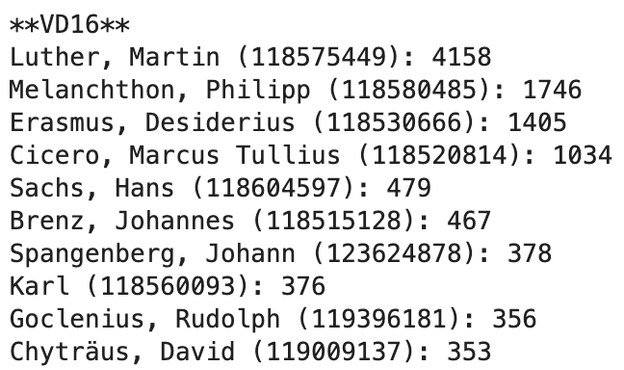
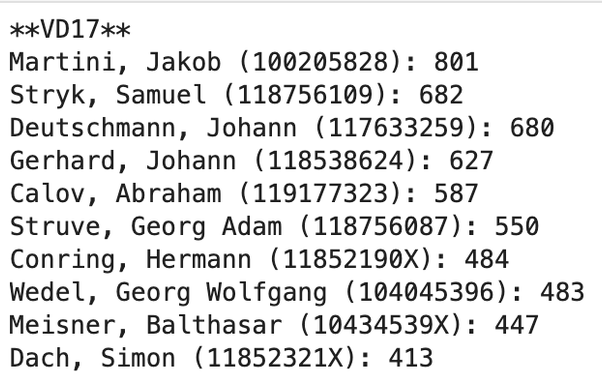
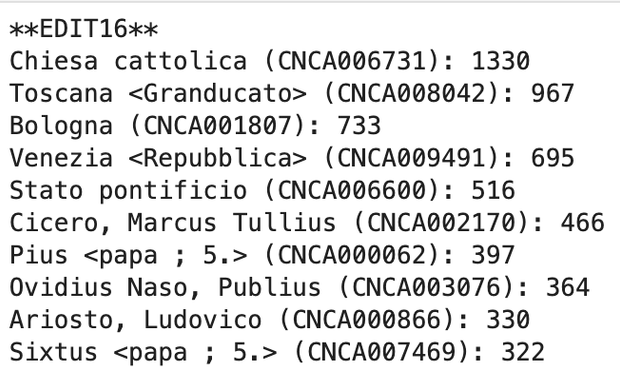
Top 10 authors in #EDIT16, #VD16 and #VD17 respecitvely. Some of them I hadn't even heard of ... 😳

Dieser Aufsatz zu #vd16 #vd17 #vd18 war mir glatt entgangen: Lauer et al. (2024). Zukunft der VD – Vision einer forschungsadäquaten Nationalbibliographie der frühen Neuzeit. Bibliotheksdienst, 58(9–10), 507–525. https://doi.org/10.1515/bd-2024-0076

Komisch, dass das größte Hindernis bei der Nutzung der VDs für distant reading nicht erwähnt wird: Man kommt nur beim vd17 gut an die Daten ran. Vd18 ist anspruchsvoll, vd16 nur mit Amtshilfe. Gäbe es die Daten, wär der gewünschte Index kein Problem.

Zukunft der VD – Vision einer forschungsadäquaten Nationalbibliographie der frühen Neuzeit

Zusammenfassung VD 16, VD 17 und VD 18 erfassen als retrospektive Nationalbibliographie die Drucke des deutschen Sprachraums von 1500 bis 1800 und sind wichtige Werkzeuge für die Erforschung der europäischen Kulturgeschichte. Mit über 730.000 katalogisierten und rund 587.000 digitalisierten Titeln bieten sie großes Potenzial für Distant-Reading-Ansätze. Der Beitrag beschreibt die Herausforderungen und Perspektiven der Weiterentwicklung der drei VD mit ihren gewachsenen Datenbeständen. Die Zukunft der VD liegt im Aufbau eines zentralen Index und der Verbesserung der Daten und Beteiligungsstrukturen für eine forschungsfreundliche Nationalbibliographie der frühen Neuzeit.

De Gruyter