 Zsolt Zsemba
Unmet Expectations Are Not the Problem. The Silence Around Them Is.
The Root of Most Relationship Suffering
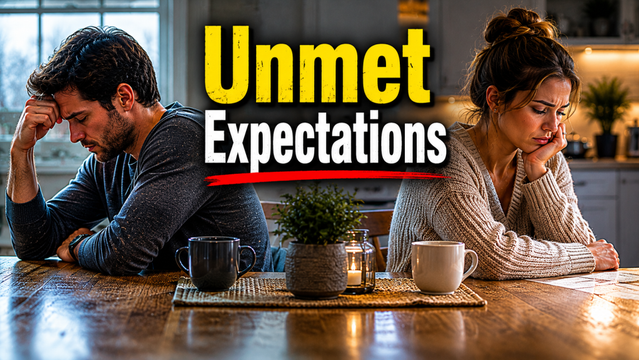
You expected something to go a certain way. It did not go that way. Or they expected something from you, and you did not meet it. That gap, between what was expected and what actually happened, is where most relationship suffering lives. Not the dramatic betrayals. Not the explosive arguments. The quiet, accumulating weight of things that were wanted and not received, things that were needed and not given, things that were assumed and never confirmed.
Unmet expectations are the slow leak in a relationship. They do not announce themselves. They just drain the energy quietly until one day someone looks around and wonders why everything feels empty, and neither person can point to the exact moment it started.
Big Love and Little Love Are Not the Same Thing
There is a distinction worth understanding clearly because most people confuse the two and then wonder why the relationship collapsed, even though they still care about each other.
Big love, the unconditional kind, says I want what is best for you, even if I get nothing in return. It is the love a parent has for a child. The love you carry for someone long after a relationship ends. The love that does not require participation or reciprocity to exist. It is real, and it is genuine, and it has nothing to do with whether a romantic relationship can function.
Romantic love operates differently. Romantic love says I want mutual care, mutual participation, and mutual value exchange. It requires something back. Not because that is selfish. Because that is what romantic love actually is. It is a relationship between two people, not a donation from one person to another. When the mutuality breaks down, when one side stops participating or stops caring or stops showing up in the ways the other person needs, romantic love does not die instantly. But something inside it starts to switch off. Quietly. One unmet expectation at a time.
Romantic Desire Can Deactivate Without Hatred
This is the part that confuses people most and causes the most pain when it happens. Someone can still love you as a human being and simultaneously feel their romantic desire for you deactivate. These two things are not contradictory. They are just operating on different levels.
If you cheat on someone, they may completely lose the desire to participate romantically with you. Not because they hate you. Not because they will never heal. But because trust was broken and emotional safety was damaged, and the perception of who you are to them shifted in a way that the romantic part of their brain cannot simply override by deciding to forgive. Forgiveness is possible. The restoration of romantic desire is a separate process that forgiveness alone does not guarantee.
The same thing happens in smaller ways over time. Someone who says horrible things during conflict, who humiliates their partner, who uses their intimate knowledge of that person as a weapon when they are angry, may be forgiven. Their partner may understand they were triggered, emotional, and not fully themselves in that moment. But something shifts. The place inside that partner that made them feel safe and open and romantically available gets smaller. It does not disappear overnight. It contracts. And every subsequent incident contracts it further until the romantic participation simply is not there anymore, even though the love as a human feeling still exists.
Conditional Is Not a Dirty Word
Romantic relationships are conditional. That is not a failure of love. That is the nature of romantic love. It requires conditions to function. Safety. Respect. Reciprocity. Trust. When those conditions are consistently unmet, the relationship cannot sustain itself, regardless of how much both people want it to.
The problem is that most people treat conditionality as something to be ashamed of. As if needing something back from a romantic partner makes you demanding or insufficient in your love. It does not. It makes you a person in a relationship rather than a person making an endless sacrifice for one. Knowing what you need and being honest about those needs is not the same as being difficult. It is the basic requirement for a relationship that actually works for both people.
The Expectations You Never Said Out Loud
Most unmet expectations were never stated. They were assumed. Felt as obvious. Held internally with the certainty that any reasonable person in a relationship would naturally understand them without being told. And then we didn’t meet. And then felt as a betrayal or a signal of not caring, even though the other person had no clear idea what was expected of them.
You expected them to check in when you were going through something hard. They did not know you needed that. You expected them to prioritize the relationship during a stressful period. They were managing their own stress and did not read yours. You expected that certain behaviour would stop after one conversation. They did not understand the weight that behaviour carried for you. None of these are failures of love necessarily. They are failures of communication. And the suffering they produce is real, regardless of the cause.
What Deactivation Actually Feels Like
When romantic participation starts to deactivate, it does not feel like a decision. It feels like a gradual absence. The warmth that was automatic starts to require effort. The desire to reach for the other person physically or emotionally becomes something you have to generate rather than something that just exists. The generosity that came easily starts to feel like a choice you are making consciously rather than an expression of how you feel.
Most people in this state do not know how to name what is happening. They know something is wrong. They know the connection feels different. They may still love their partner deeply as a person. But the romantic engine is running on fumes, and neither person has identified why or what to do about it before it stalls completely.
The Only Way Back Is Through the Conversation
Unmet expectations do not resolve themselves. Romantic deactivation does not reverse on its own. The path back requires both people to be honest about what happened, what was expected, what was not received, and what needs to change for the romantic participation to restore itself. That conversation is uncomfortable because it requires vulnerability from both sides. It requires admitting what you need rather than waiting for the other person to intuit it. It requires hearing what you failed to provide without collapsing into defensiveness.
It is also the only conversation that actually moves anything. Everything else, the arguments, the silence, the hope that things will just get better on their own, is just a delay. The expectation you never said out loud is still sitting there. Say it. Before the romantic participation that was built over the years finishes deactivating over a need that was never clearly communicated in the first place.
#bigLoveVsRomanticLove #relationshipCommunication #relationshipExpectations #relationshipSuffering #romanticDeactivation #romanticLoveConditional #unmetExpectationsRelationships #ZsoltZsemba