 Fabio Giglietto
#toread #paper Durably reducing conspiracy beliefs through dialogues with AI by Thomas H Costello, Gordon Pennycook, David Gertler Rand https://doi.org/10.31234/osf.io/xcwdn
#toread #paper Italians’ attitudes towards AI: how technology issues travel across social conversation by Eliana Fattorini et al. https://doi.org/10.1080/1369118x.2026.2689030
 Supergeante
Au-delà du techno-féodalisme : pour une critique de l’impérialisme numérique
Comment penser les transformations du capitalisme sous l’effet de la montée en puissance des technologies numériques ? Nikos Smyrnaios revient ici sur le débat autour du techno-féodalisme pour avancer une autre hypothèse, qu’il nomme « impérialisme numérique ». Il en dégage ici les principales dimensions et souligne l’importance de la plateformisation de l’espace public, pour comprendre les logiques actuelles de domination mais aussi de résistance.
https://www.contretemps.eu/au-dela-du-techno-feodalisme-pour-une-critique-de-limperialisme-numerique/ #toread
Comment penser les transformations du capitalisme sous l’effet de la montée en puissance des technologies numériques ? Nikos Smyrnaios revient ici sur le débat autour du techno-féodalisme pour avancer une autre hypothèse, qu’il nomme « impérialisme numérique ». Il en dégage ici les principales dimensions et souligne l’importance de la plateformisation de l’espace public, pour comprendre les logiques actuelles de domination mais aussi de résistance.
https://www.contretemps.eu/au-dela-du-techno-feodalisme-pour-une-critique-de-limperialisme-numerique/ #toread

Au-delà du techno-féodalisme : pour une critique de l’impérialisme numérique - Contretemps
Comment penser les transformations du capitalisme sous l’effet de la montée en puissance des technologies numériques ? Nikos Smyrnaios revient ici sur le débat autour du techno-féodalisme pour avancer une autre hypothèse, qu’il nomme « impérialisme numérique ». Il en dégage ici les principales dimensions et souligne l’importance de la plateformisation de l’espace public, pour comprendre les logiques actuelles de domination mais aussi de résistance.
#toread #paper Who’s driving the AI hype in its formative phase? A longitudinal analysis of stakeholders in the US and German AI discourse on Twitter 2012–2021 by Vanessa Richter et al. https://doi.org/10.1007/s00146-026-03079-6
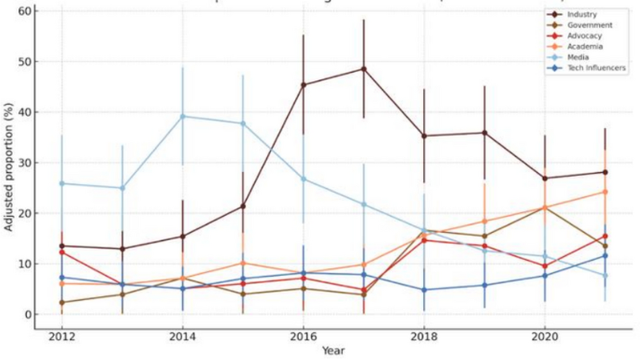
Who’s driving the AI hype in its formative phase? A longitudinal analysis of stakeholders in the US and German AI discourse on Twitter 2012–2021 - AI & SOCIETY
AI has become an ambiguous yet powerful term that routinely refers to different technological advances, with stakeholders competing for public attention to influence public perceptions and decision-makers. Whilst research has focussed on specific AI stakeholders and identified industry dominance in debates around AI, a detailed investigation of the role of different AI stakeholders within public discourses in the formative phase of AI development in the 2010s is missing. This paper proposes a multi-dimension typology for analysing AI stakeholders across different types and different levels. This AI stakeholder typology is exemplified by comparing stakeholders longitudinally in the AI Twitter discourse across the US and Germany from 2012 until 2021. This early period of budding AI hype delineated country-specific trajectories and specific political and economic framings that continue to influence the current discourse and regulation of GenAI within these two countries. The results highlight the institutionalisation of stakeholders in the German discourse, whilst the US dataset reveals strong shifts in stakeholder types and levels. Overall, the analysis offers insights into different cycles of institutionalisation in the early AI discourse on Twitter. It also highlights clear shifts in stakeholder involvement at different stages of public AI discourse in its formative phase in different socio-cultural and geographical contexts.
#toread #paper What is informative to young adults? Decoding informativeness perceptions among audiences of audio-visual digital platforms by Lion Wedel https://doi.org/10.1080/21670811.2026.2685660
#toread #paper AI coding agents can reproduce social science findings by Meysam Alizadeh et al. http://arxiv.org/abs/2606.11447v1

AI Coding Agents Can Reproduce Social Science Findings
Recent anecdotal evidence suggests that AI coding agents can reproduce published findings when provided with original data and code; yet systematic evaluation across social sciences remains limited. Existing evaluation benchmarks are insufficient, either small or conflate agent performance with problems in the reproduction materials themselves, such as code that fails to execute correctly. Here we introduce SocSci-Repro-Bench, a benchmark of 221 tasks spanning four disciplines and 13 substantive domains, constructed from studies whose results are either fully reproducible with available materials or demonstrably non-reproducible due to missing data, allowing us to isolate agents' reproduction capacity. Evaluating two frontier coding agents, Claude Code and Codex, we find that both can reproduce a large share of social science findings, with Claude Code substantially outperforming Codex. These reproduction rates considerably exceed those previously reported for general-purpose LLM-based agents on comparable reproducibility benchmarks. Both agents also perform strongly on a reasoning task requiring identification of underlying research questions, and additional analyses suggest that results are not primarily driven by memorization. Providing the original paper PDF alongside replication materials modestly improves performance but introduces bias on tasks where reproduction is impossible. We also show that agents can be nudged toward confirmatory specification search through subtle prompt framing. Together, these findings suggest that at least some frontier coding agents can serve as reliable executors of computational workflows while underscoring the need for careful benchmarking and prompt design as AI systems assume larger roles in scientific production.
#toread #paper Evaluating echo chambers, rabbit holes, and radicalization pathways on YouTube by Megan A. Brown et al. https://doi.org/10.1080/10584609.2026.2671765
 MaineC
@FOSSBackstage if there were a reading club for this book (remote with the option to meet in person in Berlin occasionally):
https://academic.oup.com/book/44727
"Open Source Law, Policy and Practice (2nd edn)
Amanda Brock (ed.)"
Focus: perspective of the EU/ German market
Would anyone here be interested in joining?
Disclaimer: I know and appreciate several of the authors, it's been on my #toread pile for a while)
Maybe ping @FOSSBackstage

Wenn es einen Leseclub für dieses Buch gäbe (remote, mit der Option auf persönlichen Austausch in Berlin):
https://academic.oup.com/book/44727
"Open Source Law, Policy and Practice (2nd edn)
Amanda Brock (ed.)"
Fokus: Betrachtung aus der Perspektive des dt Marktes.
Hätte daran irgendwer Interesse?
(Disclaimer: Ich kenne einige der Autoren, deshalb ist das Buch schon länger auf meinem #toread Stapel)
Vllt Ping @FOSSBackstage