 aeshnid
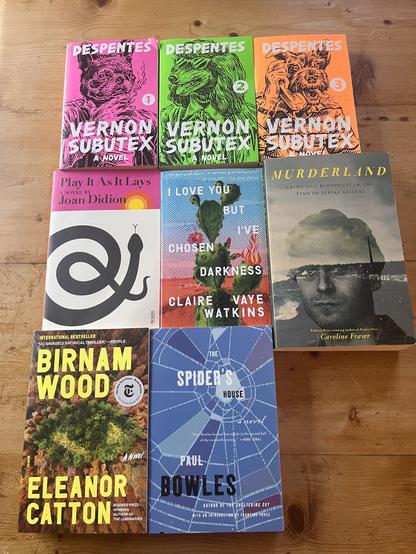
Summer reading. I left a place for the new #MJohnHarrison…
#Bookstodon #SummerReading #TheEndOfEverything
#Bookstodon #SummerReading #TheEndOfEverything
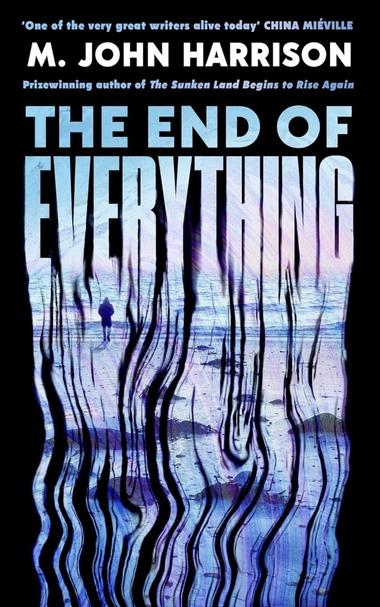
To say I’m excited about the impending publication of the new novel, The End of Everything, by M. John Harrison would be something of an understatement.
“Phillip Tennent makes his living at the tideline, collecting artefacts that wash up from the Channel. It's been years since the crisis changed everything, but its exact nature remains obscure. Government barely functions, the seas are full of new creatures, Europe has been mislaid. It feels like the end.
Now Phillip has fished out of the water an object he can't keep. A creature that keeps changing. An artefact he must take inland, before it destroys everything he thinks he knows.”
I love that cover design, the sickly way the “Everything” in the title collapses towards the bottom of the page, a metaphor for decay, runoff, entropy or perhaps something much worse.
As another (connected) Mike once asked “What is the exact nature of the catastrophe?”
#MJohnHarrison #TheEndOfEverything #SpeculativeFiction #Books #Bookstodon @bookstodon

RE: https://mastodonsweden.se/@fof/115888026766156886
Den här boken är otroligt underhållande. Slutet är iofs givet från början, det får man ta.
Golly, one whole year to wait! Thank you for the teaser.
("Petrol coloured water" is such an evocative image.)
"but you already feel, somewhere in the back of your head, the whole contraption tipping & lurching toward a real structured thing. I love that feeling."
Creator's reward. Very precisely expressed.
#MJohnHarrison #writing #structurefinallyemerging #creativity #TheEndOfEveryThing
Had a great time discussing dark matter, dark energy and anti-matter at #BloomDK with @Hotblack43 + Carol Anne Oxborrow, inspired by Jeffery Hangst's talk..
Did you know the #ASIM instrument on the #ISS literally measures the annihilation of positrons in the upper atmosphere via the gamma rays emitted? Utterly fascinating.
https://link.springer.com/article/10.1007/s11214-019-0592-z
So anyway, my next book is from the festival haul. #TheEndOfEverything by @AstroKatie

The Atmosphere-Space Interactions Monitor (ASIM) is an instrument suite on the International Space Station (ISS) for measurements of lightning, Transient Luminous Events (TLEs) and Terrestrial Gamma-ray Flashes (TGFs). Developed in the framework of the European Space Agency (ESA), it was launched April 2, 2018 on the SpaceX CRS-14 flight to the ISS. ASIM was mounted on an external platform of ESA’s Columbus module eleven days later and is planned to take measurements during minimum 3 years. The instruments are an x- and gamma-ray monitor measuring photons from 15 keV to 20 MeV, and an array of three photometers and two cameras measuring in bands at: 180–250 nm, 337 nm and 777.4 nm. Additional objectives that can be addressed with the instruments relate to space physics like aurorae and meteors, and to Earth observation such as dust- and aerosol effects on cloud electrification. The paper describes the scientific objectives of the ASIM mission, the instruments, the mission architecture and the international collaboration supported by the ASIM Science Data Centre. ASIM is the first space mission with a comprehensive suite of instruments designed to measure TLEs and TGFs. Two companion papers describe the instruments in more detail (Østgaard et al. in Space Sci. Rev., 2019; Chanrion et al. in Space Sci. Rev., 2019).
 Brian Lavelle
 Draws_Shoots_And_Leaves
 Johan Malmström
 the roamer
 Petar Toushkov
 Ruth Mottram
 Degrowth or Extinction