Could a powerful geomagnetic storm be the reason 8,000 Victorian homes suddenly lost power in January this year?

I had a chat with Dr Richard Marshall from Australian Bureau of Meteorology Space Weather about the origin of solar storms and the risks they present to our communities and critical infrastructure.

So great to be able to have such fantastic and professional insights about these important events and how we, as a society, need to mitigate against them.

https://www.spaceaustralia.com/feature/earthly-impacts-solar-storms

📸 NASA SVS

#SpaceAustralia #SolarStorm #geomagneticstorm #Astrodon #heliophysics

Excited to share my first #SpaceAustralia feature article for 2026 about an exciting and ambitious project that is unfolding 1km below the surface in regional Victoria.

Last year, I had the incredible opportunity to visit the Stawell Underground Physics Laboratory (SUPL) with Dr Katie Mack and explore the ambitious efforts of the SABRE South experiment. Shielded from cosmic rays by a kilometre of rock, this lab offers the ideal conditions to search for the faint whispers of dark matter, which still accounts for 25% of all matter in the Universe—and yet remains completely undetected.

Check out the article (and yes, check out our funky boots in the clean room!) and keep a lookout for exciting news of the detectors switching on later in 2026.

https://www.spaceaustralia.com/feature/australias-dark-matter-quest

📸 F. Morrison / SUPL

#DarkMatter #ParticlePhysics #Astronomy #Astrodon #CosmicRays

Excited to now share this story; papers have been accepted!

Apep is an awesome system, unlike any other we know about. It is named after the Egyptian God of Chaos - because, well, it is chaos!

Two Wolf-Rayet systems orbited by a third supergiant. As all their winds collide, they form these beautiful structures that have now been observed with #JWST and ESO's VLT.

I had a chat with fellow student from Macquarie Uni. Ryan White who has led one of the two papers that are released about this.

My latest for #SpaceAustralia

https://www.spaceaustralia.com/news/order-amongst-chaos-apep

📸 NASA, ESA, CSA, STScI; Simulation: Yinuo Han (Caltech), Ryan White (Macquarie University); Visualization: Christian Nieves (STScI); Image Processing: Alyssa Pagan (STScI)

#Astronomy #Astrophysics #Astrodon #Apep #Science #WolfRayet

Well, here's some very exciting news!

I've been wanting to share this for a few months, but had to await the pre-print to drop.

A NEW GLITCH EVENT ON A MILLISECOND PULSAR HAS BEEN OBSERVED!

These events are extremely rare - only two others since MSPs were discovered.

Glitches are more commonly observed in the younger, canonical pulsar population as MSPs are much older and should have sorted out these types of disruptive events over their evolution.

That's what makes them so stable!

OR ... maybe they're not as stable as we once thought ...

This new paper predicts that we should see a glitch per MSP once every 400 years or so.

Glitches, profile changes .... as our instruments become more sensitive and datasets expand in time, we're starting to see that MSPs might not be as stable as we once thought ...

That's really important!

https://www.spaceaustralia.com/news/new-glitch-millisecond-pulsar

📸 NASA SVS

#SpaceAustralia #RadioAstronomy #Astrodon #Astrophysics #Science #Pulsars

I am so very excited to share this story. Def. a career highlight!

Having the opportunity to sit down and have a one-on-one candid chat with the woman who discovered pulsars and changed the course of astrophysics, leading to me being extremely passionate about this topic and eventually moving into a career of pulsar astronomy. Yeah, this was big.

I hope you enjoy this interview, where Prof. Bell Burnell offers some personal insight into the history of the big discovery as well as the legacy of one of astronomy’s most iconic and influential figures.

What an honour it is to tell this story!

https://www.spaceaustralia.com/feature/interview-dame-professor-jocelyn-bell-burnell

📸 University of Cambridge

#SpaceAustralia #RadioAstronomy #Pulsars #JocelynBellBurnell #Astrophysics #Science #Astrodon

Today was a good day. I got to meet one of my heroes.

Got to spend one-on-one time with the woman who discovered pulsars, Dame Prof. Jocelyn Bell Burnell, and interview her for a #SpaceAustralia article 🥺🥺🥺

And she signed a copy of my first-ever PhD paper which I will now have framed and remember forever! 😭😭😭

She is the most humble, nicest person. Just kindness, personified. And such an extremely interesting life - as you can imagine.

I'll publish my article and interview with her in about 12 hours from now (around 8:30am Sydney time) - so keep an eye out for it.

Thanks to Manisha Caleb who took this photo of us.

#Pulsars #RadioAstronomy #JocelynBellBurnell #Astrodon #Science #Astrophysics

*** EXCITING NEWS ****

Dame Prof. Jocelyn Bell Burnell is coming to Sydney!

A few of us early-career scientists will be sharing our science and the stage with her.

BUT BUT BUT ... I've been granted a one-on-one interview with her for a #SpaceAustralia article!

What an honour!

I get to spend time / have a chat with the woman who discovered pulsars (the objects that I research) - and then be able to share that story with everyone.

It's a huge thing for me!

To be able to write the story, from first-hand account, of that of a Titan in my field of research / astronomy!

JBB will be in Sydney from next week and is also giving a public lecture at the University of Sydney.

Sadly, it looks like the event has already sold out for those who couldn't grab tickets, but keep an eye out for my SpaceAustralia article - will be released on 21st October!

#Pulsars #Science #RadioAstronomy #Astrophysics #JocelynBellBurnell #Astrodon

A personal milestone ✅

I’m incredibly proud to share that my first-ever, first-author paper has been accepted for publication in the Publications of the Astronomical Society of Australia (PASA)!

Last week I got to share this work with the pulsar community at the Sardinia Pulsar Conference too.

This project has been at the very heart of my PhD journey so far - a deep, four-year analysis into an unusual and still-mysterious profile change event in one of the most stable and widely used pulsars, PSR J1713+0747. It first appeared on my radar in early 2021 and, since then, it’s been a fascinating and humbling experience trying to unravel what really happened.

In pulsar timing, we rely on the long-term stability of millisecond pulsars to search for phenomena like nanohertz gravitational waves using pulsar timing arrays. But what happens when that stability falters?

This paper explores that very question - examining what changed on this millisecond pulsar, how the polarisation evolved, and what it might mean for the future of precision timing efforts as we prepare for a new generation of ultra-sensitive telescopes.

Seeing this work now out in the world - contributing to the scientific conversation is something I’ve dreamt of for a long time (the last notch to feel like I have fully moved into my science career!). I hope it helps our community better understand the complex and wild behaviour of these exotic stellar clocks.

Read my feature article on SpaceAustralia.com below - and if you have questions about the research, I’d love to chat!

https://www.spaceaustralia.com/feature/pulsar-threw-tantrum

📸 R. Mandow et al. 2025

#Pulsars #RadioAstronomy #Astrophysics #SpaceAustralia #Astrodon

👀👀👀👀

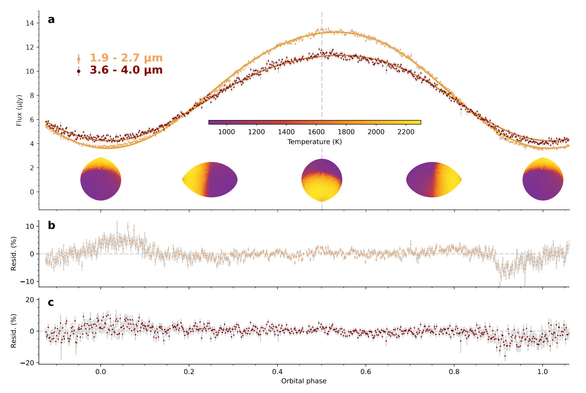
Super neat preprint! 📡

A rare, hot-Jupiter exoplanet orbits the pulsar PSR J2322-2650.

Astronomers used #JWST to observe it across the full orbit, and found its atmosphere rich in carbon AND it having a strong westward wind! 🤯

So glad that people are using JWST to look at the pulsar planets, esp. since the pulsar is not going to be visible at the JWST wavelengths.

These things are orbiting so close to the pulsar that they are being ablated (spider pulsar!), and one side of them is gonna glow more than the other side.

The first exoplanets discovered were pulsar planets!

They are, however, extremely rare because to form a pulsar you need a supernova, and so things get messy.

Here's an article I wrote about them a little while back on #SpaceAustralia

https://www.spaceaustralia.com/news/science-talk-what-are-pulsar-planets

#Pulsars #Astrophysics #Science #Astrodon #RadioAstronomy #JWST