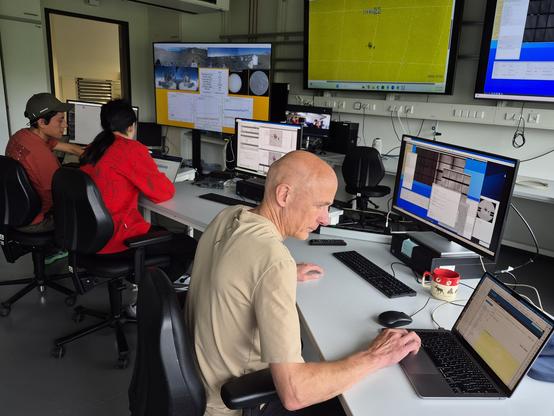
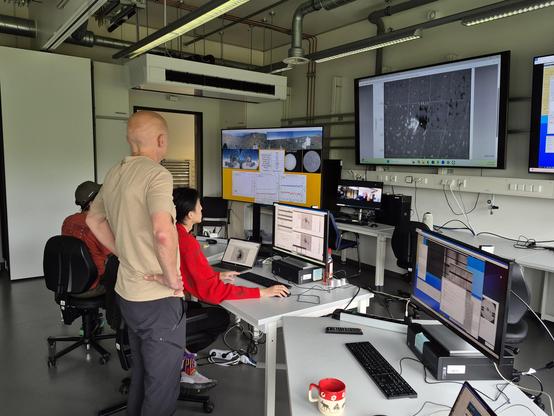
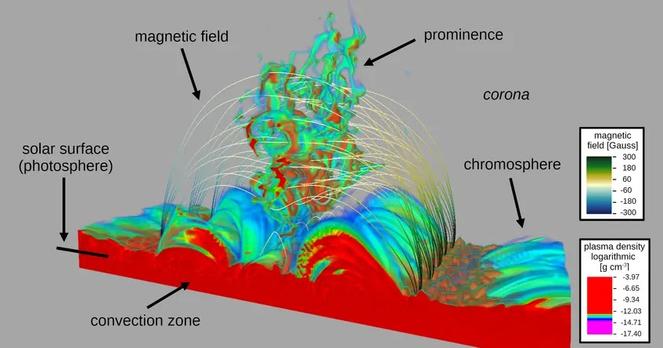
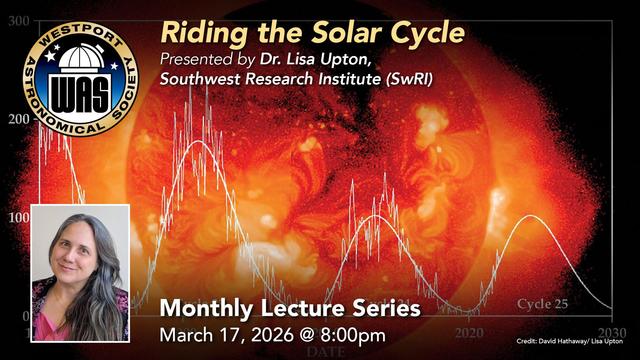
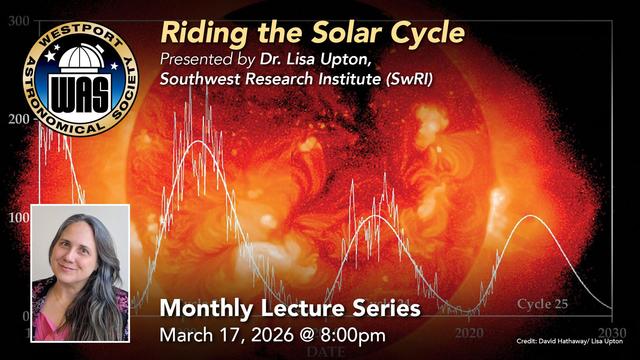
WAS welcomes back Dr. Lisa Upton to our science lecture series! How well did we predict Solar Cycle 25 — and what comes next? Join us tonight, March 17 at 8PM in our classroom, live on YouTube, or via Zoom webinar.
was-ct.org/events/solar-cycle-25-update/
#Astronomy #SolarPhysics #SpaceWeather #SolarCycle25 #Heliophysics #STEM #WomenInSTEM #WestportObservatory #WestportAstronomicalSociety

WAS welcomes back Dr. Lisa Upton (SwRI) for her 3rd lecture with us! How well did we predict Solar Cycle 25; and what comes next? Join us March 17 at 8PM in the Westport Observatory's classroom (we'd love to see you!) and if you can't join us there watch live on YouTube, or via a Zoom webinar.

was-ct.org/events/solar-cycle-25-update/

#Astronomy #SolarPhysics #SpaceWeather #SolarCycle25 #Heliophysics #STEM #WomenInSTEM #WestportObservatory #WestportAstronomicalSociety

📄 Solar Flares: Magnetohydrodynamic Processes

Quicklook:
Shibata, Kazunari et al. (2011) · Living Reviews in Solar Physics
Reads: 26 · Citations: 734
DOI: 10.12942/lrsp-2011-6

🔗 https://ui.adsabs.harvard.edu/abs/2011LRSP....8....6S/abstract

#Astronomy #Astrophysics #SolarPhysics #MagneticReconnection #ParticleAcceleration

Solar Flares: Magnetohydrodynamic Processes

This paper outlines the current understanding of solar flares, mainly focused on magnetohydrodynamic (MHD) processes responsible for producing a flare. Observations show that flares are one of the most explosive phenomena in the atmosphere of the Sun, releasing a huge amount of energy up to about 10<SUP>32</SUP> erg on the timescale of hours. Flares involve the heating of plasma, mass ejection, and particle acceleration that generates high-energy particles. The key physical processes for producing a flare are: the emergence of magnetic field from the solar interior to the solar atmosphere (flux emergence), local enhancement of electric current in the corona (formation of a current sheet), and rapid dissipation of electric current (magnetic reconnection) that causes shock heating, mass ejection, and particle acceleration. The evolution toward the onset of a flare is rather quasi-static when free energy is accumulated in the form of coronal electric current (field-aligned current, more precisely), while the dissipation of coronal current proceeds rapidly, producing various dynamic events that affect lower atmospheres such as the chromosphere and photosphere. Flares manifest such rapid dissipation of coronal current, and their theoretical modeling has been developed in accordance with observations, in which numerical simulations proved to be a strong tool reproducing the time-dependent, nonlinear evolution of a flare. We review the models proposed to explain the physical mechanism of flares, giving an comprehensive explanation of the key processes mentioned above. We start with basic properties of flares, then go into the details of energy build-up, release and transport in flares where magnetic reconnection works as the central engine to produce a flare.

ADS
An artificial intelligence-enabled, physics-informed forecasting model designed to predict the emergence of large, flare-producing active regions on the #Sun weeks in advance of their occurrence.
#Heliophysics #SolarPhysics #SpaceWeather #AI #MachineLearning #sflorg
https://www.sflorg.com/2026/02/hp02192601.html
New research takes first step toward advance warnings of space weather

Solar active regions do not emerge randomly. Instead, they cluster along large-scale, warped magnetic “toroidal bands.”

New in the #VirtualObservatory: “SSA Synoptic maps” by IDOC: Integrated Data and Operating Center
https://idoc-dachs.ias.u-psud.fr/tableinfo/synopticmaps.epn_core
#SolarPhysics
Table information for 'synopticmaps.epn_core'

📄 Euclid Quick Data Release (Q1) -- Data release overview

Quicklook:
Euclid Collaboration et al. (2025) · arXiv e-prints
Reads: 915 · Citations: 64
DOI: 10.48550/arXiv.2503.15302

🔗 https://ui.adsabs.harvard.edu/abs/2025arXiv250315302E/abstract

#Astronomy #Astrophysics #SolarPhysics #AstrophysicsAstrophysicsOfGalaxies

Euclid Quick Data Release (Q1) -- Data release overview

The first Euclid Quick Data Release, Q1, comprises 63.1 sq deg of the Euclid Deep Fields (EDFs) to nominal wide-survey depth. It encompasses visible and near-infrared space-based imaging and spectroscopic data, ground-based photometry in the u, g, r, i and z bands, as well as corresponding masks. Overall, Q1 contains about 30 million objects in three areas near the ecliptic poles around the EDF-North and EDF-South, as well as the EDF-Fornax field in the constellation of the same name. The purpose of this data release -- and its associated technical papers -- is twofold. First, it is meant to inform the community of the enormous potential of the Euclid survey data, to describe what is contained in these data, and to help prepare expectations for the forthcoming first major data release DR1. Second, it enables a wide range of initial scientific projects with wide-survey Euclid data, ranging from the early Universe to the Solar System. The Q1 data were processed with early versions of the processing pipelines, which already demonstrate good performance, with numerous improvements in implementation compared to pre-launch development. In this paper, we describe the sky areas released in Q1, the observations, a top-level view of the data processing of Euclid and associated external data, the Q1 photometric masks, and how to access the data. We also give an overview of initial scientific results obtained using the Q1 data set by Euclid Consortium scientists, and conclude with important caveats when using the data. As a complementary product, Q1 also contains observations of a star-forming area in Lynd's Dark Nebula 1641 in the Orion~A Cloud, observed for technical purposes during Euclid's performance-verification phase. This is a unique target, of a type not commonly found in Euclid's nominal sky survey.

ADS

Hungry for more footage after having seen the Sunrise III movie covering the 2022 campaign? We've got you covered with these 2024 materials:

Hang and Communications test 17 May 2024 https://www.youtube.com/watch?v=eQiVPpATd8E

Launch attempt 28 May 2024 https://www.youtube.com/watch?v=mXoVcNZKa94

Launch 10 July 2024 https://www.youtube.com/watch?v=ImKdr7xHAUA

and the absolutely stunning 5min time lapse in-flight video at https://www.mps.mpg.de/8591870/SunriseIII_IRIS2_FullFlight_withLogos_1080p.mp4

via https://www.mps.mpg.de/solar-physics/sunrise-gallery

@sunrise3

#SunriseIII #Sunrise_III #Sun #SolarPhysics #Kiruna #Goettingen #MPSGoettingen

NASA 2024 - SUNRISE - Hang and Communications test

YouTube
There are some events that can't be stopped whether people are looking up or not.
#sundaystunday #photography #photographie #stunday #astronomy #astro #eclipse #solarPhysics #moon

It's Gänseliesel day in Göttingen! Freshly minted PhD graduate Johannes Hölken attended the official ceremony at the Aula, has been picked up by us and ferried to the Gänseliesel fountain in the city center, and is about to bring the goose girl on the top of the fountain some flowers. Meanwhile, other carts around us are also interesting to look at!

#IMPRS #phd #Göttingen #germandoctoralhat #solarphysics #mpsgoettingen #unigoettingen

📄 Benchmarking CME Arrival Time and Impact: Progress on Metadata, Metri…

Quicklook:
Verbeke, C. et al. (2019) · Space Weather
Reads: 95 · Citations: 55
DOI: 10.1029/2018SW002046

🔗 https://ui.adsabs.harvard.edu/abs/2019SpWea..17....6V/abstract

#Astronomy #Astrophysics #SolarPhysics #CoronalMassEjectionsCmes #ModelValidation

Benchmarking CME Arrival Time and Impact: Progress on Metadata, Metrics, and Events

Accurate forecasting of the arrival time and subsequent geomagnetic impacts of coronal mass ejections (CMEs) at Earth is an important objective for space weather forecasting agencies. Recently, the CME Arrival and Impact working team has made significant progress toward defining community-agreed metrics and validation methods to assess the current state of CME modeling capabilities. This will allow the community to quantify our current capabilities and track progress in models over time. First, it is crucial that the community focuses on the collection of the necessary metadata for transparency and reproducibility of results. Concerning CME arrival and impact we have identified six different metadata types: 3-D CME measurement, model description, model input, CME (non)arrival observation, model output data, and metrics and validation methods. Second, the working team has also identified a validation time period, where all events within the following two periods will be considered: 1 January 2011 to 31 December 2012 and January 2015 to 31 December 2015. Those two periods amount to a total of about 100 hit events at Earth and a large amount of misses. Considering a time period will remove any bias in selecting events and the event set will represent a sample set that will not be biased by user selection. Lastly, we have defined the basic metrics and skill scores that the CME Arrival and Impact working team will focus on.

ADS