 Zapwai
https://www.twitch.tv/zapwai
Streaming some Problems and Theorems in Analysis by Pólya & Szegő
#Mathematics #polya #realanalysis
Streaming some Problems and Theorems in Analysis by Pólya & Szegő
#Mathematics #polya #realanalysis

Keeping busy with Sudoku, Wordle, Crosswords, and mining textbooks for statements to practice proving in #Metamath ...
Inspired by this video playlist on #RealAnalysis #Math
https://www.youtube.com/playlist?list=PLYPU-RArkLZNwMZ55-y8FZZEeY7zCJX59
Which was created from https://www.jirka.org/ra/ _Basic Analysis:
Introduction to Real Analysis_ by Jiří Lebl. #JiříLebl a #CreativeCommons (4.0) free #math #textbook
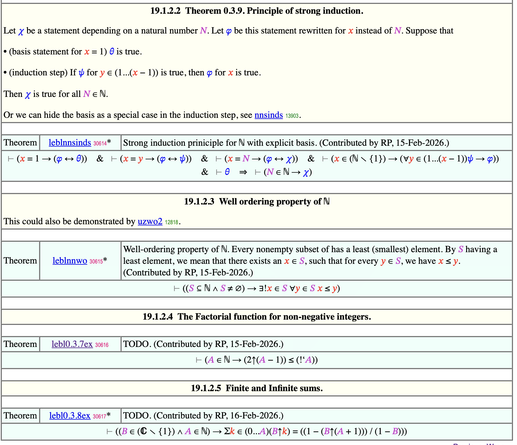
In Metamath's compressed format, my proofs of strong induction over the natural numbers took 316 bytes, well-ordering of the natural numbers: 376 bytes, 2ⁿ⁻¹ ≤ n! : 1204 bytes, formula for finite sum of geometric series: 2566 bytes. The last has 147 steps, some of which are reused and some of which depend on up to 8 prior steps and on a truncated library of 30477 statements of syntax, axioms, definitions, and theorems from the wider world of Metamath.
A FORGOTTEN EPISODE in French-occupied Naples in the years around 1800—just after the French Revolution—illustrates why it makes sense to see mathematics and politics as entangled. The protagonists of this story were gravely concerned about how mainstream mathematical methods were transforming their world—somewhat akin to our current-day concerns about how digital algorithms are transforming ours. But a key difference was their straightforward moral and political reading of those mathematical methods. By contrast, in our own era we seem to think that mathematics offers entirely neutral tools for ordering and reordering the world—we have, in other words, forgotten something that was obvious to them.
In this essay, I’ll use the case of revolutionary Naples to argue that the rise of a new and allegedly neutral mathematics—characterized by rigor and voluntary restriction—was a mathematical response to pressing political problems. Specifically, it was a response to the question of how to stabilize social order after the turbulence of the French Revolution. Mathematics, I argue, provided the logical infrastructure for the return to order. This episode, then, shows how and why mathematical concepts and methods are anything but timeless or neutral; they define what “reason” is, and what it is not, and thus the concrete possibilities of political action. The technical and political are two sides of the same coin—and changes in notions like mathematical rigor, provability, and necessity simultaneously constitute changes in our political imagination.
#Mathematics #Math #Analysis #MassimoMazzotti #LAReviewOfBooks #Epistemology #Revolution #RealAnalysis #HistoryOfMath #HistoryOfMathematics


 Ryan
Ryan Richard Penner
 Adam Coffman
 Adrian Riskin

 Robert Mooney