Quantum programming is an emerging discipline that challenges developers to think beyond classical bits and deterministic algorithms. Instead of manipulating binary 0s and 1s, quantum programmers work with qubits that can exist in multiple states at once and harness phenomena like superposition and entanglement to perform computations in fundamentally new ways. Quantum programming demands a shift in thinking: information is encoded in probability amplitudes, operations are reversible linear transformations, and results emerge from statistical patterns rather than single-run outputs. The reward is the ability to tackle certain computational problems that are intractable for classical computers, by exploiting the exponential state
In this paper, we investigate the fundamental laws of quantum programming. We extend a comprehensive set of Hoare et al.'s basic laws of classical programming to the quantum setting. These laws characterise the algebraic properties of quantum programs, such as the distributivity of sequential composition over (quantum) if-statements and the unfolding of nested (quantum) if-statements. At the same time, we clarify some subtle differences between certain laws of classical programming and their quantum counterparts. Additionally, we derive a fixpoint characterization of quantum while-loops and a loop-based realisation of tail recursion in quantum programming. Furthermore, we establish two normal form theorems: one for quantum circuits and one for finite quantum programs. The theory in which these laws are established is formalised in the Coq proof assistant, and all of these laws are mechanically verified. As an application case of our laws, we present a formal derivation of the principle of deferred measurements in dynamic quantum circuits. We expect that these laws can be utilized in correctness-preserving transformation, compilation, and automatic code optimization in quantum programming. In particular, because these laws are formally verified in Coq, they can be confidently applied in quantum program development.
We wish our guests a continued valuable exchange and for their further research many groundbreaking insights in the field of quantum computing.
#QuantumComputing
#QuantumCompilation
#QuantumProgramming
#QuantumTechnologies
#QuantumPhysics
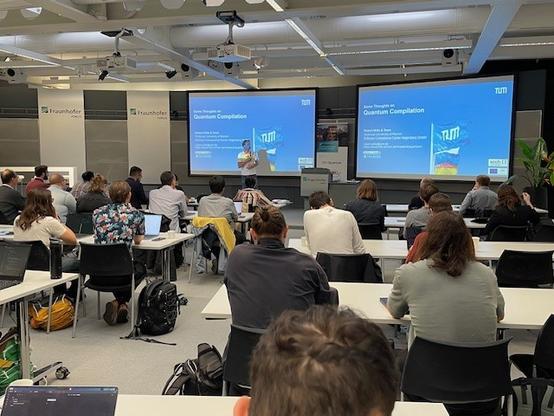
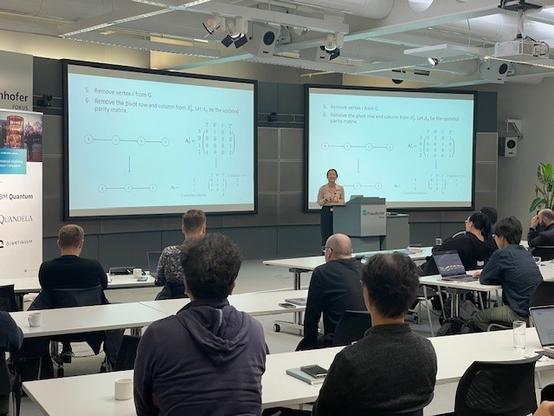
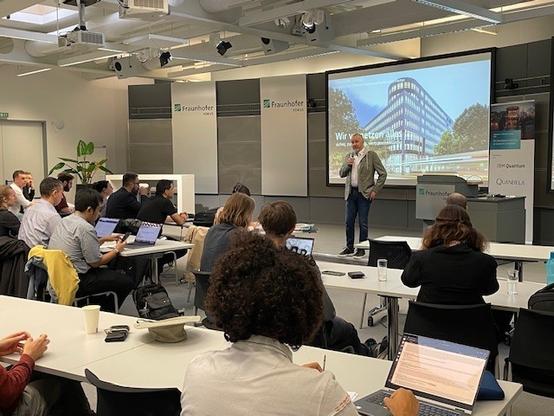
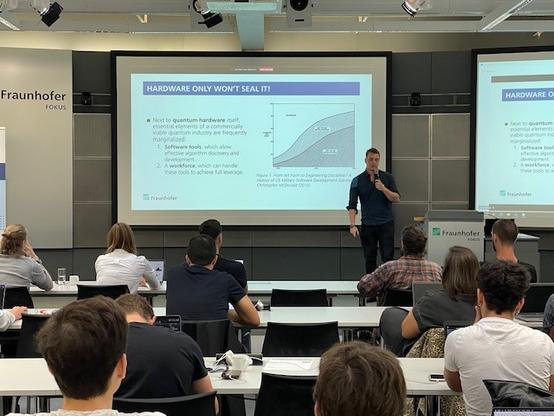
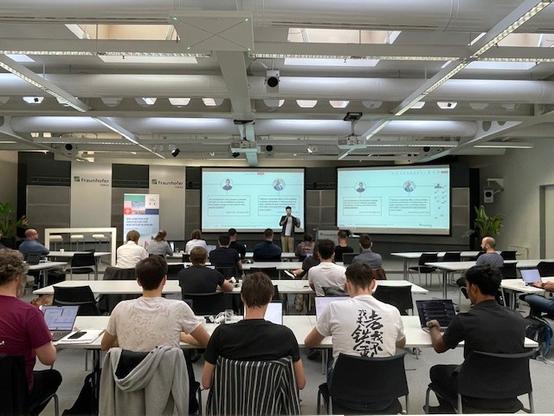
Today is the day: it's time for the “Thinq Qrisp Community Kick-off”. 🚀
The event is aimed at developers, researchers and experts from industry and science who want to actively participate in the further development and application of quantum computing technologies. We are happy and proud to host the event and to be part of such a great initiative.
➡️ https://www.fokus.fraunhofer.de/en/event/fokus/sqc/qrisp_24-07
#QuantumComputing
#quantumcompilation
#quantumprogramming
#quantumtechnologies
Do not hesitate to contact us if you have any questions! We look forward to a smart audience for the training and an exciting online course.
#ProfessionalTraining
#QuantumComputing
#QuantumAlgorithms
#QuantumPhysics
#QuantumProgramming
#FOKUSakademie
The Thinq Qrisp Community - Benefits for You:
✔️ Innovation Space: Develop new ideas and technologies for #QuantumProgramming.
✔️ Rapid Integration: New technologies are quickly incorporated into the open-source Qrisp project.
✔️ Central Hub: Connect with leading minds in #QuantumSoftware development.
Professionals from industry and academia are already working on quantum computer programming and sharing knowledge within the community.
Join us and become a part of the #ThinqQrispCommunity!
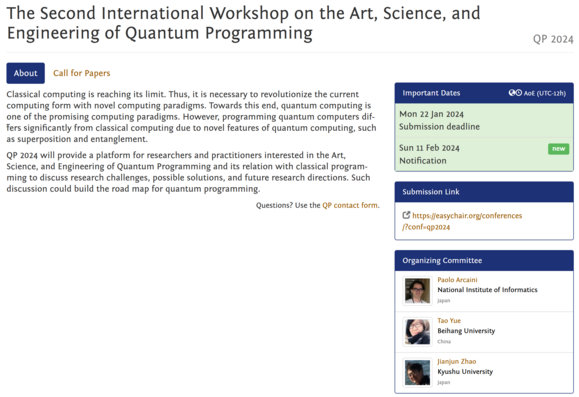
The fourth workshop at #prog24 is QP, the #QuantumProgramming workshop. Submit until January 22, 2024.
QP 2024 will provide a platform for researchers and practitioners interested in the Art, Science, and Engineering of Quantum Programming and its relation with classical programming to discuss research challenges, possible solutions, and future research directions. Such discussion could build the road map for quantum programming.
Classical computing is reaching its limit. Thus, it is necessary to revolutionize the current computing form with novel computing paradigms. Towards this end, quantum computing is one of the promising computing paradigms. However, programming quantum computers differs significantly from classical computing due to novel features of quantum computing, such as superposition and entanglement. QP 2024 will provide a platform for researchers and practitioners interested in the Art, Science, and Engineering of Quantum Programming and its relation with classical programming to discuss research ch ...
🚀 #Qrisp 0.3 - Elevate Your #QuantumProgramming Experience!
We are thrilled to unveil the latest update to Qrisp, our cutting-edge quantum programming language. Qrisp 0.3 is here, packed with exciting features designed to supercharge your quantum programming tasks: ➡️ https://www.qrisp.eu/general/changelog/0.3.html
#Qrisp #QuantumProgramming #QuantumComputing #Optimization #Industry #Innovation #Qrisp03 #Technology #Futurism