https://phys.org/news/2025-07-scientists-density-modes-component-fluid.html

"We study #quantumfluids of light, or in other words, optical systems where light behaves like a #superfluid, which are much like…#superconductors." Quentin Glorieux, "The goal…was to see whether it's possible to push this analogy further by creating a mixture of two interacting fluids of light. Mixtures…support rich collective dynamics and offer a new platform for the study of quantum phase transitions, topological structures or even analog gravity."

Scientists provide clear observation of spin and density modes in a two-component fluid of light

Recent physics studies have found that light can sometimes flow in unexpected ways, behaving like a so-called "superfluid." Superfluids, such as ultracold atomic gases or helium-4 below specific temperatures, are phases of matter characterized by flowing behavior with zero viscosity (i.e., with no resistance).
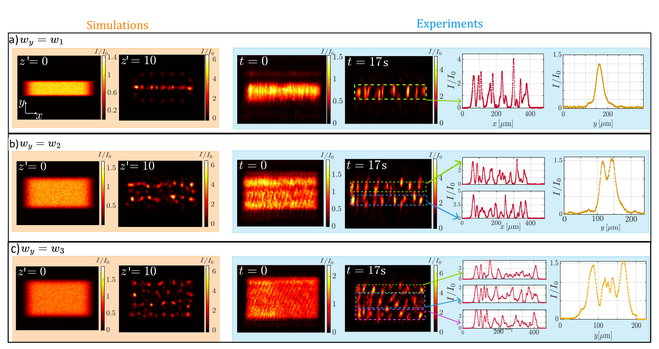
Observation of 2D dam break flow and a gaseous phase of solitons in a photon fluid

https://arxiv.org/abs/2409.18738

#solitons #opticalsolitons #integrability #quantumfluids #physics

arXiv:2409.18738

We report the observation of a two-dimensional dam break flow of a photon fluid in a nonlinear optical crystal. By precisely shaping the amplitude and phase of the input wave, we investigate the transition from one-dimensional (1D) to two-dimensional (2D) nonlinear dynamics. We observe wave breaking in both transverse spatial dimensions with characteristic timescales determined by the aspect ratio of the input box-shaped field. The interaction of dispersive shock waves propagating in orthogonal directions gives rise to a 2D ensemble of solitons. Depending on the box size, we report the evidence of a dynamic phase characterized by a constant number of solitons, resembling a 1D solitons gas in integrable systems. We measure the statistical features of this gaseous-like phase. Our findings pave the way to the investigation of collective solitonic phenomena in two dimensions, demonstrating that the loss of integrability does not disrupt the dominant phenomenology.

[complexlight.org](https://www.newcomplexlight.org/observation-of-2d-dam-break-flow-and-a-gaseous-phase-of-solitons-in-a-photon-fluid/)

[PhysRevLett.133.183801](https://journals.aps.org/prl/abstract/10.1103/PhysRevLett.133.183801)

Observation of 2D dam break flow and a gaseous phase of solitons in a photon fluid

We report the observation of a two-dimensional dam break flow of a photon fluid in a nonlinear optical crystal. By precisely shaping the amplitude and phase of the input wave, we investigate the transition from one-dimensional (1D) to two-dimensional (2D) nonlinear dynamics. We observe wave breaking in both transverse spatial dimensions with characteristic timescales determined by the aspect ratio of the input box-shaped field. The interaction of dispersive shock waves propagating in orthogonal directions gives rise to a 2D ensemble of solitons. Depending on the box size, we report the evidence of a dynamic phase characterized by a constant number of solitons, resembling a 1D solitons gas in integrable systems. We measure the statistical features of this gaseous-like phase. Our findings pave the way to the investigation of collective solitonic phenomena in two dimensions, demonstrating that the loss of integrability does not disrupt the dominant phenomenology.

arXiv.org
https://www.nature.com/articles/s42254-023-00630-y
Analogue simulations of quantum gravity with fluids
22 August 2023
Braunstein, Faizal, Krauss, Marino & Shah: the potential use of analogue hydrodynamic systems beyond classical general relativity towards the exploration of quantum gravitational effects…We aim at bridging the gap between the non-overlapping communities of experimentalists working with classical and #quantumfluids and #quantumgravity theorists
Analogue simulations of quantum gravity with fluids - Nature Reviews Physics

Experiments in fluids have enabled the simulation of several aspects of black holes and quantum field theory in curved spacetime. This Perspective article discusses possible hydrodynamic simulators of quantum gravitational effects, ranging from the resolution of curvature singularities to the emergence of spacetime geometry from quantum degrees of freedom.

Nature

Hello Mastodon!

This is account of the group led by Alberto Bramati, Quentin Glorieux and Hanna Le Jeannic (@Quantum_Hanna) at the Laboratoire Kastler Brossel (@lkb_lab)

We study nano-optics, quantum emitters and quantum fluids of lights in Rb vapors and polaritons.

#quantumoptics #quantumgas #rubidium #polaritons #nanophotonics #emitters #nanofibers #quantumfluids #quantumlight

I don't think I've given a proper #introduction yet, so here's mine. I'm a postdoc at #Dartmouth College, where I am working on bosonic analogs of condensed matter systems and strongly correlated electron systems. I graduated with a Ph.D. in 2021 from #BostonCollege, where I worked under Prof. Kevin Bedell on #CondensedMatter theory, with a focus on #FermiLiquid theory. My main interests are #QuantumFluids, unconventional #Superconductors, #FrustratedMagnetism, and #QuantumHall physics.