 Greg Restall
My *next* talk in this spring/summer of research combines some longstanding interests of mine (Graham Priest’s Logic of Paradox) and more recent interests (natural deduction and the sequent calculus). I bet you didn’t think that you could creatively apply Gentzen’s thoroughly standard rules of natural deduction to give you a sound and complete calculus for Priest’s LP, but it turns out that you can.
It’s neat to see that an old (fiddly, complicated) decidability argument I wrote up in the 1990s is getting some attention. Here, Raj Goré and Anthony Peigné formalise (and generalise) my decidability argument for display formulations of some substructural logics. This is interesting work, worth looking into.
https://link.springer.com/article/10.1007/s11225-026-10239-8
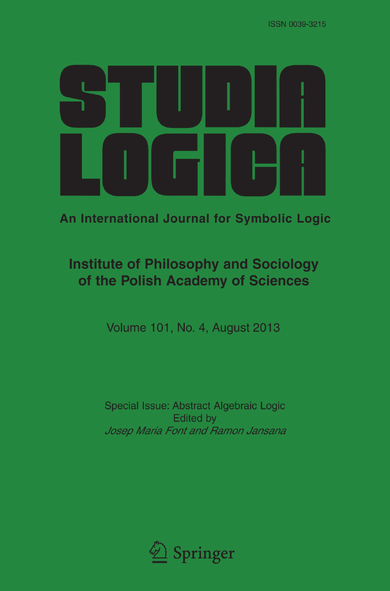
A General Formalised Framework for Reasoning About Display Calculi - Studia Logica
We encode Belnap’s basic theory of display calculi in the proof assistant Coq/Rocq version 8.18.0 and formalise the proof that Belnap’s conditions C2–C8 imply the cut-elimination theorem. Our framework allows us to formally prove meta-theoretic results such as Hilbert-completeness and derivability of explicit rules, such as cut, but also others if required. What makes our formalisation powerful is that it works entirely with an abstraction that can be instantiated to many possible logics and display calculi, although we make no attempt to precisely characterise the logics that can be properly displayed in our formalisation. For this reason, our work can be seen as a formalisation of a display calculus framework and a cut-elimination theorem for a wide range of display calculi. As examples, we apply our work to classical propositional logic (CPL), tense logic (Kt), and non-commutative non-associative Lambek calculus to obtain complete display calculi as well as formally proved cut-elimination theorems, but we believe our formalisation to be also applicable to many others. We also encoded a proof of the decidability of CPL that relies only on the structure of proofs within an additive display calculus for CPL. To our knowledge, our work is the first formalisation of a decidability result in display calculus. Moreover, all of our formal proofs are constructive as they never require the addition of the law of excluded middle in Coq’s environment (which is constructive by default), which means we were also able to extract computer programs from our proof of cut-elimination able to convert CPL/Kt/Lambek derivation trees into cut-free ones. As formal proofs are known to be significantly longer to write than usual pen-and-paper proofs, our work led to the development of a multitude of files of Coq code comprising more than 15,000 lines.
 RSS News Feed
hcommons.social:
I’m looking forward to spending time today with @ohad, @modaltype and other folks at the LFCS at Edinburgh, and getting to talk about some weird substructural modal logic. https://consequently.org/presentation/2026/tlmh-edi/#logic #prooftheory
Greg Restall (@[email protected])
I’m looking forward to spending time today with @[email protected], @[email protected] and other folks at the LFCS at Edinburgh, and getting to talk about some weird substructural modal logic. https://consequently.org/presentation/2026/tlmh-edi/ #logic #prooftheory
I’m looking forward to spending time today with @ohad, @modaltype and other folks at the LFCS at Edinburgh, and getting to talk about some weird substructural modal logic.
Oh, look! In a few weeks time I’m going to be over in Edinburgh, giving a talk the LFCS. https://informatics.ed.ac.uk/lfcs/lfcs-seminar-tuesday-5th-may-greg-restall
If you’re in town on May 5 and like crazy proof theory, this could be fun. I’ll be talking about what happens when you take a hypersequent calculus for the modal logic S5, and *thoroughly* linearise it, removing all traces of contraction and weakening. The result is stranger than you might think. (Well, it was stranger than I first thought, anyway.) Along the journey we experience strange algebras, cut elimination and decidability arguments, and weird local/global perspective shifts. I learned a lot when thinking about this stuff, so hopefully the audience gets something out of it, too.

 Jon Awbrey
Propositions As Types Analogy • 1
• https://inquiryintoinquiry.com/2013/01/29/propositions-as-types-analogy-1/
One of my favorite mathematical tricks — it almost seems too tricky to be true — is the Propositions As Types Analogy. And I see hints the 2‑part analogy can be extended to a 3‑part analogy, as follows.
Proof Hint ∶ Proof ∶ Proposition
∷
Untyped Term ∶ Typed Term ∶ Type
or
Proof Hint ∶ Untyped Term
∷
Proof ∶ Typed Term
∷
Proposition ∶ Type
See my working notes on the Propositions As Types Analogy —
• https://oeis.org/wiki/Propositions_As_Types_Analogy
#Mathematics #CategoryTheory #ProofTheory #TypeTheory
#Logic #Analogy #Isomorphism #PropositionalCalculus
#CombinatorCalculus #CombinatoryLogic #LambdaCalculus
#Peirce #LogicalGraphs #GraphTheory #RelationTheory
 undrendo
I was recently reading Turing's essay "Intelligent Machinery" (<https://archive.org/details/turing1948>, <https://doi.org/10.1093/oso/9780198250791.003.0016>), and Turing says something very interesting:
"Recently the theorem of Gödel and related results (Gödel, Church, Turing) have shown that if one tries to use machines for such purposes as determining the truth or falsity of mathematical theorems *and one is not willing to tolerate an occasional wrong result*, then any given machine will in some cases be unable to give an answer at all."
the emphasis is mine. I didn't know about that clause, "and one is not willing to tolerate an occasional wrong result". Can any mathematician or logician here tell me where I can find more technical details about this and what it's meant by Turing? Thank you!

 Carlos Tomas Grahm
Formal verification — (machines constructing and checking mathematical proofs) — keeps getting better. Cobblestone (@TaliaRinger https://arxiv.org/abs/2410.19940
) and other divide-and-conquer approaches now automate proofs we once thought unreachable.
But something feels different about where this is heading.
As we push automation forward, we’re starting to touch the edges of what a “proof” actually is — not just a verified computation, but a statement about what can’t be opposed.
I’m not sure the field has fully realized how close we’re getting to an ontological shift in what counts as proof itself.

Cobblestone: A Divide-and-Conquer Approach for Automating Formal Verification
Formal verification using proof assistants, such as Coq, is an effective way of improving software quality, but requires significant effort and expertise. Machine learning can automatically synthesize proofs, but such tools are able to prove only a fraction of desired software properties. We introduce Cobblestone, a divide-and-conquer approach for proof synthesis. Cobblestone uses a large language model (LLM) to generate potential proofs, uses those proofs to break the problem into simpler parts, automatically identifies which of those parts were successfully proven, and iterates on the remaining parts to build a correct proof that is guaranteed to be sound, despite the reliance on unsound LLMs. We evaluate Cobblestone on four benchmarks of open-source Coq projects, controlling for training data leakage. Fully automatically, Cobblestone outperforms state-of-the-art non-LLM tools, and proves many theorems that other LLM-based tools cannot, and on many benchmarks, outperforms them. Each Cobblestone run costs only $1.25 and takes 14.7 minutes, on average. Cobblestone can also be used with external input, from a user or another tool, providing a proof structure or relevant lemmas. Evaluated with such an oracle, Cobblestone proves up to 58% of theorems. Overall, our research shows that tools can make use of partial progress and external input to more effectively automate formal verification.
 Carlos Tomas Grahm
Hi everyone — I’m Carlos Tomas Grahm, an independent mathematician with a background in continuum mechanics and mathematical logic.
I started in modeling under an NSF-funded Texas A&M grant, developing what’s still the most accurate carotid-artery model in the literature.
These days I’m exploring how the structure of definitions shapes proofs — from ordered vs. non-ordered reasoning to broader questions in complexity theory.
I’m here to share occasional notes (and probably too many thoughts) on proof structure, modeling, and the weirdly human process of finding rigor.
Looking forward to meeting others who love the math side of things — whether it’s theory, teaching, or applied modeling.
#Mathematics #Logic #Modeling #Complexity #ProofTheory #Mathstodon
hcommons.social: -
Tomorrow, I get to give the last of my three talks on inferentialism. It’s time to buckle up your λs, and join in the search for some unicorns…https://consequently.org/presentation/2025/whl-a/#prooftheory #semantics #linguistics

Greg Restall (@[email protected])
Attached: 1 image Tomorrow, I get to give the last of my three talks on inferentialism. It’s time to buckle up your λs, and join in the search for some unicorns… https://consequently.org/presentation/2025/whl-a/ #prooftheory #semantics #linguistics