Prison Imperialism: A Critical Examination of Bukele’s Deal with the U.S

The deal for a prisoner exchange proposed by the El Salvadoran president presents a dangerous threat to incarcerated people in the U.S. The continued outsourcing of the U.S. penal system signals the empire’s growing carceral activities and its attempt to remain a dominant force in the region.

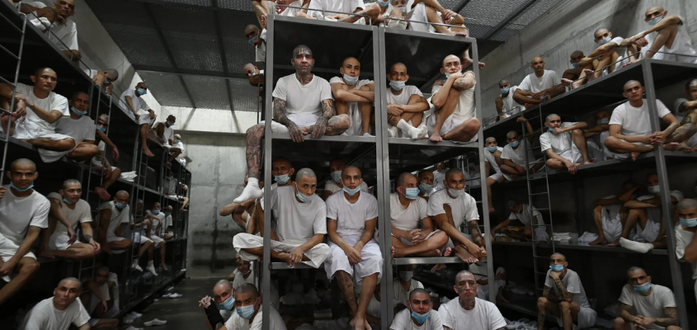
El Salvador’s President Nayib Bukele has recently proposed a controversial agreement with the United States: to house ‘violent’ criminals from the U.S. in his country’s prisons in exchange for financial compensation. This deal, confirmed by Bukele on social media, would see convicted individuals, including U.S. citizens and legal residents, incarcerated in El Salvador’s Terrorism Confinement Center (CECOT) , a mega-prison with a capacity for 40,000 inmates. While Bukele frames this as a mutually beneficial arrangement—low-cost for the U.S. but financially significant for El Salvador—the implications of this agreement extend far beyond economics. It raises critical questions about the global replication of carceral systems, human rights violations, and the broader phenomenon of *prison imperialism*.

CECOT, the centerpiece of Bukele’s anti-crime campaign, is a stark representation of his government’s harsh approach to incarceration. Since its opening in 2023, the facility has been criticized for its inhumane conditions. Inmates are confined in overcrowded cells, denied visitation rights, and stripped of access to rehabilitation programs. The prison’s design prioritizes punitive measures over reform, with no efforts to prepare detainees for reintegration into society. Instead, prisoners are subjected to rigid control, occasional motivational talks, and supervised exercise routines. This model, has drawn condemnation from human rights organizations, which have documented cases of abuse, torture, and neglect, including over 260 deaths during Bukele’s crackdown.

Bukele has been aligning El Salvador with the U.S. agenda since agreeing to send a contingent to Haiti to bolster the occupying entities of the US, the United Nations Integrated Office in Haiti (BINUH), and the Core Group’s mission led by Kenyan police to help ‘fight gangs’ in the nation.

The ongoing occupation of Haiti and calls for increased foreign military presence in Haiti have been justified as the only solution to political or economic crises. Yet, the true ongoing crisis in Haiti is a crisis of imperialism .

Bukele’s proposal to incarcerate U.S. criminals is not merely a bilateral agreement with the Trump administration; it reflects a broader trend of U.S imperialism’s imposition on the region, only this time it is taking on the face of prison imperialism. This concept refers to the exportation of carceral systems and ideologies from dominant powers like the U.S. to other nations, often under the guise of security or economic cooperation. The U.S., with its massive incarcerated population of 1.9 million and an additional 3.7 million under parole or probation, has long been a global leader in punitive justice. By outsourcing its prisoners to El Salvador, the U.S. not only offloads its carceral burden but also reinforces the global normalization of mass incarceration.

Prison imperialism is deeply intertwined with the mechanisms of capitalism and neoliberal dominance. As capitalism expands beyond national borders, so too do its systems of control. Prisons, as extensions of militarized policing, serve as tools to suppress dissent and maintain order. In the U.S., this system has its roots in settler colonialism and fascist ideologies, which have been exported globally to uphold Western hegemony. The replication of these systems in countries like El Salvador ensures the continued dominance of neoliberal policies, often at the expense of human rights and sovereignty.

The United States, representing just over 4 percent of the world’s population, incarcerates approximately 20 percent of its prisoners. This staggering statistic underscores the scale of the U.S. carceral system, which disproportionately targets Black people, imprisoning them at five times the rate of whites. Beyond the 1.9 million currently incarcerated, another 4.5 million are under explicit carceral surveillance through parole and probation, bringing the total number of people under carceral management to nearly 7 million. When considering the broader impact, estimates suggest that 65 million people—a conservative figure—have passed through this system at some point, leaving them with criminal records that subject them to various forms of exclusion and marginalization.

The carceral state extends even further, infiltrating daily life through border militarization, pervasive surveillance, broken windows policing, police violence, xenophobic legislation, gentrification, deportation, checkpoints, and the school-to-prison pipeline. These mechanisms create a society where carceral logic governs not only prisons but also the “freeworld,” normalizing exclusion and control as tools of governance

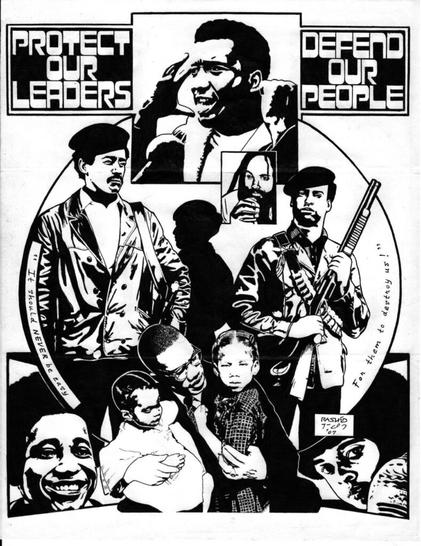
The conditions in CECOT and the broader implications of Bukele’s deal highlight the dangers of prioritizing security over human dignity. The lack of due process , the inhumane treatment of prisoners, and the absence of rehabilitation programs underscore the dehumanizing nature of this carceral model. Moreover, the global expansion of such systems criminalizes dissent, both domestically and internationally. Activists and organizers fighting against austerity, neoliberalism, and occupation—such as the African People’s Socialist Party or political prisoners like Mumia Abu-Jamal and Imam Jamil Al-Amin—are often targeted and silenced by these oppressive structures.

Bukele’s agreement with the U.S. is not just a financial transaction; it is a manifestation of prison imperialism, a system that perpetuates global inequality and repression. By understanding this phenomenon as an extension of capitalist and colonial domination, we can better grasp the interconnectedness of carceral systems worldwide. Resistance to these systems must be equally interconnected, challenging not only the conditions within prisons but also the ideologies that sustain them. As we witness the expansion of punitive justice models, it is imperative to advocate for alternatives that prioritize human rights, rehabilitation, and sovereignty over profit and control.

The fight against prison imperialism is not just about El Salvador or the U.S.; it is about dismantling a global system that thrives on oppression and exploitation.

Erica Caines is a writer and organizer in Baltimore and the DMV. Caines is the Field Operations and Membership coordinator of The Black Alliance For Peace, a member of the survBlack working-class centered Ujima People’s Progress Party in Maryland, and founder of #LiberationThroughReading, providing African children with books that represent them.

Clau O’Brien Moscoso is an organizer and co-coordinator of the Black Alliance for Peace Haiti/Americas Team. Originally from Barrios Altos, Lima, she grew up in Kearny, New Jersey. She attended college, lived, and organized in New York City for 15 years, and is now based in Lima, Perú, writing about Latin America and the Caribbean for the Black Agenda Report.

source: Black Agenda Report
https://abolitionmedia.noblogs.org/?p=17045

#elSalvador #imperialism #prisonRepression #repression #us

Nayib Bukele (@nayibbukele) on X

We have offered the United States of America the opportunity to outsource part of its prison system. We are willing to take in only convicted criminals (including convicted U.S. citizens) into our mega-prison (CECOT) in exchange for a fee. The fee would be relatively low for

X (formerly Twitter)

Conditions So Bad That Prisoners Set Themselves on Fire: Crisis and Cover-up at Red Onion Super-Max

by Phil Wilayto

Just how bad are things at Virginia’s Red Onion supermax prison?

On May 24, 2023, DeAndre Gordon deliberately started a fire in his cell that caused a third-degree burn on his leg. Gordon, who is Black, said he had been badly beaten by guards at the prison and feared for his life.

“I didn’t know any other way that I could get out of their custody besides to set myself on fire,” Gordon told a reporter with Radio IQ. “Because they don’t have a burn center in Southwest Virginia, I knew that I would be going to Richmond.”

According to the American Burn Association, Virginia has just three facilities capable of dealing with severe burns. Two are in Richmond: the Evans-Haynes Burn Center at VCU Health, a state institution, and the Wound Healing Center at Doctors Hospital, a private hospital. The third is at the Eastern Virginia Medical School in Norfolk.

Red Onion, in Wise County, is about 375 miles west of Richmond.

On Aug. 23 of this year, Demetrius Wallace, 27, also Black, says he set fire to his leg to force a transfer out of Red Onion.

The Defender spoke with Wallace on Nov. 1.

“I did actually set my foot on fire,” Wallace said. “I got the charge that shows it. They came to my cell door and saw the flames on the side of my leg. They took me to medical, they assessed me right there that night, told me they don’t deal with burns, they would have to talk with the nurse practitioner, and that I would have to be taken off the mountain.

“That was Friday, Aug. 23 … so Monday around 2 in the afternoon, they drove me seven hours away to the VCU burn unit. As soon as the doctor sees me, he said, ‘When did this happen?’ I said, ‘Friday.’ He said, ‘Why haven’t you been here?’ I said, ‘I’m not trying to be funny, but I can’t drive myself from the prison.’

“He said to the COs [correction officers], ‘You see this foot? You tell your major I can’t treat him immediately, I have to put him on antibiotics’ to treat the infection.

“I stayed in the hospital for 14 days. They had to do an allograft [a temporary graft using skin from a skin bank] and a skin graft. After 14 days I was sent back to Red Onion state prison. Harassed me, everything is still the same, stuck me in the hole, still being denied access to my JPay [a commercial email service for prisoners] or my actual phone.”

Asked why he had set himself on fire, Wallace said, “I got a lawsuit in because I was assaulted and sprayed by the COs twice while I was handcuffed. So as soon as I filed the lawsuit, they started retaliation. They denied my fiance access to the prison, for no reason; you had COs and a lieutenant looking at her Facebook; they messaged her … She has screenshots.”

Wallace also said he wasn’t the only prisoner who has recently set himself on fire.

“I was in medical, and I witnessed five other offenders who came back there. They had burned their legs or arms. There are still two or three there now.”

On or about Sept. 15, Ekong Eshiet, a 28-year-old African-born prisoner at Red Onion, says he also set fire to his leg.

On Oct. 25, he gave an interview to Prison Riot Radio, a Philadelphia-based online program that provides a platform for prisoners to speak out about prison conditions and other issues.

In the interview, Eshiet said that, two days before, on Oct. 23, he had begun a hunger strike.

“I’m trying to get off of here. I’m doing my best, I’m going about this the right way, I guess, with the hunger strike way. But if I have to, I don’t mind setting myself on fire again, and this time I’ll set my whole body on fire.

“Before I have to stay up here and do the rest of my time up here, I would rather die before I stay up here, because every day I’m dealing with discrimination, whether it’s behind my race, my last name or my religion.”

The Defender has been in touch with Kevin Rashid Johnson, a longtime prisoner activist and author who last December went on a 71-day hunger strike, demanding to be transferred from Red Onion because he said there were no medical facilities in that area equipped to deal with his several severe medical issues. He eventually was sent to VCU Health, then transferred to Greensville Correctional Center, and is now back at Red Onion.

Rashid wrote the Defender that he was in the medical unit at the prison when Eshiet was brought in for treatment, and Rashid said he saw for himself the severe burns on the man’s leg.

“He had been placed in a cell next to me in the prison’s medical department, where I overheard him talking with others about a series of prisoners including himself setting fire to themselves. I could not help asking him what was going on.

“He told me simply that the racism, the horrid and inhumane conditions at the prison, were so intolerable that he and others were setting themselves on fire in desperate attempts to get transferred. These were not protests, he made clear, but acts of desperation hoping to get out of an insufferable situation.”

Rashid, at great risk to himself, wrote a report that he sent to outside news media and support groups. The report was picked up by Prison Riot Radio, the Arlington-based Interfaith Action for Human Rights and The Virginia Defender, among others.

On Oct. 25, this reporter called Red Onion and spoke with the warden, David Anderson. I explained that we had received a report that as many as a dozen prisoners at Red Onion had recently set themselves on fire, and asked if the report was correct.

“No, it’s not true,” Anderson said.

After a pause, he added, “I really shouldn’t be commenting on this.”

“So you’re saying that no one has set themselves on fire?” I asked.

“I can’t speak any further about that,” Anderson answered.

I told Anderson I would send him an email, with further questions. He said he would forward the email to the proper department for a response.

These are the questions sent on Oct. 25:

* Over the last two months, did one or more prisoners at Red Onion set themselves on fire, as claimed by the letter writer?

* If so, what are the names and prison ID numbers of the men?

* What is now the location of each of the men?

* What is the medical condition of each of the men?

* Have any of the men been charged with institutional or criminal offenses as a result of these alleged actions?

As of this writing, on Nov. 4, there has been no response.

Meanwhile, we have been trying to find corroboration on the reports.

In addition to speaking directly with Demetrius Wallace, we called Marsha Prichett, Eshiet’s mother, on Oct. 25. She said her son has had a very hard time since being sent to Red Onion in June.

“There’s been name calling, they call him Eat-Shit, they spit in his food. After he hurt himself, they treated him for minor burn wounds. “Then the hospital called us to let us know Ekong was in the hospital, but they said we couldn’t visit with him or talk to him because the warden said he was a danger to himself or others. So we couldn’t visit because of what the warden said.”

On Nov. 1, a Friday, the Defender reached out to VCU Health to ask if any Red Onion prisoners had been treated there recently for severe burns. At first we were told the hospital was not allowed to give us that information because of the issue of patient privacy. We hadn’t asked about any particular patient.

On Nov. 4, a Monday, we received a call from Danielle Pierce with VCU Public Relations. We asked if, from Aug. 1 until the present, any Red Onion prisoners had been brought to VCU Health for treatment for severe burns.

“I’m happy to look into it for you,” Pierce said.

Since our press deadline was the next morning, we didn’t expect to receive an answer in time for this story, but we will post any response on this newspaper’s website: virginiadefender.org. [Post-press update: As of Friday, Nov. 8, there has been no response.]

On Nov. 1, the Defender also called and left messages at the offices of Virginia General Assembly Delegate Don Scott, a former prisoner who is now Speaker of the House. We will report any response we get on our website.

We also have been trying to get various Virginia media to cover this story.

What is Red Onion?

This Google Earth map gives some idea of how isolated the Red Onion super-max prison is, situated on top of Red Onion Mountain in rural Wise County, far from the famiies of most of the men confined there.

The Justice Policy Center of the Urban Institute describes a supermaximum prison, or “super-max,” as “designed to hold the putatively most violent and disruptive inmates in single cell confinement for 23 hours per day, often for an indefinite period of time.”

Red Onion is a super-max prison. It opened in 1998 in the midst of a big right-wing and media scare about a new crime wave that supposedly was coming, but somehow never did.

Red Onion was supposed to house around 800 of “the worst of the worst” Virginia prisoners. As it turned out, there weren’t enough “worst” prisoners to fill the cells, so Virginia began taking in prisoners from other states – for a price. Further, many of the Virginia prisoners who wound up there were transferred from lower-level security prisons simply for breaking rules, not for committing violent crimes.

Red Onion quickly gained a reputation for extreme repression, cruelty and racism.

A 1999 report by Human Rights Watch stated that the “Virginia Department of Corrections has failed to embrace basic tenets of sound correctional practice and laws protecting inmates from abusive, degrading or cruel treatment” and claimed that “racism, excessive violence and inhumane conditions reign inside.”

In 2001, Amnesty International released a report citing human rights violations at the prison.

The 2016 HBO documentary film “Solitary: Inside Red Onion State Prison” focused on the use and effects of solitary confinement.

In one particularly notorious case, Nicolas Reyes, a Salvadoran immigrant, was kept in solitary confinement for 13 years because he couldn’t complete the mostly English-language Step-Down Program required to be released.

Reyes only spoke Spanish and couldn’t read or write in any language.

With support from the ACLU and other organizations, Reyes was finally released and received a monetary award of $115,000 – which works out to about a dollar for every day he suffered in extreme physical, social, cultural and linguistic isolation.

This is what Rashid has recently written about the prison:

“Red Onion and its sister supermax Wallens Ridge State Prison, are both located in the mountains of the far southwestern corner of Virginia in rural, segregated white communities, while their prisoner populations are near totally Brown and Black.

“Since opening in 1998 and 1999, respectively, both prisons have operated without oversight in regions where the local populations are culturally conditioned to secrecy and hostility to outside scrutiny. Which makes for prisons shielded by a curtain of secrecy, inhumane abuse and racism.

“And while Virginia has been closing down many of its predominantly Black staffed prisons across the state, it has shifted resources and focused new prison construction projects in favor of opening and operating prisons in remote, racially segregated regions of the state like where Red Onion and Wallens Ridge are located.

“The strongest public exposure and protest needs to be directed at these expensive, inhumane and unneeded human warehouses. They must be opened up to broad public scrutiny and accountability, and closed down.

“This exposure and protest should be continually directed against the Virginia governor, Virginia Department of Corrections Director Chadwick Dotson and the state’s General Assembly.

“Every effort must be made to share this information and increase public awareness about these places, their inhumane conditions and the desperate extremes they are driving fellow humans to in their pleas for relief.

“Dare to Struggle Dare to Win!

“All Power to the People!”

Interfaith Action for Human Rights has started an online petition urging change at Red Onion. To sign, log onto change.org and search for “Investigate Self-Harm Episodes and Improve Inhumane Conditions at Red Onion Prison.”

As we go to press, Kevin Rashid Johnson, Ekong Eshiet and Demetrius Wallace are all being held in solitary confinement – what the prison calls “restrictive housing.” All three men have reason to fear for their lives.

Rashid, who has been targeted because of his outspoken condemnation of the whole Virginia prison system, has outside attorneys working to try to get him transferred out of Red Onion.

Note: Both Rashid and Demetrius Wallace have given the Defender permission to quote them for this story. We haven’t spoken directly with Ekong Eshiet.

Conclusion

At this point, we are confident in reporting that at least two men held at the Red Onion State Prison – Demetrius Wallace and Ekong Eshiet, and possibly others, have taken the desperate step of setting themselves on fire to try to force the prison officials to transfer them out of that notorious hellhole.

And the prison system is not only denying that these events ever happened, but have taken steps to isolate the men involved in order to keep the public from knowing about it.

The Virginia Defenders are calling for an immediate, independent, impartial, outside investigation of the conditions of these three men, as well as the general conditions at Red Onion. We will be sending copies of this story to Gov. Glenn Youngkin, Virginia Attorney General Jason Miyares, all members of the Virginia General Assembly, U.S. Senators Tim Kaine and Mark Warner, Virginia Department of Corrections Director Chadwick Dotson and all our contacts in the Virginia media.

And to our readers: If you want to get involved in the struggle for Prison Justice, email the Virginia Defenders for Freedom, Justice & Equality at [email protected]; call or text 804-644-5834 or write to: Defenders, PO Box 23202, Richmond, VA 23223.

This story is republished with permission from the Virginia Defenders.

source: SF Bayview

https://abolitionmedia.noblogs.org/?p=12621

#abolition #blackLiberation #northAmerica #prisonRepression #redOnion #us

Deine Plattform für Petitionen

Mehr als 500.000.000 Menschen setzen sich in ihrem Umfeld für Veränderungen ein. Mach mit!

Change.org

SOIREE DE SOUTIEN CONTRE L'A69 💥
Toulouse, jeudi 28 novembre - 19h

La répression continue de s’abattre sur la lutte contre l'A69. Une copaine est actuellement en détention provisoire à Tarbes : https://iaata.info/Soutien-a-Louna-meuf-trans-en-detention-provisoire-dans-le-cadre-de-la-lutte-6998.html

Nous avons actuellement besoin de 80 000 euros pour couvrir les frais de justice, et nous ne sommes pas à l’abri d’autres mauvaises surprises.

Pour apporter notre soutien à la lutte, retrouvons nous jeudi 28 novembre au hangar de la Cépière.

Au programme :

  • projection de courts-métrages auto produits qui retracent la lutte
  • un super karaoké animé par notre rappeuse préférée, La virgule.

Cantine à prix libre et buvette sur place 🍿🥤
Venez nombreux-ses !

💰 Pour faire un don en ligne : https://www.helloasso.com/associations/alerte-planete/collectes/a69-solidarite-face-aux-proces

Source:Comité Soulèvements de la terre 31
#StopA69 #NoMacadam #ZADpartout #PrisonRepression

Soutien à Louna, meuf trans en détention provisoire dans le cadre de la lutte contre l’A69

Texte de soutien à Louna, une meuf trans incarcérée en détention provisoire dans le cadre de la lutte contre l'A69.

@BassinesNon

***English Translation for international solidarity from anglophones***

Since the blockade on 9th December 2022, we have not ceased to be battered by the backlash. In less than 2 years of direct actions, more than 150 people are dealing with court proceedings.

The associated costs put all together are dizzying. To take collective responsibility for the defense is proof of our solidarity in these especially difficult times.

Each hearing brings with it variable costs depending on the issues involved, the lawyers chosen, the attendance of key witnesses, the number of people involved. Above all we cannot estimate the number of appeals or hearings in the supreme court which will add again to the cost.

As a consequence we are calling for a first wave of donations to cover the costs to come in the next months with an estimated amount of €80,000.

Thank you for your support

https://opencollective.com/xr-toulouse-et-alentours/projects/objectif-80-000euros

Source : A69 Canal Info
#StopA69 #NoMacadam #PrisonRepression

Objectif 80 000€ - Open Collective

Privilégier cette nouvelle cagnotte avec moins de frais : https://www.helloasso.com/associations/alerte-planete/collectes/a69-solidarite-face-aux-proces

OBJECTIF 80 000€ ⏩ Appel à dons ⏪

Depuis le blocage du 9 décembre 2022 la répression n'a pas cessé de s'abattre sur nous. En moins de 2 années d'actions de terrains, plus de 150 personnes ont été poursuivie dans plus de 80 procédures juridiques.

Les frais associés, mis bout-à-bout sont vertigineux. Prendre en charge collectivement la défense des activistes est la preuve de notre solidarité dans ces moments parfois si difficiles.

Chaque audience implique des frais variables suivants les enjeux, les avocat⋅es chois⋅es, la présence de grand⋅es témoins et le nombre de personne impliquées. Mais surtout nous ne pouvons pas encore estimer le nombre de procédures en appel et en cours de cassation qui ajouterait autant de frais.

Ainsi, nous avons choisi d'appeler à cette première vague de dons pour couvrir les frais à venir dans les prochains mois avec un montant indicatif de 80 000€.

Merci pour votre soutien !

https://opencollective.com/xr-toulouse-et-alentours/projects/objectif-80-000euros

Source : A69 Canal Info
#StopA69 #NoMacadam #PrisonRepression

Objectif 80 000€ - Open Collective

Privilégier cette nouvelle cagnotte avec moins de frais : https://www.helloasso.com/associations/alerte-planete/collectes/a69-solidarite-face-aux-proces