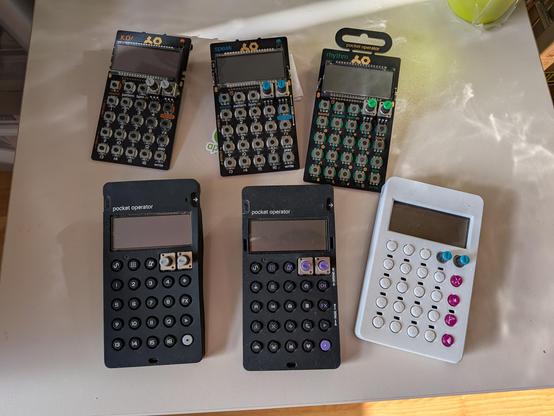
The PO-35 Speak (& PO-137 Rick & Morty) is another lead synth, but based on a vocoder. You can record audio and generate interesting tones from it. For leads, I prefer it over the Factory and Robot.

The graphics are still meh like the other POs in this series, but at least the 137's graphics aren't tiny. There's one built-in drum track using the Tonic engine so it effectively has the core function of the Tonic, with the limitation that you can only play one drum sound per step.
#pocketoperator

@SquirrelwithaninvisibleW I'm thinking some sort of mixer is warranted - Pocket Operators sound much better when played out through an amp. I don't know enough about midi sync though to work out how to make it work. My mate's a music teacher and producer - I'll ask him.

I had great fun taking breakbeats with supporting basslines up from 140 to 170 bpm. #pocketOperator

The PO-33 KO (& PO-133 Street Fighter) is probably the most popular PO. The KO has the unfortunate hand-drawn graphics, and the latter has too-small licensed graphics. Functionally, they're super-accessible samplers, and while not as quick to get going (since you need to record samples), it's the most flexible PO in the lineup.

The pots are finicky when trimming samples, and the learning curve is higher than other POs, but if you want a cheap hardware sampler, they're great. #pocketoperator

The PO-32 Tonic is like the PO-12 (with worse FX), only it lets you swap out the sounds by recording binary data from audio clips (think old modem sounds). You can find a ton of these on YouTube, or generate your own sounds via the MicroTonic VST on a computer. It's a shame MicroTonic isn't available for iOS, as that would make the Tonic an even better mobile synth.

It's a shame you can only load one patch of 16 sounds at a time (vs 16 patches). And the graphics are pretty meh. #pocketoperator

The PO-28 Robot and PO-128 Megaman are chiptune-style lead synths. I had the latter, which is the better of the two because you can change key. Like the Factory though, it didn't work for me because I suck at live-jamming melodies. These are logical add-ons if you dig the Arcade though, and they also work great for ambient stuff if you have a way to add FX.

The graphics on the Megaman are painfully small for some reason. #pocketoperator

Vielleicht war das Suchabo nach Pocket Operatoren auf Kleinanzeigen doch nicht eine so gute Idee?!

#kleinanzeigen #PocketOperator #TeenageEngineering #PO33 #PO35 #PO12 #PO20 #pocket_operator

The PO-24 Office was fun as a niche noisemaker. It's like the Rhythm but with weird industrial sounds to layer. Like the Rhythm it's also fun for putting down a quick groove, but I can see some folks getting tired of the sounds quickly. The "An American Workplace" captures how far you can take the Office. If you like percussion, it pairs well with the Rhythm and Tonic. https://youtu.be/bQqKRPZ4g78?si=wUBRs9YM7HPrJ8Wd #pocketoperator
"An American Workplace" -EP made ENTIRELY with the PO-24!

YouTube
The PO-20 Arcade is obviously the definitive chiptunes PO. With external FX you can do some cool ambient things like with the Factory, and the chord/glide features make the Arcade a pretty unique PO otherwise. If you want a self-contained chiptunes gadget, this is the PO for you, and I almost kept it for that purpose alone. But at the end of the day, chiptunes wasn't enough of a draw for me to dedicate time to mastering the Arcade. #pocketoperator

The PO-16 Factory was perhaps my least favorite PO. The sounds by themselves were kind of jarring, and I mainly picked the Factory up to be a completionist, and because I heard a nice ambient track after running the Factory through some FX, which convinced me to give it a go. I guess I also didn't vibe with the more melody-focused POs for live-jamming, which perhaps is a skill issue more than anything else.

Suffice to say, sold this one first. #pocketoperator