 Professional Moron
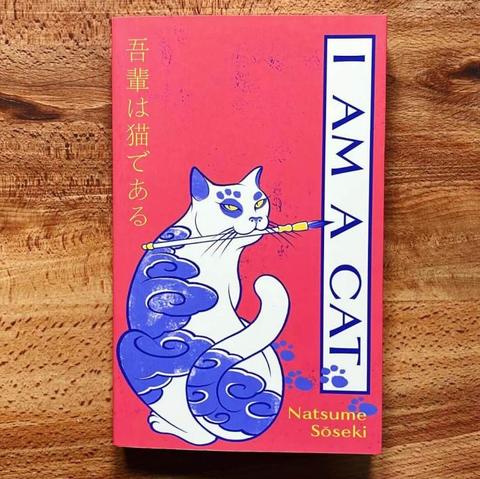
Book of da Month: I Am a Cat (Volume 1) by Natsume Sōseki 🐈⬛
I Am a Cat (吾輩は猫である—Wagahai wa Neko de Aru) was published in 1905, a satirical novel by Japanese poet, novelist, and scholar Natsume Sōseki (1867-1916).
Told from the perspective of a feline narrator, the once stray kitten is adopted into the home of an upper-middle-class family. The cat observes the world around it, lampooning the Meiji-era society as it preens itself, and presenting playful mockery for all ages. Meow indeed.
Satire and Self-Importance in I Am a Cat (Volume 1)
“Living as I do with human beings, the more that I observe them, the more I am forced to conclude that they are selfish.”
It’s a fun idea, to mock human society from the perspective of a cat. The animals that have little respect for the things we take so seriously. It’s also now an intriguing historical record on the Meiji period (1868-1912) of Japan.
From the same era, over in Victorian era England, Edwin A. Abbott penned the novella Flatland: A Romance of Many Dimensions (1884). It shows how long satire has played on creative minds, anyway, even if Abbott’s work is better.
A key difference is I Am a Cat is a long book. You can but it in three volumes, or 10 instalments, so it’s worth flagging up why the concept ended up so protracted. The 2025 edition we picked up has a new translation by Nick Bradley. In his introduction, he notes:
“What eventually became the novel I Am a Cat originally began as a short story published in 1905 in the literary magazine Hototogisu (the Japanese word for ‘cuckoo’). The story, when it was published, was so incredibly popular that Sōseki, similar to Conan Doyle and his popular Sherlock Holmes character, found himself pressured by the Japanese reading public into writing more stories from the perspective of his feline narrator.”
Intended as a one-off novella, then, but commercial pressure mounted and the writer was compelled to do more.
Despite its title, I Am a Cat isn’t entirely from the perspective of a feline. As it does cut quite regularly to conversations between citizens, such as Mr. Sneaze and his fast-talking friend Waverhouse. These are set alongside biting witticisms from the cat, notably on Japan’s modernisation and a greater focus on individualism.
“In the old days, a man was taught to forget himself. Today it is quite different: he is taught not to forget himself and he accordingly spends his days and nights in endless self-regard. Who can possibly know peace in such an eternally burning hell? The apparent realities of this awful world, even the beast lines of being, are all symptoms of that sickness for which the only cure lies in learning to forget the self.”
And then there’s the cat stuff like this.
“Had I the time to keep a diary, I’d use that time to better effect; sleeping on the veranda.”
These philosophical musings continue at a slow pace, playing out over 500 pages if you want to read the full collection, so we generally found the book better to leaf through and pick random pages to enjoy. As the book is very much of its time, marketed now as an obscure delight for readers to discover, but it won’t be quite what some want (we saw many online reviews claiming the work is “boring”).
Ironically, that kind of plays into what Natsume Sōseki was intending for I Am a Cat. The entitlement and fussiness of the human condition.
“Artfulness, uncharitableness, self-defensive wariness: these are the fruits of worldly learning. The penalty of age is this rather ugly knowingness. Which would seem to explain why one never finds among the old a single decent person. They know too much to see things straight, to feel things cleanly, to act without compromise.”
To heighten the sense of casual mockery, Sōseki used a high-register writing style. As in, it’s quite pretentious and full of grand-scale big old words to look all clever. That decision was to poke fun at Japanese higher society.
That begins with the very title of Wagahai wa Neko de Aru.
Wagahai is now classed as a really pompous pronoun to use, along the lines of those people who use “one” or “oneself”. It’s now associated with aristocratic behaviour. Basically, its use implies the user of the term considers themself to be superior to all around them.
A great little bit of nuance there that can easily get lost in translation.
However, as we’ve flagged, it is very much a book of its time. From what we’ve seen, readers claim each book from the 10 initial instalments can be read as a standalone work. Which is good, as we wouldn’t want to go through 500+ pages of this stuff.
Japan’s obsession with cats, alongside the classics status of Sōseki’s work (it’s a frequent one to read in Japanese schools), mean it’s played its way into Nippon’s public conscience.
But in the West with this new release, its cultural impact won’t be the same as that longstanding reverence isn’t established. Regardless, we find it a historical marvel and an important work of Japanese literature. In that sense, it’s worth having in your collection (and showing to your cat).
#Books #Cat #Cats #History #IAmACat #Japan #Literature #MeijiPeriod #NatsumeSōseki #pardy #Reading #Satire #satirical