 goesselgold
It has been _0_ days since the latest discovery of a bug at my workplace.

It has been _0_ days since the latest discovery of a bug at my workplace.
RE: https://norden.social/@goesselgold/116676968960237070
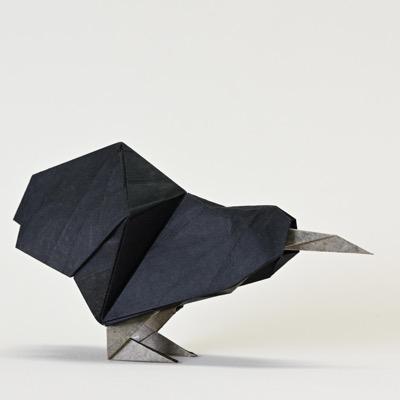
As with all design work, it is sometimes hard to decide when you’re finished. This model needed some more shaping to give it a better posture and more stability – it now stands on its own legs. I think I’ll leave it at that.
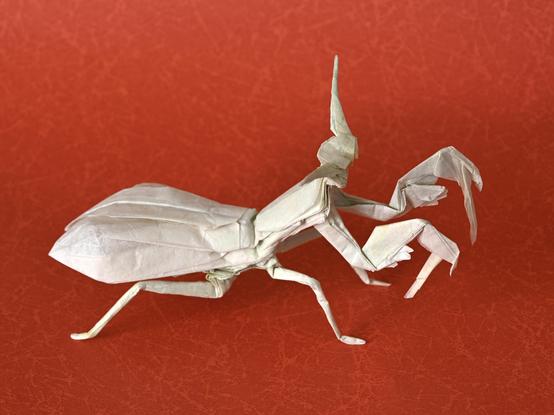
Robert Lang’s Cicada Nymph Ia, Opus 588, folded by me. With this model I think I finish the series of Lang’s cicadas. It’s been quite a ride.
Robert Lang’s Cicada nymph, Opus 588, folded by me from the crease pattern. I consider this still a prototype for the real model, because I haven’t figured out how to make the eyes—they are quite distinctive on his model, and the front legs don’t look quite right. I did not think this would turn out so well though after I messed up some folds in the center and just smashed them together. But the mistakes are completely hidden on the inside.
When you never have folded a model just from the crease pattern but start trying with a difficult one.
It’s really justified that they say you “solve” a crease pattern.
A nice pair: Satoshi Kamiya’s Cicada Nymph and Robert Lang’s Classical Cicada.
Folded by me from mulberry tissue.
Origami cicada nymph, designed by Satoshi Kamiya, folded by me. Now I got this under my belt.
I came back to one of the earlier versions of Robert Lang’s cicadas, opus 377. This time I am quite happy about how it turned out.
Newly folded Shizuoka Cicada to match the scale of opus 676
Robert Lang’s Cicada Opus 676. Folded from one uncut square of double tissue paper (about 38 cm side length), shaped with the help of methylcellulose.
Some folds were quite challenging to do, but the beauty and the realism of the model were definitely worth the effort.