Review on solving dynamics of quantum matter by means of neural quantum states #NQS out now:

https://arxiv.org/abs/2506.03124

#machinelearning boosts real-time simulations in #quantum many-body systems, in particular in the challenging regime of two spatial dimensions.

Simulating dynamics of correlated matter with neural quantum states

While experimental advancements continue to expand the capabilities to control and probe non-equilibrium quantum matter at an unprecedented level, the numerical simulation of the dynamics of correlated quantum systems remains a pivotal challenge - especially in intermediate spatial dimensions. Neural quantum states are emerging as a new computational tool to investigate the time evolution of many-body quantum systems in previously inaccessible regimes. We review the recent progress in the field with a focus on the different time propagation methods, an overview of the reported applications, and a discussion of the major current challenges.

arXiv.org

Efficient optimization of deep neural quantum states toward machine precision

Neural quantum states have emerged as a novel promising numerical method to solve the quantum many-body problem. However, it has remained a key challenge to train modern large-scale deep network architectures, which would be vital in utilizing the full power of the underlying artificial neural networks. In this recent preprint we take on this challenge:

https://arxiv.org/abs/2302.01941

#nqs #quantum #deepnetworks

Efficient optimization of deep neural quantum states toward machine precision

Neural quantum states (NQSs) have emerged as a novel promising numerical method to solve the quantum many-body problem. However, it has remained a central challenge to train modern large-scale deep network architectures to desired quantum state accuracy, which would be vital in utilizing the full power of NQSs and making them competitive or superior to conventional numerical approaches. Here, we propose a minimum-step stochastic reconfiguration (MinSR) method that reduces the optimization complexity by orders of magnitude while keeping similar accuracy as compared to conventional stochastic reconfiguration. MinSR allows for accurate training on unprecedentedly deep NQS with up to 64 layers and more than $10^5$ parameters in the spin-1/2 Heisenberg $J_1$-$J_2$ models on the square lattice. We find that this approach yields better variational energies as compared to existing numerical results and we further observe that the accuracy of our ground state calculations approaches different levels of machine precision on modern GPU and TPU hardware. The MinSR method opens up the potential to make NQS superior as compared to conventional computational methods with the capability to address yet inaccessible regimes for two-dimensional quantum matter in the future.

arXiv.org

Highly Resolved Spectral Functions of Two-Dimensional Systems with Neural Quantum States

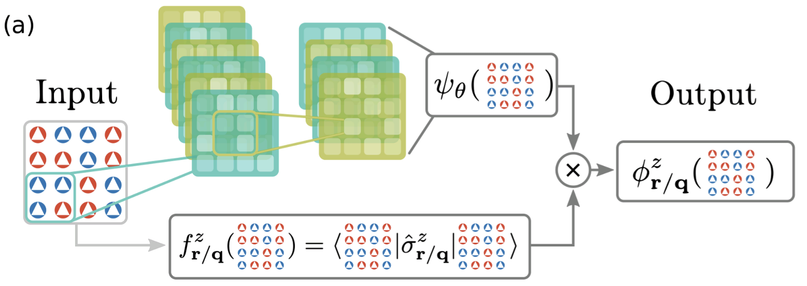
Spectral functions are central to link experimental probes to theoretical models in condensed matter physics. However, performing exact numerical calculations for interacting quantum matter has remained a key challenge. In this recent publication, we develop a versatile approach using neural quantum states to obtain spectral properties:

https://journals.aps.org/prl/abstract/10.1103/PhysRevLett.131.046501

#quantum #machinelearning #nqs

Highly Resolved Spectral Functions of Two-Dimensional Systems with Neural Quantum States

Spectral functions are central to link experimental probes to theoretical models in condensed matter physics. However, performing exact numerical calculations for interacting quantum matter has remained a key challenge especially beyond one spatial dimension. In this work, we develop a versatile approach using neural quantum states to obtain spectral properties based on simulations of the dynamics of excitations initially localized in real or momentum space. We apply this approach to compute the dynamical structure factor in the vicinity of quantum critical points (QCPs) of different two-dimensional quantum Ising models, including one that describes the complex density wave orders of Rydberg atom arrays. When combined with deep network architectures we find that our method reliably describes dynamical structure factors of arrays with up to $24\ifmmode\times\else\texttimes\fi{}24$ spins, including the diverging timescales at critical points. Our approach is broadly applicable to interacting quantum lattice models in two dimensions and consequently opens up a route to compute spectral properties of correlated quantum matter in yet inaccessible regimes.

Physical Review Letters