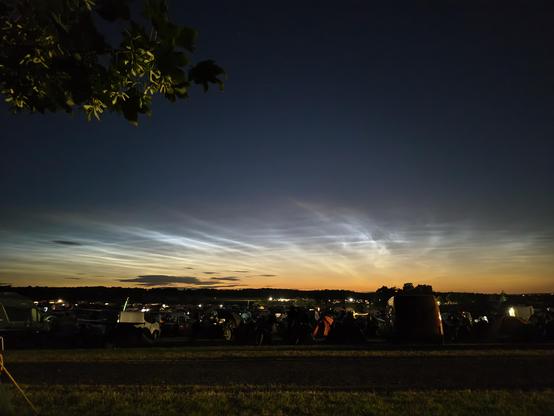
With a few plausible changes, noctilucent clouds could become global, and ubiquitous. The net result? White nights of a most alien sort...

Read more at my #blog: https://www.adamasnemesis.com/2025/10/23/a-noctilucent-world/

This post's featured image is of a noctilucent cloud on Mars, as captured by the Curiosity rover.

#worldbuilding #scifi #sciencefiction #clouds #climate #climatechange #meteorology #climatology #atmospheres #noctilucentcloud

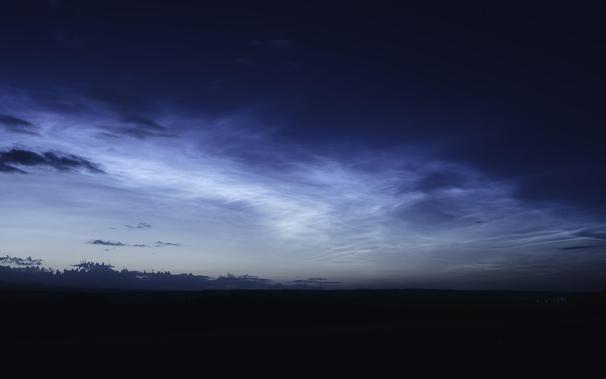
Small but rather bright and beautifully structured #NoctilucentCloud display over Bochum, Germany, on 10 July 2025 between 1:15 and 2:00 UTC - so far not two of the major displays this season from here have looked even remotely alike, and this one was perhaps the most attractive. Keep 'em coming ...! More timesteps in https://www.facebook.com/groups/nlcaroundtheworld/posts/1711440259491572/

Is it "Noctilucent cloud" in english? 😀

Again shiny clouds in the middle of the night. Very impressiv to see, hard to capture with camera.

#photography #NoctilucentCloud #Nachtwolken

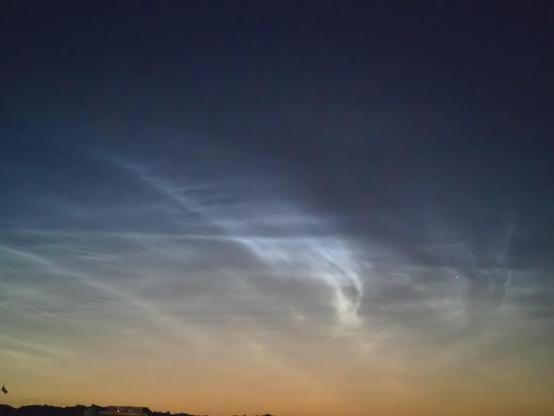
And some more NLCs tonight - a quick capture on the ipHone this time

#NLC #noctilucentcloud #perthshire #scotland #iphoneography #nightsky

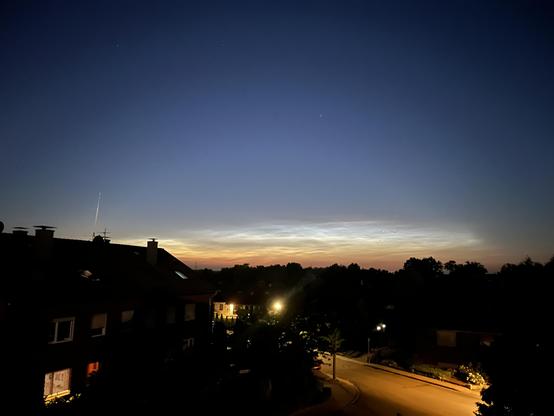
The sky is shining a while after sunset. #rostock #photography #noctilucentcloud #Nachtwolken
Apparently the northern hemisphere's #NoctilucentCloud season is opening, which was expected around this time of year. If you're near enough to polar latitudes (definitely 50°N+, maybe lower if there's an outbreak), look for them during morning or evening astronomical twilight, reflecting sunlight from 80km/50mi altitude in the direction of the sunset or sunrise. https://social.tchncs.de/@Fettlaus/114616634713194665 #NLC #NLCalert #SpaceWeather
Laus🐜:AFD: (@[email protected])

Attached: 1 image #AuroraBorealis or not?

Mastodon
Just as the very first indications of the northern #NoctilucentCloud season are seen (in https://www.facebook.com/groups/120898778545736/posts/1671843040117961 and https://www.facebook.com/LeuchtendeNachtwolken/posts/pfbid024ZrpF9YFz47GgZwzdwCuwHHF8sAjNWcNTogbNoZeme9cKqA6yjDGSbcafCQpm8Hol the relevant data) the new citizen science project https://citsci.org/projects/space-cloud-watch/ is asking for your observations: https://science.nasa.gov/get-involved/citizen-science/space-cloud-watch-needs-your-photos-of-night-shining-clouds/ - it's about the recently seen equatorward extension of the NLC phenomenon and its possible causes.
Noctilucent clouds around the world | Welcome to the new NLC Season 2025 | Facebook

Welcome to the new NLC Season 2025. All three Lidars in Europe shows first signs of NLCs in the Mesosphäre. Hopefully, we get this Year a nice NLC Season with brilliant Displays. Happy NLC - Hunting!

Did the 2022 Hunga eruption impact the noctilucent cloud season in 2023/24 and 2024?

Abstract. The 2022 Hunga Tonga – Hunga Ha'apai eruption emitted approximately 150 Tg H2O into the middle atmosphere, which is still detectable 2 years after the event. Microwave Limb Sounder (MLS) observations show that the Hunga H2O reached the upper polar mesosphere in the Southern Hemisphere (SH) in the beginning of 2024, increasing the H2O mixing ratio in January by about 1 ppmv between 70 and 80° S up to an altitude of 83 km. No clear signal was detected for the noctilucent cloud occurrence frequency inferred from Ozone Mapping and Profiling Suite – Limb Profiler (OMPS-LP) measurements. It cannot, however, be ruled out that a slight increase from mid-January to February is potentially caused by the additional water vapour from the Hunga event. Several months later, the water vapour anomaly reached the polar summer mesopause region in the Northern Hemisphere (NH) during the noctilucent cloud season in 2024. However, a subsequent anomalous warming during the second half of the season might have hindered the ice particle formation, leading to a decrease in occurrence frequency of the mesospheric clouds compared to previous years. To summarize, based on the analysis performed in the study, we show that the volcanic water vapour needs 2 years to reach the summer polar mesopause region. This resembles the Krakatoa case that is argued to have caused the first sightings of noctilucent clouds 2 years after its eruption in 1883.

Heute Nacht hat sich der Blick Richtung Norden gelohnt #LeuchtendeNachtwolken #NoctilucentCloud #NLC #nlcnow waren wunderschön am Himmel zu bewundern.
#NoctilucentCloud in Norddeutschland #NLC #nlcnow