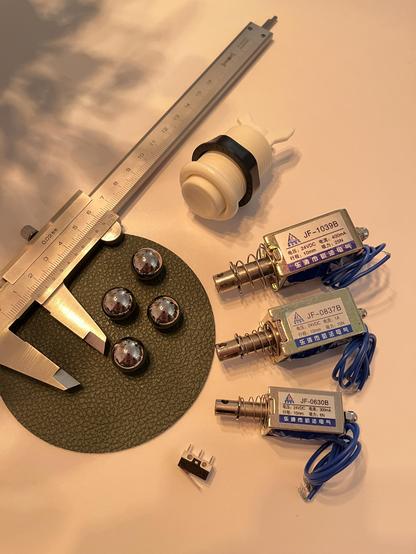
Got my hands on the first parts for doing my #smallPinball / #miniaturePinball trials. I’m pretty set on the 15 mm balls – look at how cute they are! – but everything else is basically a first guess. I can already tell that these microswitches (the little thing at the bottom) are too stiff for what I need, but it was hard to know that beforehand as the actuation force was not specified. The coils I’m excited to try though – they should be good for at least some of the mechanisms.
My holdup with projects like this is always the step of moving from ideas in my head and/or computer into the real world. I keep overthinking what do I need to procure to facilitate that transition, and I'm trying to push myself to accept that it's okay that things might not work out on the first try – even then, they will likely point me into the right direction. #miniaturePinball
I'm at the point with #miniaturePinball where I have modelled several of the basic mechanisms to the point where I need to decide what type of coils I will use to actuate them. I ordered a "tasting set" of a few different types to try, along with some tiny microswitches and 15 mm balls. Let's see when they show up.

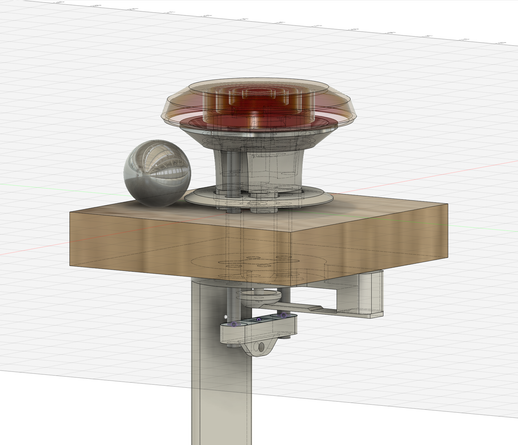
Jet bumpers, pop bumpers, thumper bumpers… the round things that forcefully kick the ball away when it approaches, go by many names. They are probably right behind flippers as some of the most iconic attractions in pinball machines.

I tried to stay true to the original mechanics, only changing little things to better suit 3D printing. The ball that’s roughly 1/5 the weight of the regular might yet turn out to be too light to activate the switch, but that remains to be tested. #miniaturePinball

Knowing just a bit about how pinball machine electronics work, I had an inkling that using a different voltage to drive “high-power” devices would be just fine, but never hurts to make sure.

Not having to design the electronics platform is going to save me so much time and headache that I can spend elsewhere in the project, which will for sure be needed. #miniaturePinball

From the start a big question for my #miniaturePinball project has been the electronics. I of course thought about making something custom, but I also discovered the FAST Pinball platform. It seemed otherwise perfect but I wasn’t sure if it would work to drive small solenoids at low voltages, as it’s meant for full-size pinball machines.

So I asked them. They were super supportive of the idea in their response and saw no issues with it, so looks like this might be the way to go.

When you awaken from a dream with a theme for your pinball machine and can’t fall asleep again because the brain immediately goes down the rabbit hole of visualising the shots and drafting the ruleset.

Not complaining though. Now I have something to work towards.

#miniaturePinball

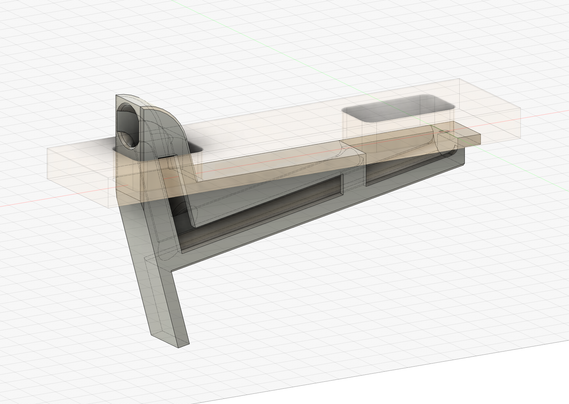
I did not really reinvent the wheel here – like almost all pinball machines since the early 1990s, this trough simply uses gravity to store the incoming balls and one solenoid to kick them out. Up to six balls can hang out there at once. What's different is that this is designed for 3D printing – it prints as a single part without supports. Missing from the model are the solenoid and holes for screws and optical sensors that detect the balls. But getting there with this one! #miniaturePinball
Been 3D-modelling some playfield mechanisms for my #miniaturePinball project. This here will become the main trough; for the uninitiated, it's the device that captures the balls when you lose them (right side), and then serves them for you to shoot into play (left side). Unlike the flippers which are more or less mechanically identical across manufacturers and decades, there has been a lot more variety in the design of the trough, and that's what makes it interesting to me.