Stephen
The Day the Micro-Rotor Was Introduced: Buren Super Slender and Universal Microtor
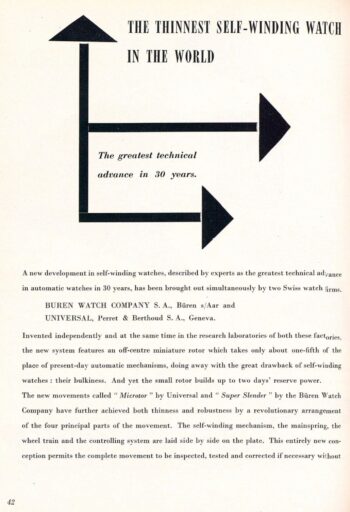
On February 18, 1958, representatives from Buren Watch Company and Universal Genève announced “the greatest technical advance in 30 years,” the micro-rotor automatic watch movement. This joint announcement, and the actions of the inventors and companies before and after it, contradict the oft-repeated story of conflict between them. In fact, the invention and introduction was friendly, thanks to the cordial Hans Kocher, who invented the micro-rotor yet allowed others to share the limelight and the credit.
Buren and Universal collaborated in the simultaneous introduction of the micro-rotor automatic movement in 1958Debunking the Legend
Like so many areas of watchmaking history, the story of the micro-rotor automatic watch is rich with folklore. And like too many other topics, most of those stories are flat-out wrong. I have been hearing this particular story for years, and was shocked to find that it is entirely contradicted by the plain facts published at the time.
Here’s the gist of what I was told about the launch of the Buren and Universal micro-rotor movements:
- Buren was first to market, introducing their micro-rotor movement in 1957 or maybe even 1954
- Universal infringed on Buren’s patent, didn’t have the technical expertise to design a new movement, and maybe never even had a patent of their own
- Buren sued Universal or tried to block them from marketing the Microtor
- And inexplicably that Universal actually produced the Buren movement because they couldn’t get it to work
None of this is remotely true.
- Technician-watchmaker Hans Kocher of Buren Watch Company invented the micro-rotor movement, filing a patent in 1954
- Jean-Michel Froidevaux and Fred Bandi, skilled technician-watchmakers at Universal, independently invented their own micro-rotor technology, filing a patent just 11 months later
- Kocher and Bandi collaborated on the launch, co-authoring an article on the technology and writing about each other’s work in supportive terms
- Buren and Universal announced their work at a joint press conference on February 18, 1958 and released their micro-rotor watches at the Basel Fair that year
- The companies targeted different markets and there is no sign of a lawsuit or any acrimony
- Both companies, along with Piaget, continued actively to develop micro-rotor movement technology for over a decade
- The technology was abandoned after both were purchased by American companies more interested in quartz electronic watches
So let’s sit back and enjoy the true story of the development of the micro-rotor watch movement!
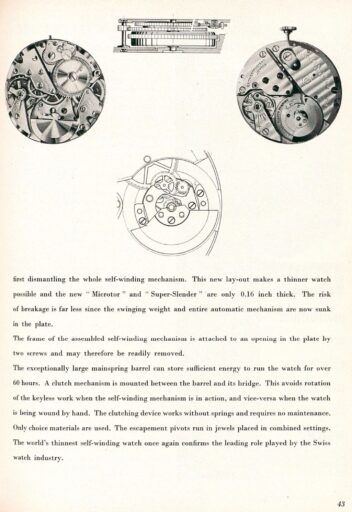
Coverage of the joint 1958 launch of the Buren Super Slender and Universal MicrotorImage: Europa Star Eastern Jeweler 46, 1958
The Rise of Self-Winding Watches
Le Locle watchmaker Abraham-Louis Perrelet is usually credited for building the first self-winding watch in the 1770s. Many1 have questioned the primacy of Perrelet’s “montre à secousses” (“shaking watch”), but many subsequent watchmakers, including Abraham-Louis Breguet, Louis Recordin, and the Jaquet-Droz family, claimed to have been inspired by his design. Perrelet’s watch used a weight mounted to the side of the movement, causing it to shake when moved. The concept of automatic winding (and even the name “perpetual”) were widely known through the 19th century but such a complex mechanism was deemed unnecessary to bring to market.
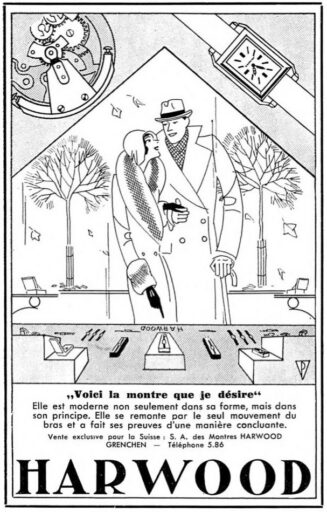
Harwood saw a market for a sealed self-winding watchAfter World War I, Englishman John Harwood saw a need for self-winding watch. Soldiers were increasingly wearing wristwatches, and these were often damaged by moisture and dust. Inspired by a playground see-saw, Harwood independently2 invented a rocking weight segment that could wind the watch without a hole in the case. He patented the concept in 1923, built a prototype using a Blancpain movement, and brought the Harwood Perpetual to market with the help of A. Schild and Fortis of Grenchen. The watch only went into production late in the decade, and just a few thousand were produced before the Great Depression soon spelled the end.
You might also enjoy reading about “The Backward Evolution of the Rotating Bezel“
Harwood showed that the advent of the wristwatch had created customer demand for a self-winding movement, and the race was on to deliver a more practical one. I previously wrote about Eugène Meylan’s automatic winding mechanism, which was sold by Glycine starting in 1931. Another early player in automatic watches was Blancpain, which built a patented sliding watch called the Rolls for the French firm, Léon Hatot. Another modestly-successful automatic watch in this period was the Wig-Wag, which used the motion of the movement relative to the strap to wind the watch. But these oddball automatics soon fell by the wayside3.
It was the Rolex Oyster Perpetual that brought together all of the elements of the modern automatic wristwatch. Introduced about 19344, Rolex used a centrally-mounted rotor and winding mechanism stacked on top of their excellent movement. This technique was impractical in a pocket watch (which tended to sit vertically in a pocket) but made much more sense when strapped to a wrist. But the Rolex Oyster Perpetual movement was so thick it had to be mounted in a so-called “bubble-back” expanded case.
The Rolex Oyster Perpetual really was ahead of its time!Image: Journal Suisse d’Horlogerie, January 1936
Seeing their success, especially though World War II, every Swiss company was racing to compete with Rolex with their own waterproof automatic watch. Felsa’s 1947 Bidynator brought bi-directional winding to the table5, ETA’s 1948 Eternamatic showed the potential of a rotor supported by ball bearings6, and Patek Philippe developed a “circumferential” rotor that extended down and around the movement. But all of these mechanisms added thickness, even as stylish consumers of the 1950s demanded ever-thinner watches. But making a thin automatic watch was inconceivable until the late 1950s, and the slimmest offerings (Zenith’s Cal. 133 and Movado’s Cal. 331) were bumper automatic movements, thin by accident rather than intentional design.
Hans Kocher and the Micro-Rotor
Hans Kocher grew up in the shadow of the H. Williamson watch factory in Büren an der Aare, Switzerland. He ran errands for the company as a young boy, and his work ethic so impressed the company’s chairman that he was sent to London to learn the business. But Kocher’s life took a turn when he met Austrian-born Josefine Rinner, a confectionary entrepreneur living in Zürich. The couple moved to Spain after the war, and their son (also named Hans) was born there in 1919. Kocher only settled down in 1923, marrying Josefine and returning to Bienne to work for the Williamson company. But the factory was bankrupt by 1931, with a group of local businessmen purchasing it. They invited Hans Kocher to return to Büren to take over management of the factory in 1932, and he spent the rest of his career there.
This rotor-in-a-rotor concept shows Kocher’s progress of inventionBut this is the story of the younger Hans Kocher, who apprenticed in Büren before studying at the Technical school in Bienne. Following World War II, young Hans Kocher moved to Saint-Imier and worked in the technical department of the nearby Cortébert Watch Company. He was a wunderkind, filing patents, developing a central-seconds movement, and reorganizing the company’s manufacturing process. In 1951, after he proved himself, Kocher returned home to become technical director of the Buren Watch Company7.
Kocher believed that technology could elevate Buren in the competitive Swiss watch market and decided to build the best-possible automatic watch movement. Although many aspects of automatic winding were already patented by others, he saw an opportunity to address some of the shortcomings of contemporary automatic watches. For example, Kocher invented a mechanism to allow an automatic watch to be wound by hand, addressing widespread anxiety about power reserve. He also invented a few different bi-directional winding mechanisms and a more effective jewel pivot.
Another Kocher invention seemed to go nowhere: He embedded a tiny rotor inside the main winding rotor, creating a “Tilt-A-Whirl” effect to accelerate startup. Although this didn’t make it into production, this was the first glimpse of a micro-rotor winding system. A month later, Kocher filed a patent that he would later call his greatest work.
Hans Kocher’s design for Buren had a symmetry lacking in the production movementOn June 21, 1954, Buren Watch Company filed a patent for a fully-realized micro-rotor automatic watch movement. Rather than adding a rotor on top of an existing movement, Hans Kocher redesigned the entire ebauche, reorganizing the wheel train to sink a tiny rotor inside. This was much more than a re-packaging effort, with nearly every component re-designed.
It would take nearly four years of development to bring the micro-rotor movement to market. The Swiss government had largely restricted companies from producing their own ebauches, but this was allowed for in-house and complicated movements. And the micro-rotor was indeed a very complicated movement, requiring entirely new design and tooling to be installed at the factory in Büren!
Kocher’s original micro-rotor movement design was elegant and symmetrical, already quite well-developed even in 1954. He called it a “planetary rotor” because he thought it resembled the planetary gearsets in automatic transmissions. But he spent years working on the construction and mechanics of the rotor and the exact arrangement of the wheels and bridges. And he soon had an unexpected collaborator.
Universal, Froidevaux, and Bandi
On May 27, 1955, Manufacture des Montres Universal of Geneva filed a remarkably similar patent for a micro-rotor movement. This was 11 months after Buren’s filing, yet three years before either patent would be published. Although the Swiss patent is un-signed, the American patent specifies that the inventors were Jean-Michel Froidevaux and Fred Bandi, two technician-watchmakers even younger than Hans Kocher. Both were incredibly talented and had made numerous inventions related to automatic watch winding and other areas of horology.
Patek Philippe filed for a patent their own micro-rotor movement in 1975, bringing their Cal. 240 to market a few years later. It has been continually updated and is one of the most-loved movements by enthusiasts like me. Chopard Manufacture leaned into the micro-rotor concept with the launch of the L.U.C movements in 1997, and it remains a highlight of the company’s offerings. A new Universal Genève launched in 2005, bringing a new Microtor (Cal. UG-100) to market in 2006. Schwarz Etienne and Parmigiani Fleurier both introduced new micro-rotor movements in 2010, and both supply these to other fine watch makers to this day. Armin Strom, Hermès, Girard-Perregaux, Bulgari, and many others have also released high-end micro-rotor movements. And Piaget never stopped developing their micro-rotor movements.
The original Universal design is similar to Büren’s at a glance but obviously not derivativeAt a glance, the Universal patent looks very similar to Buren’s, but a closer examination shows that nearly every aspect of the design is different. The American patent authorities examined it closely, rejecting only the most broad claim made by Universal. Given these differences, and the evident skills and imagination of Froidevaux and Bandi, I believe that it was independently invented.
Froidevaux left Universal by 1956, just as the company was developing the micro-rotor watch movement for production. This was the same year that Universal opened its own new factory near Geneva, severing ties with the chronograph factory in Ponts-de-Martel that had been the source of complicated in-house movements for Universal since 1941. The new Carouge-Genève factory was likely outfitted with new machinery to produce the micro-rotor, along with other in-house movements developed by Fred Bandi.
It is very likely that the amiable Hans Kocher knew of the work underway in Geneva by this time, and he may have offered Fred Bandi some technical advice. Indeed, we know that the two collaborated on a paper outlining the benefits of the micro-rotor movement, which was published in the September/October 1957 edition of Journal Suisse d’Horlogerie. They cite the improvements gained by this design in reducing movement height, stress on the rotor bearings, and ease of servicing.
Hans Kocher of Buren and Fred Bandi of Universal jointly announced the micro-rotor movement in this 1957 article in the Journal Suisse d’HorlogerieUp this point the thinnest automatic watch movements (Zénith’s Cal. 133 and Movado’s Cal. 331) had “bumper” movements rather than a free rotor. This is no surprise – the “sandwich stack” required to have a free rotor was inherently thicker than a winding mass that sat on the same plane as the wheel train and balance. But no bumper movement could match a micro-rotor embedded completely into the ebauche. Although not much thinner than hand-winding movements, the Büren and Universal movements were 20% thinner than most automatics at 4.1 to 4.2 mm8.
The Joint Release of the Buren Super Slender and Universal Microtor
On February 18, 1958, Raoul Perret of Universal Genève and Hans Kocher of the Buren Watch Company held a joint press conference in Geneva to announce “the greatest technical advance in 30 years.” Journalists from the major Swiss papers and industry journals learned about the revolutionary new micro-rotor technology, that would enable the companies to deliver the thinnest self-winding watches in the world. The companies promised that new watches using these movements would be released at the Basel Fair in April.
Ten days before the fair, on April 2, 1958, the Swiss paper Neue Zürcher Zeitung published an article with more detail on the technology of these new movements. Noting that “the fundamental concept behind this novel winding mechanism is identical in both designs,” the article praises both companies’ products, noting that “the specific technical solutions employed differ significantly.” This article was written by Fred Bandi, Technical Director for Universal Genève. Hans Kocher also wrote articles about the two companies’ launches, both independently and jointly with Bandi.
This 1958 advertisement, coinciding with the Basel Fair, shows both the Universal and Buren logos. The example preserved in The Watch Library even features a hand-written formula for the moment of inertia of a solid rotor, likely penned by a curious watchmaker!Finally, on April 12, 1958, the Basel Fair opened, with both companies showcasing watches housing their new micro-rotor movements. They even placed a joint advertisement in the Journal Suisse d’Horlogerie, featuring the logos of both companies.
The Büren showcase focused on the theme of “universality”The Buren Watch Company showed off their new Super Slender watch line at the fair, featuring Cal. 1000. This was a new ultra-thin watch line with a case meant to make the most of their “thinnest-ever” automatic watch movement. Confusingly, the company’s Basel Fair booth was a generic paean to post-war globalization, dedicated to the theme “l’universalité.” The new Super Slender movement was depicted on a small card at the corner, with the ultra-thin watches arranged among other more mundane products.
The Universal Genève display was dedicated to the Microtor Universal used the Microtor movement in the famous PolerouterUniversal Genève presented a strong contrast, dedicating their entire display to the new Microtor movement. They even built a large model in a transparent plexiglass case, demonstrating the internal relationship between the micro-rotor and wheel train. The new Cal. 215 was used in an existing product line, the Polerouter (which had been introduced as “Polarouter” in 1954). Although Universal offered new dial designs for 1958, the Microtor’s slimmer profile was not leveraged for a watch that was notably thin.
Buren proudly proclaimed that their Super Slender was the thinnest automatic watch in the worldBoth watches were brought to market in the following months with no hint of production delays. They are widely seen and advertised over the next few years in press coverage, company advertising, and retail promotion. For example, an April 1958 ad for international retailer Turler lists the Universal Polerouter Microtor for 270 francs in steel or 820 francs in gold. Meanwhile, the Buren Super Slender was advertised in 1959 for 170 francs in steel or 185 francs for the model with a calendar complication, called Cal. 1001.
What Happened Next
Buren and Universal leaned heavily into their micro-rotor watch movements for the next few years, developing and updating them continually. And two more ultra-thin automatic movements appeared at Basel in 1959 and 1960: The Sandoz 333, which used a peripheral rotor movement designed by FHF, and Piaget’s knock-out 2.3 mm thin micro-rotor Cal. 12 P. But the introduction of the Bulova Accutron on October 25, 1960 upended the entire industry.
Buren modified the wheel train bridge in 1959Buren actually introduced two micro-rotor movements at Basel in 1958: The base Cal. 1000 was truly “super slender” at 4.2 mm, but they also showed Cal. 1001, which added a date complication and 0.6 mm thickness. Although not as revolutionary as the micro-rotor, Paul Marmier’s patented date mechanism was quite innovative. It used an eccentric cam to keep the advance finger safely back from the date wheel teeth to avoid the risk of damage. The date advanced in just 12 minutes at midnight, and the mechanism also allowed quicker setting of the date by moving the time back to 11:30.
By 1959 Buren added Cal. 1002 and 1003, which featured a thinner balance cock to make way for an elongated wheel train bridge screwed to the base plate for greater stability. The original Cal. 1000 and 1001 remained in production, however, into the 1960s.
The Universal Polerouter collection expanded in 1959 with the Jet and Date modelsUniversal added a date complication as well, though theirs added over 1 mm to the thickness of the base Cal. 215. This did not pose an issue because the Microtor was used in watches of more ordinary thickness like the Polerouter Date. But the Geneva company did finally lean into the thin profile of the basic Microtor movement with the new 1959 Polerouter Jet, boasting that it was as thin as a hand-winding watch and the thinnest waterproof automatic watch in the world. Universal put the Microtor-Calendrier movement on a diet over the next few years, beveling the edges and slimming it to 4.7 mm (once again 0.1 mm thinner than the competing Buren movement). And Universal proved the robustness of their movement by equipping members of the Swiss Greenland Expedition with Microtor-powered Polerouters during the International Geophysical Year.
Other watches had previously been advertised for their ultra-thin profile, including Omega’s Centenaire and Cyma’s Navystar, but Movado, Sandoz, and Piaget were the strongest contenders. Movado had claimed the crown for the thinnest watch in 1935 with the Novoplan and delivered the automatic Cal. 331 in 1952, which was just 4.3 mm thick thanks to a beveled bumper rotor.
The Sandoz 333 was supposed to be the thinnest automatic watch but was launched a year too lateSandoz announced the “thinnest waterproof watch” in 1954 with their hand-winding Cal. 55, allowing them to produce a 6.9 mm watch. And they saw an opportunity in a peripheral rotor concept under development at the Fabrique d’Horlogerie de Fontainemelon. Unaware of the micro-rotor8, Sandoz and FHF targeted the 1959 Basel Fair to launch this new ultra-thin automatic watch. Despite being upstaged, the Sandoz 333 remains the first peripheral-winding automatic watch to market.
Piaget claimed outright victory for the thinnest watch in 1957 with the 4 mm Ref. 904, housing the 2.0 mm Cal. 9 P. Valentin Piaget of their specialist movement maker Complications SA saw unrealized potential in the micro-rotor concept. His Cal. 12 P, patented in 1958 and announced at the Basel Fair in 1960, dispensed with the center wheel and radically sliced away the ebauche. Measuring just 2.3 mm thick, this movement allowed Piaget’s Ref. 12 watches to stay at just 4 mm thick overall. Piaget has remained committed to this design, producing Cal. 1200 to this day!
The 1965 Buren Intra Matic was a modern interpretation of the ultra-thin dress watchImage: Europa Star 35, 1965
Buren embraced Piaget’s ideas, and their Cal. 1280 was similarly stripped-down, coming in at just 2.85 mm thick. This was used in their modern Intra Matic9 line, launched at the Basel Fair in 1965. Variations with date and central seconds ranged up to 3.60 mm, still over half a millimeter thinner than their original Super Slender.
The Intramatic movement made history on March 3, 1969 when Hans Kocher10 and Gerald Dubois announced the Chronomatic movement, built on Buren’s micro-rotor ebauche. This would be the first Swiss automatic chronograph in customer hands, used by Breitling, Heuer, and Hamilton, which had purchased Buren in February of 1966. Hamilton-Buren was taken over by the SIHH group in 1971 and the once-great Büren factory was closed the following year, with all assets sold. This came just as the Chronomatic was gaining market traction and sadly just before the launch of Buren’s great Calbre 8211.
The Universal Golden Shadow was just 4 mm thickImage: Eastern Jeweler 93, 1966
Universal also collaborated with Piaget, filing a joint patent in March of 1959 for a slim ratcheting winding system for micro-rotor movements. They continually updated their Microtor movement line, culminating in the 1966 introduction of the re-designed Cal. 66. Unlike the hand-made Piaget Cal. 12 P, the new Universal and Buren movements were designed for mass production and daily wear. And Universal once again beat Buren’s mark, with their ebauche measuring just 2.50 mm thick. This time Universal leaned into the thinness of the movement, matching Piaget with a new Golden Shadow watch line just 4 mm thick.
Everything changed for Universal in August of 1966, as the Bulova Watch Company of New York purchased the company. Flush with cash from the Accutron, a global phenomenon never before seen in watchmaking, Bulova sought to solidify its control over the luxury watch industry by bringing the Geneva firm under its control. Universal continued production of the Microtor family into the 1970s and even developed the world’s thinnest quartz movement in 197512. But Bulova was slow to embrace quartz as the market for the Accutron evaporated. The Universal factory in Geneva was bankrupt by the late 1970s and was sold in 1983 to new investors.
The Micro-Rotor Lives On
The micro-rotor is not dead. Far from it: There are more micro-rotor movements on the market today than ever before!
Universal was re-launched as an upscale sister brand to Breitling on April 8, 2026 and two new Microtor movements form the core of the new offerings. The new double-barrel Polerouter Microtor is a lovely tribute to Hans Kocher, who was deeply involved in both innovations. And the new Compax Microtor movement recalls the pioneering Chronomatic movement.
Research Notes