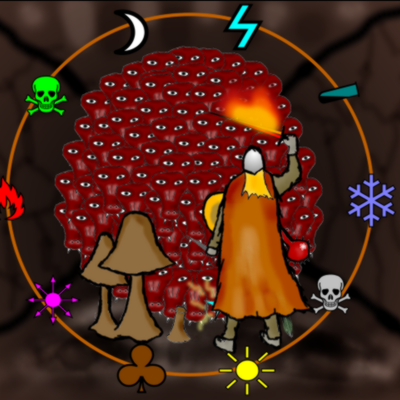
Mastery-focused players of run-based games (e.g. Dungeon Crawl Stone Soup, Wordle, Slay the Spire) want to compare their skills to other players.

How can they do this when it is impossible to know their exact probabilities of winning, and only observe their results?

Furthermore, we want the early attempts to not matter (they were still learning the game -- as in Go, it is best to lose the first 100 games as quickly as possible,
experimenting with various strategies), and also, we want playing more times to never drop the score (so, after getting a good score, they can still play their
favorite game without caring).

Here are some options:

* Block Winrate(\(n\)): Play \(n\) times, count the number of wins. Play n times, count the number of wins. And so on. The score is the number of wins in the best block.

* Rolling Winrate(\(n\)): Similar to Block Winrate, but any consesuctive sequence of \(n\) runs is considered.

* Streak_1(\(n\)): The longest streak of wins, capped with \(n\). After winning a streak of \(n\) games, we have proven ourselves, so what is the point to play anymore?*

* Streak_2(\(n\)): The greatest total length of two consecutive streaks, in other words, like the above, but one loss can be ignored.

OK, then, so it seems we should not only compare the players, but rather, compare the *methods* for comparing the players instead? (1/3)


#roguelike #mathart #mathviz

We cannot tell how fast we are moving (for example, do not feel that Earth is moving very fast). This is related to how the objects move at constant speed in a straight line if no force is acting on them.

This is not the case in spherical or hyperbolic geometry, though (assuming a naive model of time*). In this visualization, every point in the yellowish "ghost" moves in a straight line at constant speed. The captain could tell how fast they are moving by measuring these distortions.

* not the case in (anti-)de Sitter spacetime, as in Relative Hell. https://zenorogue.itch.io/relative-hell

#NonEuclideanGeometry #NonEuclidean #mathart #mathviz

Relative Hell by Zeno Rogue

Abandon all hope of moving faster than light

itch.io

Feeling like having a math-video marathon?

#3Blue1Brown made a list of their 25 favorite math explainers. Much of them are far above my head, but the clay animation and the string machine ones seem very cool just for the visuals.

https://www.youtube.com/watch?v=6a1fLEToyvU

#maths #mathart #mathviz #MathVisualization

25 Math explainers you may enjoy | SoME3 results

YouTube

Our new video! We take you on a journey through a small game world and showcase the non-Euclidean transformations of its third dimension.

Full video on YouTube: https://youtu.be/Rhjv_PazzZE #noneuclidean #mathart #mathviz #NoneuclideanGeometry #rogueviz

Non-Euclidean Third Dimension in Games

YouTube

Some #mathart from 2001.

Typical visualizations of surfaces I would see back then were boring, angular, and sameish -- they used the same default Mathematica colors, and the polygons were visible. (Google image "Mathematica surface graph" to find this style.)

Just like these typical graphs, this rendering method is based on triangles; however, as long as the triangles had >1 pixel, they are recursively subdivided -- and eventually single pixels are colored according to a formula.

#mathviz

If they expand in the same 'z' direction, but with different rates instead, it looks more like a horosphere (compare the first visualization in this thread); this is why hexes in the visualization below are squished when we look at them orthogonally from far away. #mathart #noneuclidean #hyperrogue #rogueviz #mathviz #visualization