 hackaday unofficial
Retrotechtacular: Measuring TV Audiences with the “Poll-O-Meter”
It may come as a shock to some, but TV used to be a big deal -- a very big deal. Sitting down in front of the glowing tube for an evening's entertainment was pretty much all one had to do after work, and while taking in this content was perhaps not that great for us, it was a goldmine for anyone with the ability to monetize it. And monetize it they did, "they" being the advertisers and marketers who saw the potential of the new medium as it ramped up in early 1950s America.
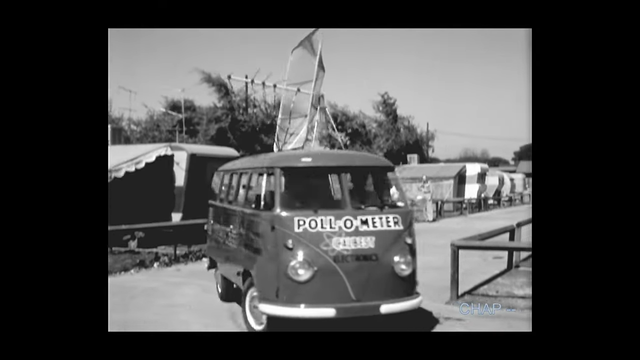
They faced a bit of a problem, though: proving to their customers exactly how many people they were reaching with their ads. The 1956 film below shows one attempt to answer that question with technology, rather than guesswork. The film features the "Poll-O-Meter System," a mobile electronic tuning recorder built by the Calbest Electronics Company. Not a lot of technical detail is offered in the film, which appears aimed more at the advertising types, but from a shot of the Poll-O-Meter front panel (at 4:12) and a look at its comically outsized rooftop antenna (12:27), it seems safe to assume that it worked by receiving emissions from the TV set's local oscillator, which would leak a signal from the TV antenna -- perhaps similar to the approach used by the UK's TV locator vans.
The Poll-O-Meter seems to have supported seven channels; even though there were twelve channels back in the day, licenses were rarely granted for stations on adjacent channels in a given market, so getting a hit on the "2-3" channel would have to be considered in the context of the local market. The Poll-O-Meter had a charming, homebrew look to it, right down to the hand-painted logos and panel lettering. Each channel had an electromechanical totalizing counter, plus a patch panel that looks like it could be used to connect different counters to different channels. There even appears to be a way to subtract counts from a channel, although why that would be necessary is unclear. The whole thing lived in the back of a 1954 VW van, and was driven around neighborhoods turning heads and gathering data about what channels were being watched "without enlisting aid or cooperation of … users." Or, you know, their consent.
It was a different time, though, which is abundantly clear from watching this film, as well as the bonus ad for Westinghouse TVs at the end. The Poll-O-Meter seems a little silly now, but don't judge 1956 too hard -- after all, our world is regularly prowled by equally intrusive and consent-free Google Street View cars. Still, it's an interesting glimpse into how one outfit tried to hang a price tag on the eyeballs that were silently taking in the "Vast Wasteland."
#retrotechtacular #antenna #audience #localoscillator #metric #television #tv #yagi