[Mirage - AI 에이전트를 위한 통합 가상 파일시스템

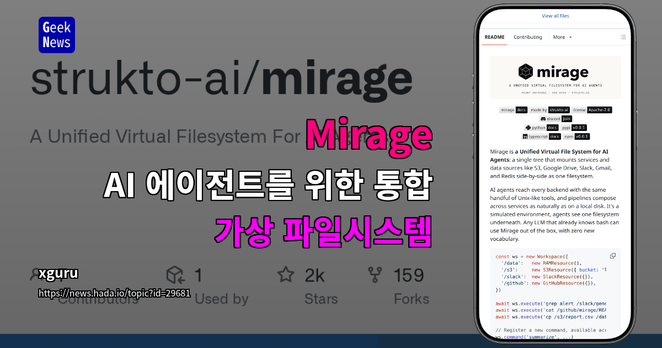
Mirage는 AI 에이전트를 위한 통합 가상 파일시스템으로, S3/구글 드라이브/슬랙/Gmail/Redis 등 다양한 백엔드를 단일 파일시스템 트리로 마운트하여 AI 에이전트가 Unix 계열 bash 도구만으로 접근할 수 있도록 설계된 오픈소스 프로젝트. 다중 리소스 마운트, 이식 가능한 워크스페이스, 앱 임베드, 에이전트 프레임워크 호환성, 경량 CLI + 데몬, 커스텀 커맨드 지원, 2계층 캐시(인덱스/파일 캐시), 플러그인 백엔드(RAM/Redis) 등을 제공하며 Apache-2.0 라이선스로 공개되었다. OpenAI Agents SDK, LangChain, Vercel AI SDK 등 주요 프레임워크와 호환된다.

https://news.hada.io/topic?id=29681

#aiagents #virtualfilesystem #unifiedbackend #bashintegration #llmdevelopment

Mirage - AI 에이전트를 위한 통합 가상 파일시스템 | GeekNews

S3/구글 드라이브/슬랙/Gmail/Redis 등 다양한 백엔드를 단일 파일시스템 트리로 마운트해 AI 에이전트가 동일한 인터페이스로 접근 가능에이전트가 서비스별 SDK/MCP를 새로 익힐 필요 없이, Unix 계열 bash 도구만으로 모든 백엔드를 다루며, 서비스 간 파이프라인을 로컬 디스크처럼 자연스럽게 구성시뮬레이션 환경으로 동작해 에이전트 입장에서는

GeekNews

Why Ruby Is the Better Language for LLM-Powered Development

LLM 기반 개발에서 Ruby가 TypeScript와 Python보다 코드 토큰 수를 28~45% 절감해 비용과 컨텍스트 윈도우 효율성을 크게 개선한다. Ruby의 간결한 문법과 자연어에 가까운 구문은 LLM이 더 정확한 코드를 첫 시도에 생성하도록 돕고, RSpec 테스트 프레임워크는 LLM 생성 코드 검증에 최적화된 기능을 제공한다. 타입스크립트의 타입 안전성과 파이썬의 ML 생태계 장점에도 불구하고, LLM과의 상호작용에서는 Ruby가 더 적합하며, 최신 JIT 컴파일러 덕분에 성능도 충분하다.

https://www.bytecode.hr/posts/why-ruby-is-the-better-language-for-llm-powered-development

#ruby #llm #tokenefficiency #rspec #llmdevelopment

Why Ruby Is the Better Language for LLM-Powered Development

Ruby uses 42–45% fewer tokens than TypeScript and 28–32% fewer than Python across every major LLM tokenizer. Here are the numbers, the code, and the argument.

Bytecode

Exciting news: Tredence’s AI Foundry will host a Builders Forum on Feb 7, 2026 in Chennai. Join leading minds in generative & agentic AI, data science, and LLM development to share open‑source tools and benchmark breakthroughs. Don’t miss the chance to connect, learn, and shape the future of machine learning. #AIFoundry #GenerativeAI #DataScience #LLMDevelopment

🔗 https://aidailypost.com/news/ai-foundry-by-tredence-host-builders-forum-feb-7-2026-chennai

The integration of Gemini CLI with Obsidian wasn't without its bumps, especially when dealing with newer features like Obsidian Bases. It's a great reminder that AI is a rapidly evolving field. My blog post breaks down the debugging process and lessons learned.

Learn more: https://www.ctnet.co.uk/gemini-cli-and-obsidian-bases-a-showcase-of-llm-strengths-and-weaknesses-in-2025/

#LLMdevelopment #Obsidian #GeminiCLI #TechBlogging #AIchallenges

Gemini CLI and Obsidian Bases: A Showcase of LLM Strengths and Weaknesses in 2025 - The Computer & Technology Network

Explore Gemini CLI's integration with Obsidian, showcasing LLM strengths and weaknesses in 2025. Learn from a real-world example?

The Computer & Technology Network

🎥 Live at saturday at 20:00 CEST: https://youtube.com/live/2vTv8W-Us1k?feature=share

Bring your ideas, questions, and experiments — the best part is the exchange of knowledge.
#AICommunity #GameDevCommunity #LLMDevelopment #OpenSource

Before you continue to YouTube

AI Agents and Large Codebases: Why Context Beats Speed Every Time

Introduction: The Real Bottleneck in AI-Assisted Development

The conversation about AI agents in large codebases often focuses on speed. Benchmarks measure how fast a model can generate code, fix bugs, or respond to prompts. While speed matters, my experience tells a different story. In AI-assisted development, especially with LLM agents working across large and complex projects, context is the true limiting factor. Without sufficient context, AI agents deliver quick but incomplete or even damaging changes.

Where AI Agents Struggle in Large Codebases

When using AI agents or LLM-based sub-agents in enterprise-scale software, the problem is rarely raw performance. It is the lack of complete, coherent context window coverage. Even advanced retrieval methods cannot always pull the right code segments, leading to blind spots that cause:

  • Broken dependencies in related modules.
  • Security checks missed due to code being outside the loaded context.
  • Naming or architectural inconsistencies across services.
  • Regressions in performance caused by incomplete view of the system.

In AI-assisted development for large codebases, these context limitations compound quickly.

Context vs Speed: Why Context Wins in AI-Assisted Development

A senior human developer is valuable not just because of coding speed, but because of architectural awareness. They understand the “why” behind system design choices. AI agents that lack this level of context inevitably cause:

  • Refactors that break unrelated parts of the code.
  • Misaligned feature implementations that ignore upstream decisions.
  • Costly cleanup work to restore consistency.

The fastest AI model in the world cannot outperform a slower one if it is working without the right context.

The Hidden Costs of Large Codebase AI Assistance

The economics of AI-assisted development change when context is limited:

  • Context expansion costs: Larger context windows increase API usage fees.
  • Multiple pass requirements: Splitting work into batches leads to more billable calls.
  • Sub-agent coordination overhead: More agents mean more reconciliation work.
  • Verification cycles: Additional cost for testing and correction.

Without careful planning, the cost of AI-generated code for large codebases can outweigh the savings.

Practical Strategies to Improve Context in AI Agents

From my work integrating AI agents in large-scale development, I have found the following strategies effective:

  • Hierarchical retrieval to pull only the most relevant code segments.
  • Persistent project memory to store decisions and architecture notes.
  • Agent memory coordination for consistent state sharing across sub-agents.
  • Cost-aware orchestration to balance performance with predictable spend.

These are engineering-level adjustments, not just model upgrades.

Conclusion: Designing AI-Assisted Development for Large Codebases

If you are serious about AI-assisted development for large codebases, focus on sustainable context management rather than raw generation speed. Without it, you risk higher costs, more regressions, and lost productivity. My own experience confirms that context, not speed, is the bottleneck. I suspect many other developers working with AI agents and sub-agents have faced the same challenges, and I would be interested to hear if your experience aligns.

#AIAgents #AIAssistedCoding #contextVsSpeed #contextWindowLimitations #developmentCosts #largeCodebases #LLMDevelopment #SoftwareEngineering

🚀 Build smarter AI with Sunrise Technologies! We deliver custom Large Language Models (GPT-4, Claude, LLaMA & more) for enterprise-grade automation, chatbots, analytics & more. Secure, scalable & multilingual.

🌐 https://zurl.co/Sxe76

#LLMDevelopment #AI #GenerativeAI

Japan’s lag in generative AI and LLM creation explained. #AIInnovationJapan

Hashtags: #chatGPT #AIinJapan #LLMdevelopment Summery: Japan is falling behind in the race to develop generative artificial intelligence (AI) algorithms, according to Noriyuki Kojima, co-founder of Japanese LLM startup Kotoba Technology. While generative AI has the potential to fuel a 7% increase in global GDP over the next decade, Japan is trailing behind the US, China, and the EU in…

https://webappia.com/japans-lag-in-generative-ai-and-llm-creation-explained-aiinnovationjapan/

Japan's lag in generative AI and LLM creation explained. #AIInnovationJapan

Hashtags: #chatGPT #AIinJapan #LLMdevelopment Summery: Japan is falling behind in the race to develop generative artificial intelligence (AI) algorithms, according to Noriyuki Kojima, co-founder of Japanese LLM startup Kotoba Technology. While generative AI has the potential to fuel a 7% increase in global GDP over the next decade, Japan is trailing behind the US, China,

Webappia