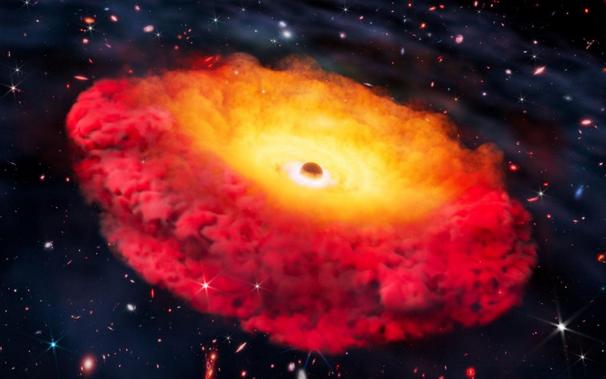
#LittleRedDot variability over a century reveals black hole envelope via a giant Einstein cross: https://arxiv.org/abs/2512.05180 -> One image tracks the same cosmic object across space and time. It's all down to a strange quirk of physics: https://www.skyatnightmagazine.com/news/rxc-j2211-0350-little-red-dots
Little red dot variability over a century reveals black hole envelope via a giant Einstein cross

"Little red dots" (LRDs) represent a new population of astronomical objects uncovered by JWST whose nature remains debated. Although many LRDs are suspected as active galactic nuclei (AGN), they show little variability on days-years timescales. We report the discovery of two gravitationally lensed LRDs at redshift $\sim$4.3 behind the cluster RXCJ2211-0350, one of which (RX1) is quadruply imaged with time delays spanning $\sim$130 years. RX1 exhibits intrinsic color and brightness variations of up to 0.7 magnitude among its images. These changes are consistent with blackbody-temperature variations of a photosphere, indicating long-term variability analogous to Cepheid-like pulsations but in a far more extended ($R \sim 2000$ AU) and massive ($M \gtrsim 10^6 \, M_{\odot}$) systems. These results suggest LRDs as a distinct class of AGN with stellar-like envelopes.

arXiv.org
The X-Ray Dot: Exotic Dust or a Late-Stage #LittleRedDot? https://arxiv.org/abs/2601.09778 -> A Potential New Piece of the “Little Red Dot” Puzzle: https://astrobites.org/2026/01/26/x-ray-dot/
The X-Ray Dot: Exotic Dust or a Late-Stage Little Red Dot?

JWST's "Little Red Dots" (LRDs) are increasingly interpreted as active galactic nuclei (AGN) obscured by dense thermalized gas rather than dust as evidenced by their X-ray weakness, blackbody-like continua, and Balmer line profiles. A key question is how LRDs connect to standard UV-luminous AGN and whether transitional phases exist and if they are observable. We present the "X-Ray Dot" (XRD), a compact source at $z=3.28$ observed by the NIRSpec WIDE GTO survey. The XRD exhibits LRD hallmarks: a blackbody-like ($T_{\rm eff} \simeq 6400\,$K) red continuum, a faint but blue rest-UV excess, falling mid-IR emission, and broad Balmer lines ($\rm FWHM \sim 2700-3200\,km\,s^{-1}$). Unlike LRDs, however, it is remarkably X-ray luminous ($L_\textrm{2$-$10$\,$keV} = 10^{44.18}\,$erg$\,$s$^{-1}$) and has a continuum inflection that is bluewards of the Balmer limit. We find that the red rest-optical and blue mid-IR continuum cannot be reproduced by standard dust-attenuated AGN models without invoking extremely steep extinction curves, nor can the weak mid-IR emission be reconciled with well-established X-ray--torus scaling relations. We therefore consider an alternative scenario: the XRD may be an LRD in transition, where the gas envelope dominates the optical continuum but optically thin sightlines allow X-rays to escape. The XRD may thus provide a physical link between LRDs and standard AGN, offering direct evidence that LRDs are powered by supermassive black holes and providing insight into their accretion properties.

arXiv.org
De “Little Red Dots” zijn supermassieve zwarte gaten
Astrofysici van de universiteit van Kopenhagen hebben aangetoond dat de raadselachtige “little red dots” – rode bronnen verspreid over beelden
#heelal #LittleRedDot #SupermassiefZwartGat #VroegeHeelal #WebbSpaceTelescope #ZwartGat
https://www.kuuke.nl/de-little-red-dots-zijn-supermassieve-zwarte-gaten/
Astronomen vinden het verst verwijderde zwarte gat tot nu toe
Het nieuw gevonden supermassieve zwarte gat bevindt zich in het centrum van een “klein rode punt”-sterrenstelsel met de aanduiding CAPERS-LRD-z9
#heelel #LittleRedDot #SupermassiefZwartGat #VroegeHeelal #WebbSpaceTelescope #ZwartGat
https://www.kuuke.nl/astronomen-vinden-het-verst-verwijderde-zwarte-gat-tot-nu-toe/

#UHH:
"
Entdeckung eines neuen „Little Red Dots“ in einer sehr massereichen Umgebung
"
"Forschende .. haben ein sogenanntes Little Red Dot im frühen Universum entdeckt. Diese Klasse von Objekten ist erst seit Kurzem bekannt und könnte neue Einblicke in die Entstehung sowie Entwicklung supermassereicher Schwarzer Löcher geben .."

https://www.min.uni-hamburg.de/ueber-die-fakultaet/aktuelles/2025/0917-entdeckung-little-red-dots-in-massereicher-umgebung.html

17.9.2025

#Astronomie #COSMOS3D #Hamburg #JWST #LittleRedDot #Quasar #Rotverschiebung #SchwarzesLoch #SMBH #Weltraumteleskop

Entdeckung eines neuen „Little Red Dots“ in einer sehr massereichen Umgebung

Universität Hamburg
A remarkable ruby - absorption in dense gas, rather than evolved stars, drives the extreme Balmer break of a #LittleRedDot at z = 3.5: https://www.aanda.org/articles/aa/full_html/2025/09/aa54681-25/aa54681-25.html -> “Black Hole Stars” could solve JWST riddle of overly massive early galaxies: https://www.mpia.de/news/science/2025-06-black-hole-stars
A remarkable ruby: Absorption in dense gas, rather than evolved stars, drives the extreme Balmer break of a little red dot at z = 3.5 | Astronomy & Astrophysics (A&A)

Astronomy & Astrophysics (A&A) is an international journal which publishes papers on all aspects of astronomy and astrophysics

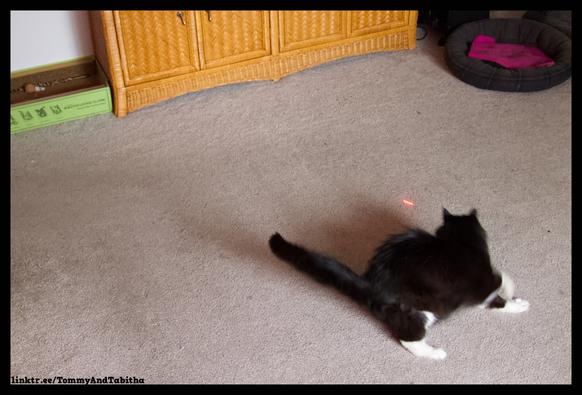
Tommy the Cat and the little red dot. Guest starring: the taller human's foot.
#cat #catplaying #littlereddot #tuxedocat #longhairedcat #floof #fedicats #pixelcats #cats #chats #katzen #gatos #gatti

Last Saturday I came across this little red dot in a Galaxy Zoo image and marked it as something someone might want to look at since it mystified me.

It seems I missed a paper published a year ago announcing a new kind of galaxy discovered with JWST, the (wait for it) Little Red Dot.

GZ just got JWST images a week or two ago and we've apparently turned up at least seven of them. No idea if this one is new, but still fun to have maybe made a minor discovery. #LittleRedDot #JWST #GalaxyZoo