 Alfred M. Szmidt
 Marce Coll
What lies in the intersection of #uxn and #lispmachine exploring that tonight
@jackdaniel I had something like that, but much less fancy when hacking on the #LispMachine.
 lispwizard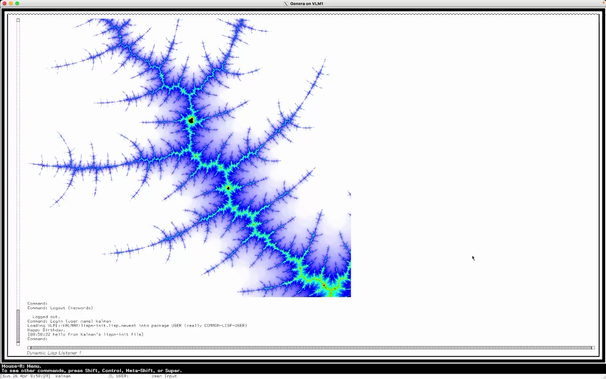
 Kent Pitman
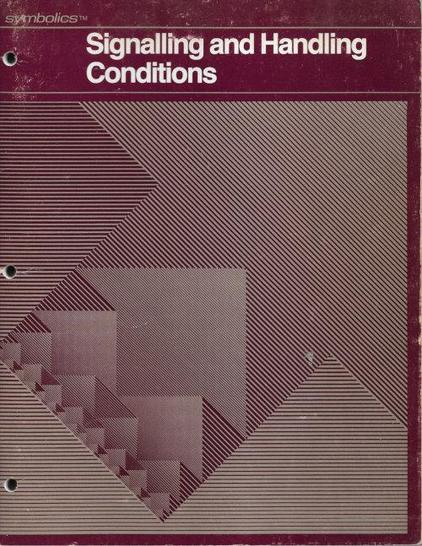
You can pick up the document 'Signalling and Handling Conditions' from this index page:
It was longer than I thought it would be, but I think you'll find it interesting to see what the Zetalisp condition system (which inspired the Common Lisp condition system) looked like.
In spirit, it was much the same. The biggest differences are:
* The CL system has 'active' restarts, where the ZL system had a passive thing where you returned a value to the case context and hoped that it would do the thing you wanted. It felt quite a bit more error-prone (if you'll pardon the reuse of 'error' here, maybe I should say 'mistake-prone').
* The ZL condition system offers a lot of really low-level stuff that did not seem proper for CL.
* The set of operations offered in ZL was richer, but also a lot more complicated, I thought, and I worried people would not really see what it was trying to do.
* Obviously, the ZL system was based on Flavors, not CLOS, and made reference to a lot of LispM-specific packages.
* The document was published in January, 1983 and identifies itself as part of Symbolics Release 4.0.
There are other differences as well.
#Zetalisp #LispMachine #LispMachines #Symbolics #LispM
#ConditionHandling #ConditionSystem #ErrorSystem #ErrorHandling #CommonLisp #CL #Flavors #CLOS #History #ComputerHistory
#InternetArchive #Bitsavers
 Dimly Lit Corners
Any attempt to reimagine a (viable) #LispMachine would not just recreate what was, it would have to imagine what could've been and how lisp machines may have evolved since 1990s… eg: support for GUI, multitasking, WiFi, internet, World Wide Web, multi-gesture touchpads, touchscreens, multi-core cpus, 8 GB RAM, virtual machines, … just to name a few
 Paolo Amoroso
This 1981 paper described an online help browser and authoring environment for TI or MIT Lisp Machines. The paper is interesting as it also briefly reviewed the state of online help systems at the time.
Tim Bradshaw discusses the myths around Lisp Machines and why they were probably never competitive.
https://www.tfeb.org/fragments/2025/11/18/the-lost-cause-of-the-lisp-machines
 The Medley Interlisp Project
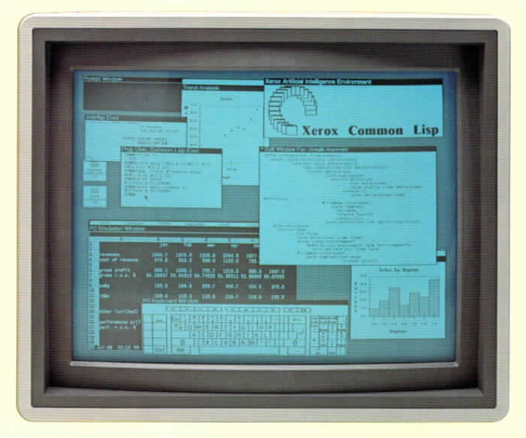
In the 1980s some Xerox Lisp Machines came with an IBM PC/XT expansion card that allowed running MS-DOS software from the Interlisp-D environment, like the black window of a spreadsheet program at the bottom left. This screenshot is from a flyer of the Xerox 1186 AI workstation.
https://groups.google.com/g/lispcore/c/aCC34TmRSmc/m/KQwufgfABQAJ
 restorante
As far as I know, in Lisp Machine, the entire software, from the operating system into user applications are all available as gigantic Lisp functions.
We can use the functions in our code. We can also edit the code, even the code of the program we are currently running, save the code, then reload it.
Yes, the operating system itself can be edited, saved and reloaded.
But it is different with Emacs. It is basically an elisp interpreter with some functionalities to aid text editing. These two are all C code.
They cannot be edited, saved and reload.
Emacs in Unix possibly is different with Emacs (EINE, ZWEINE) on Lisp Machine.
GNU Emacs as a Lisp Machine surely is very nice. But Daniel Weinreb himself disagree with that.
Is it possible that Emacs is only Lisp Machine in spirit only?
Here is the link: https://web.archive.org/web/20250427073638/http://xahlee.info/emacs/misc/Daniel_Weinreb_rebuttal_to_rms.html
Note: on the debate about the original creator of Emacs, whether it is David Moon & Guy Steele or Richard Stallman, I am completely neutral.
Edit: I have ever heard somewhere that Maxima is quite similar with GNU Emacs. At the core of Maxima is an implementation of Common Lisp. Maxima is just sitting on top of the Common Lisp.
#GNUEmacs #Emacs #LispMachine #Symbolic #LMI #RMS #DavidMoon #Maxima #CommonLisp