 salvari
Preparando a nova versión do siguelineas Raptor (unha creación de @felixstdp )
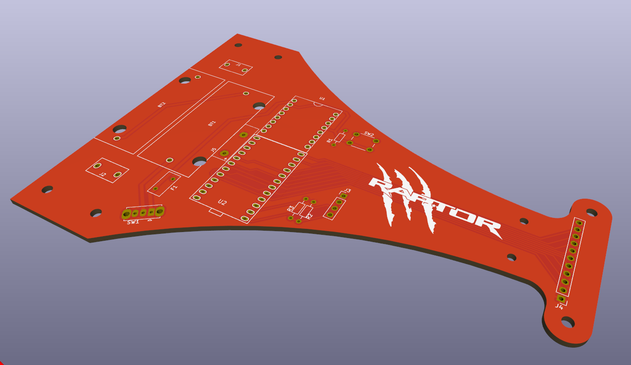
Preparando a nova versión do siguelineas Raptor (unha creación de @felixstdp )
A Line Follower With No Brains
A line follower is a common project for anyone wishing to make a start in robotics, a small wheeled device usually with some kind of optical sensor which allows it to follow a line drawn on the surface over which it runs. In most cases they incorporate a small microcontroller or perhaps an analogue computer which supplies power and steering control, but as the Crayon Car from [Greg Zumwalt] demonstrates, it's possible to make a line follower without any brains at all.
This seemingly impossible feat is achieved thanks to the line and road surface, it runs on a piece of paper over which the line is drawn with a crayon. The robot has a single straight-line drive wheel at one end and a pair of driven rollers at 90 degrees to each other at the other end, with the magic happening due to the difference in friction between paper and crayon. The robot follows a circular track with no problem, and while we can see it's not without flaws we doubt it would be possible to make a simpler follower.
Sharp-eyed readers will have noticed that this is not the first line follower we've shown you which claims to have no brains, but we'd claim that since the previous machine had an analogue circuit, this one is a more worthy contender to the crown.
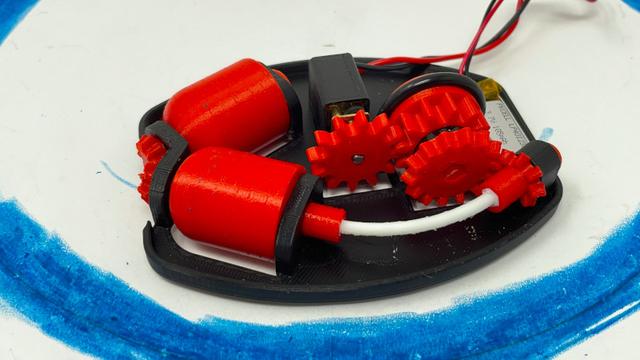
Line Following Robot uses PID for Speed
While a line-following robot may not be the newest project idea in the book, this one from [Edison Science] is a clean build using modern components and gets a good speed thanks to PID control feedback instead of the more traditional bang-bang control you see in low-end robots.
Of course, PIDs need tuning and that seems to be the weak link -- you'll have to experiment with the settings. The sensors also require calibration, but we bet both of those issues could be fixed pretty easily.
If the idea of PID is new to you, the acronym stands for porotional, integral, and derivative. To determine the output at any given time, you look at where you are compared to where you want to be (the present value vs the set point). Then you compute a proportional error. So, for a temperature, for example, if you want to be at 30 degrees and you are at 20 degrees, that a proportional error of 10 degrees. You also want to look at how much change has been building up over time and the rate of change of the error.
We've had some excellent PID tutorials in the past if you want to read some math. Thie simplest line followers don't need PIDs or even CPUs.

 Tech News 24h
 hackaday unofficial
