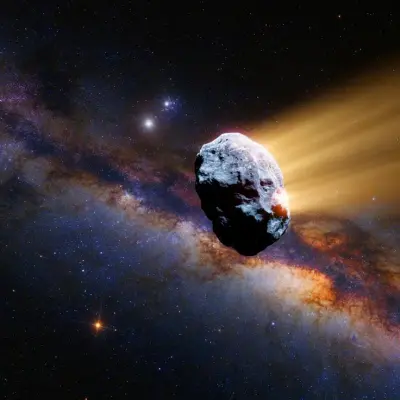
 3i/Atlas
 Daniel Fischer
A Natural ≳ 100x Telescope: Discovery of the Strongly #Lensed Type II SN 2025mkn at z=1.37: https://arxiv.org/abs/2604.07983 -> The Universe’s Most Powerful Telescope: https://www.universetoday.com/articles/the-universes-most-powerful-telescope

A Natural $\gtrsim 100\times$ Telescope: Discovery of the Strongly Lensed Type II SN 2025mkn at $z=1.37$
We present the discovery of SN 2025mkn, a gravitationally lensed Type II supernova. First detected as a blue transient in ZTF, 0.83$^{\prime\prime}$ from a $z=0.42$ elliptical galaxy, follow-up SNIFS/UH2.2m and LRIS/Keck spectra revealed absorption lines at $z=1.371$. Later JWST NIRCam imaging shows that the bright transient is a close pair of point sources separated by $\sim 0.07^{\prime\prime}$, and a 30 times fainter counterimage opposite the lens, for which NIRSpec reveals strong H$α$ emission also at $z=1.371$. The light curves and spectra are consistent with the Type II supernova source being magnified $\gtrsim 100$ times, with $\sim 250$ required to reconcile its luminosity with that of nearby events such as SN 2023ixf. Lens models are consistent with such high magnifications, and always show that the faint image arrived first (undetected in earlier ZTF imaging), consistent with the later spectral phase of this fainter image. A fourth image is also predicted and possibly detected in the NIRSpec data. Light-curve-based time-delay measurements are not possible due to the first image being the faintest; however, the resolved NIRSpec spectra offer a future opportunity for time-delay cosmography through supernova phase measurements.
 Knowledge Zone
#Lensed #Quasars are extremely distant and luminous active galactic nuclei (AGNs) whose light is bent, distorted, and magnified by the gravity of a foreground massive galaxy or galaxy cluster—a phenomenon known as gravitational lensing.
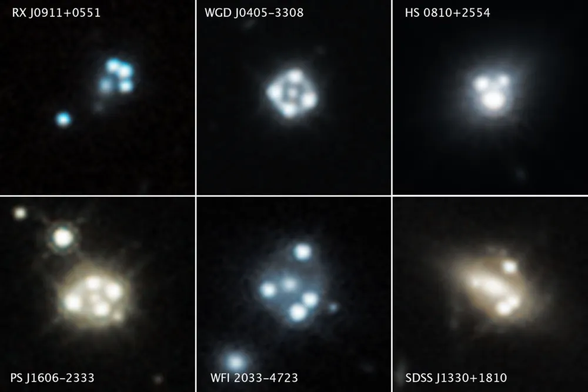
JWST’s PEARLS - a Candidate Massive Binary Star System in a #Lensed Galaxy at Redshift 0.94: https://iopscience.iop.org/article/10.3847/1538-4357/ae2003 -> JWST Spies a Potential Microlensed Massive Binary Star System: https://aasnova.org/2026/02/11/jwst-spies-a-potential-microlensed-massive-binary-star-system/

JWST’s PEARLS: A Candidate Massive Binary Star System in a Lensed Galaxy at Redshift 0.94
JWST’s PEARLS: A Candidate Massive Binary Star System in a Lensed Galaxy at Redshift 0.94, Williams, Hayley, Kelly, Patrick L., Zapartas, Emmanouil, Windhorst, Rogier A., Conselice, Christopher J., Cohen, Seth H., Dhanasingham, Birendra, Diego, José M., Filippenko, Alexei V., Frye, Brenda L., Holwerda, Benne W., Jones, Terry J., Koekemoer, Anton M., Meena, Ashish Kumar, Ricotti, Massimo, Robertson, Clayton D., Saikia, Payaswini, Sun, Bangzheng, Willner, S. P., Yan, Haojing, Zitrin, Adi
 Laszlo Xalieri
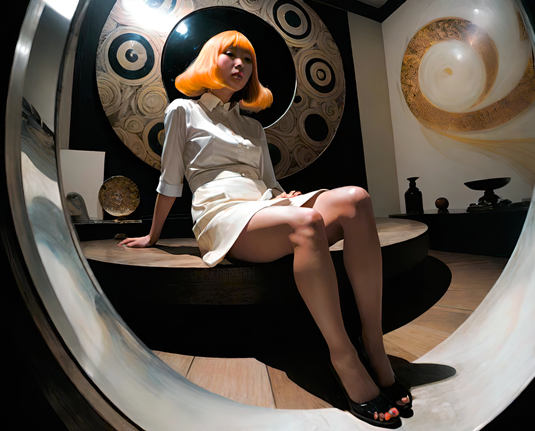
Issues with dimensional consistency, set 3. 3 of 3
#Lensed #SomethingTwisted #NonEuclidean #SpiralingShape #IComeHereForTheAmbience #WeirdArt #PsychologicalLandscape #ImSureItMustMeanSomething
#DarkArts #DigitalArt #AIAssistedArt #AIArt #WomboDream #StableDiffusion
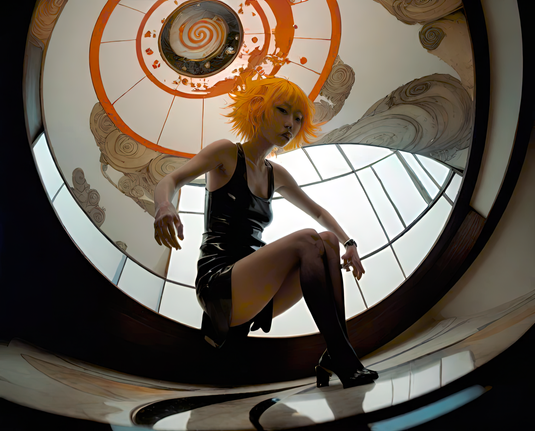



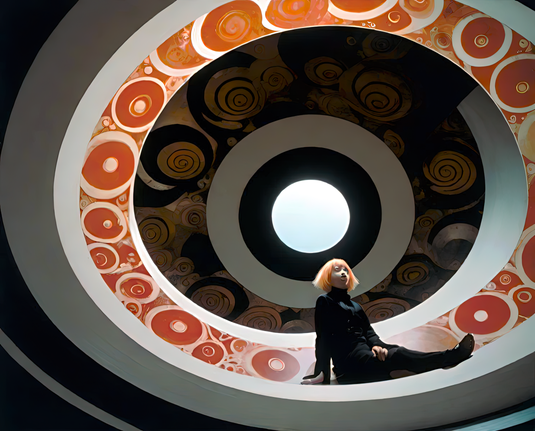
Issues with dimensional consistency, set 3. 2 of 3
#Lensed #SomethingTwisted #NonEuclidean #SpiralingShape #IComeHereForTheAmbience #WeirdArt #PsychologicalLandscape #ImSureItMustMeanSomething
#DarkArts #DigitalArt #AIAssistedArt #AIArt #WomboDream #StableDiffusion



Issues with dimensional consistency, set 3. 1 of 3
#Lensed #SomethingTwisted #NonEuclidean #SpiralingShape #IComeHereForTheAmbience #WeirdArt #PsychologicalLandscape #ImSureItMustMeanSomething
#DarkArts #DigitalArt #AIAssistedArt #AIArt #WomboDream #StableDiffusion

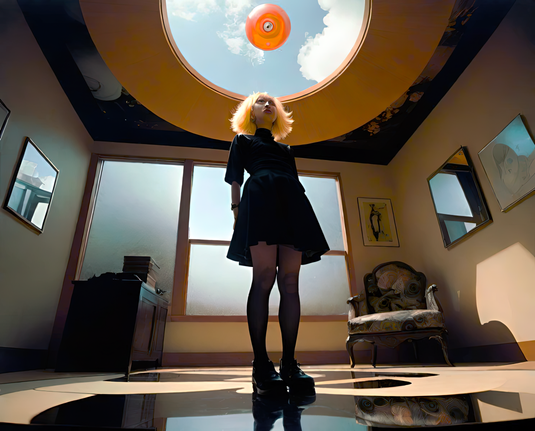
Issues with dimensional consistency, set 2. 3 of 3
#Lensed #SomethingTwisted #NonEuclidean #SpiralingShape #IComeHereForTheAmbience #WeirdArt #PsychologicalLandscape #ImSureItMustMeanSomething
#DarkArts #DigitalArt #AIAssistedArt #AIArt #WomboDream #StableDiffusion

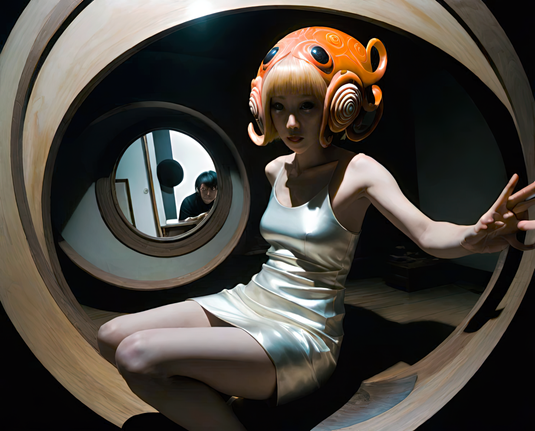

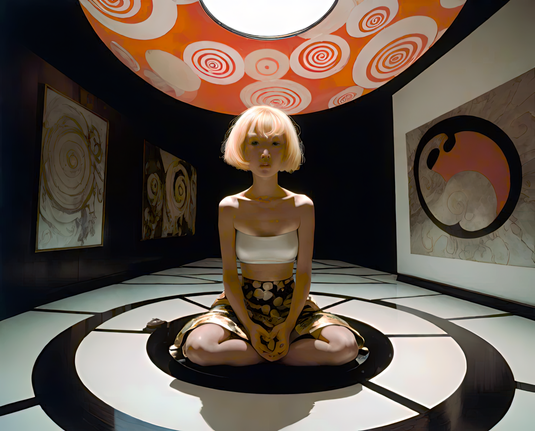
Issues with dimensional consistency, set 2. 2 of 3
#Lensed #SomethingTwisted #NonEuclidean #SpiralingShape #IComeHereForTheAmbience #WeirdArt #PsychologicalLandscape #ImSureItMustMeanSomething
#DarkArts #DigitalArt #AIAssistedArt #AIArt #WomboDream #StableDiffusion
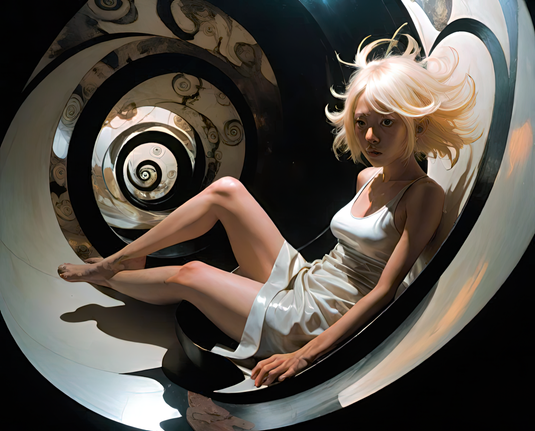
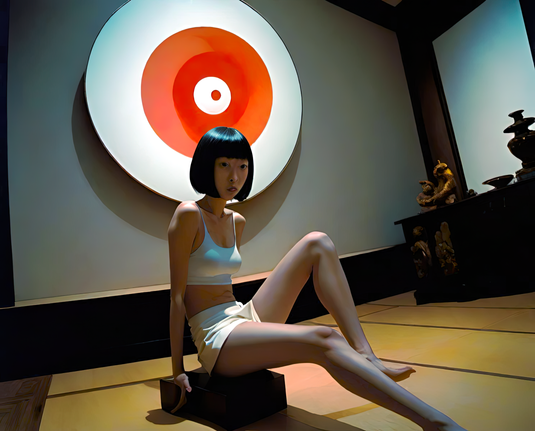

Issues with dimensional consistency, set 2. 1 of 3
#Lensed #SomethingTwisted #NonEuclidean #SpiralingShape #IComeHereForTheAmbience #WeirdArt #PsychologicalLandscape #ImSureItMustMeanSomething
#DarkArts #DigitalArt #AIAssistedArt #AIArt #WomboDream #StableDiffusion