@speaktrap I use a variety of tools, but never destructive.

Check out #LearnLockpickingWithAlice for lessons.

#LearnLockpickingWithAlice lesson 11 (part two): DIY padlock shims!

Who wants to spend a $5 on fancy padlock shims, when you can make shitty ones for the price of a soda can (and maybe a finger or two)?

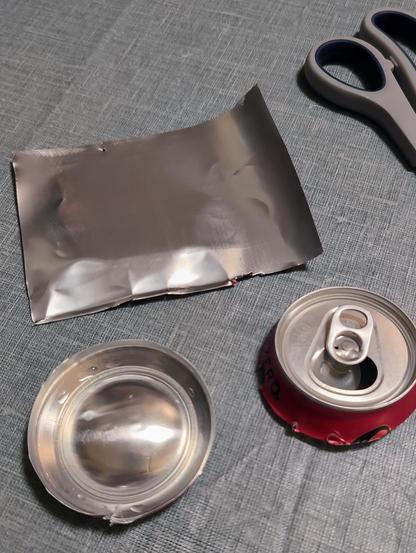
Today, I'm going to teach y'all how to turn a soda can into like 6 disposable padlock shims.

⚠️ Soda cans are razor sharp on the cut edges, please be careful; your fingers will thank you 🫶

1. To start, get yourself an empty can of soda, beer, energy drink, etc.

2. Using some scissors you don't care about, cut the top and bottom off along the bevel. You should now have a tube that is open at both ends.

3. Cut the tube down one side and flatten it out into a rectangle, then cut it into 2.5" x 1" strips.

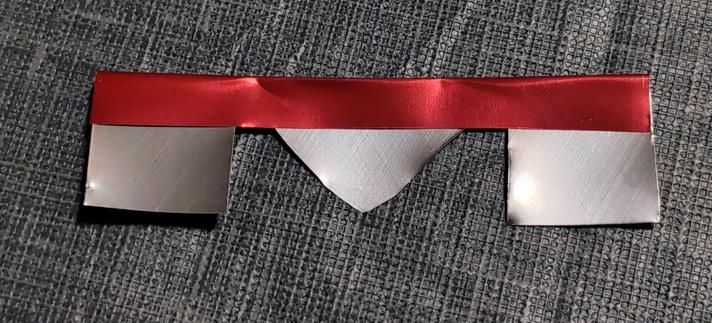
4. Take a strip and (with a marker) divide it into a 4x4 grid.

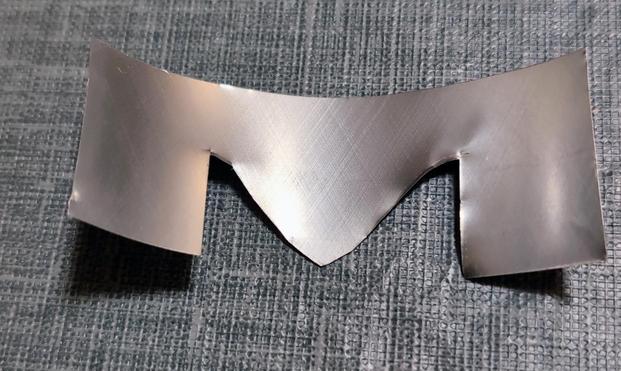
5. Then cut an "M" shape out of the bottom half of the 2.5" x 1" rectangle.

6. Fold the top ¼ of the rectangle down.

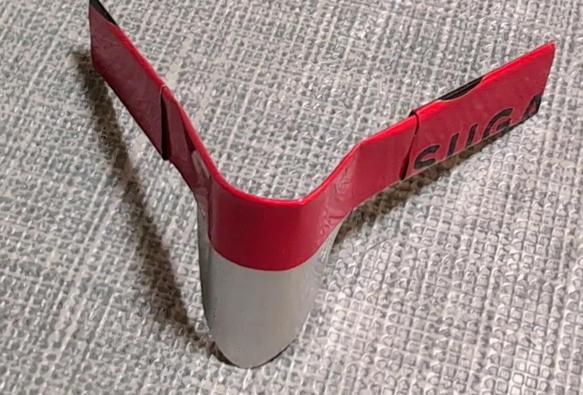
7. Fold the legs of the "M" up and over the top on each side.

8. Shape the shim around a lock shackle.

9. Shim something.

#AlicePics #DIY #Locksport #BypassTechniques #AltText

@jab01701mid check out lesson 10 of #LearnLockpickingWithAlice, you can do a 4-digit bike lock in under a minute with some practice.

#LearnLockpickingWithAlice lesson 11: Shimming shit ('cause ain't nobody got time for dial locks).

Plenty of old or cheap locks can be shimmed, but the place this technique shines most is with those front-dial combination locks. Sure, you can look up the model number, find some arcane YouTube video, and spend 30 minutes decoding it (both the video *and* the lock)...

...or you can do a little shimming fuckery and have it open in seconds.

To shim a lock, you'll need two things: a shimmable lock, and something to shim it with.

So how do I tell if a lock is able to be shimmed? Well, there are three main types of locking mechanisms on padlocks: ballbearing, spring-loaded, and warded (which you can see an example of in lesson 10). We want the spring-loaded kind.

The easy way to tell the spring-loaded ones from the ballbearing is that the cutouts in the shackle will look like either an upside-down "7" or a "]" for the pawl, instead of a ")" which indicates a ball-bearing lock. This matters because if the only thing keeping the locking pawl (that little metal bit that grabs the shackle's cutout) in place is a stiff spring, then the only thing between us and opening the lock is reaching it.

How do we reach that pawl? With a little piece of metal called a padlock shim. They look like a little mouth with a blep 👅 at the bottom—and like A Christmas Story, we want to get it right up against that pole.

How to shim a padlock:
- Insert the shim with the tongue facing away from the mechanism (toward the outside).
- Pinch the wings so it hugs the shackle.
- Push it down as far as it will go.
- Rotate/work it toward the inside of the lock while keeping pressure on it.
- Wiggle and press down on the shackle a bit to help it slide in.

Once it’s in:
- Hold the shim in place.
- Give the shackle a firm yank—and probably send your shim flying.

"Wtf, Alice, it didn't work?! How could you lie to me?"

Okay, slow down. There are a few reasons for that.

First, the mechanism might be on the other side of the shackle—or even on both sides.

If it's still not working, the shim either isn’t deep enough, isn’t long enough, or the lock isn’t spring-loaded.

Additionally, some locks are *technically* shimmable, but the clearance around the shackle is too narrow to fit a shim in. In this case, a thinner shim, or a narrow pokey piece of metal might still work.

Finally, this lesson wouldn't be complete without mentioning that padlock shims are a disposable resource. They *will* break—sometimes after only a couple uses. If you're lucky, they'll last for dozens of attempts though.

Which leads me to my friend, @deviantollam, who is well-known for making shims out of soda or beer cans. These shims are fragile, but they'll work in a pinch and only take a moment to make. If you're good, you can even tear a can into a close enough shape for the job—just be careful, those fuckers are *sharp*.

#Locksport #Bypass #Shimming

I've been thinking about new #LearnLockpickingWithAlice lessons, and I think I can easily write up ones on the following:
- shimming
- different lock varieties
* tubular
* warded
* disc-detainer
* lever
- combo lock bypasses
- handcuffs

I might write up the shimming one today and shoot some videos for it.

#LearnLockpickingWithAlice lesson 10: Decoding combination locks by "Pull-Picking".

There are a lot of types of combination locks out there, but one of the most common is also one of the easiest to open—no tools necessary.

So, today I'm going to talk about popping locks with nothing but some fingers and a little feeling around.

Almost every example of this style of combination lock uses a series of 3-4 wheels, with 10 numbers or letters arranged around each one (though a rare few have fewer positions per wheel, or a fifth wheel).

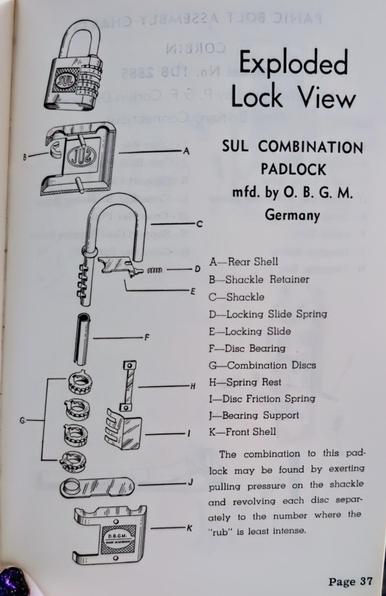
From the exploded diagram, you might already be able to see the design flaw. When you pull on the shackle, it pulls on the wheels, and—much like with traditional picking—we can exploit manufacturing defects to give ourselves more information about the solution to our puzzle. To get a feel for this, try interlacing the tips of your fingers, then lift one hand so the sides of your fingers press into each other. The pressure is distributed between all your fingers, but some take more than others. Now fold your middle finger in, so it's no longer in contact with its counterpart; the pressure is distributed between the remaining fingers. This is like the wards on the shackle pressing against the wheels. Once a wheel is set correctly, the remaining tension on the shackle is redistributed to the remaining incorrectly set wheels.

But there's a catch.

Lockmakers add smaller "false gates" along the wheel to trick you into thinking you've got the right combo when you don't.

This means each wheel can be in one of three states: not in a gate, in a false gate, or in a true gate. Our goal is to get all of them set to their true gates.

Remember earlier when I mentioned manufacturing defects and design flaws? Well, in a perfect world (for the locks) all the wheels would be perfectly cut and uniformly shaped, and the false gates would be indistinguishable from the true one. That's not the case.

False gates will always be narrower or shallower than the one true gate on each wheel, and wheels will always be slightly irregular. This means that the pressure won't distribute perfectly between each wheel, and that the false and true gates "feel" different.

Okay, enough origin story—how do you decode one of these?

Step zero: try all zeroes...no really, it's like "password123", you don't think anyone is that bad at security, but they are. Like really bad. If it's a love lock, try the current or previous year too.

Step one: pull the shackle like you're trying to open the lock. If you find you can't turn a wheel, release a little tension until you can.

Step two: find the wheel that is hardest to turn—it'll feel like it's scraping a little, or it'll lock into place and have a small amount of wiggle to it, but won't go past the next number.

Step three: cycle through wheels, repeating step two until all of them feel like they're in *a* gate. If a wheel is in a gate, it'll have a small amount of play before it bumps into the ward on the shackle—with a false gate, this *may* be almost no wiggle, with the true gate, it may move by a good half-a-position in either direction before it bumps the edge.

Step four: if it feels like all the wheels are in *a* gate, but the lock isn't open, find the wheel with the least play in it, remember the number, and try rotating it until you find another gate. Once you either come back around to that number, or find a more wiggly one, check the next least wiggly wheel.

Each wheel may have up to N-1 false gates, but will only have 1 true gate, so learning to tell the difference is the key to decoding.

When you watch a professional do this, you'll usually notice them rapidly cycling wheels, wiggling each wheel frequently. It's not a matter of trying a ton of combos quickly, but more about calibrating your feel for the gates. Every lock is a little different, but they all have tells if you listen.

#Locksport #Decoding #CombinationLocks

I'm making a #LearnLockpickingWithAlice zine for Fedi, and to hand out at an upcoming conference where I've been asked to host a lockpicking village.

It's intended to answer "what should I know about lockpicking (and Alice) in the first 5 minutes?". Then I can explain concepts, teach techniques, and run hands-on demos from there.

If Fedi is excited about this, I'll likely do more in-depth ones on specific aspects of lockpicking and related skills, like: improvised tools, decoding combo locks, slipping latches, etc.

I'll make the finished versions available on my Codeberg page for free.

---

# 1 Alice Watson's Itty-Bitty Intro to Lockpicking

## 2 Picks

Slim teardrop-tip short hook for small keyways, sturdy gem-tip medium hook for bullying, a w-rake for luck, and several turning tools. I've opened 10x more locks with those three picks than all others combined.

Sketches: each of the 3 pick profiles, and a double-ended wiper-insert turning tool

## 3 Lock Types

Warded: wards stop wrong key from turning
Wafer: flat wafers prevent core turning
Pin-tumbler: pin stacks prevent core turning
Tubular: pin-tumbler, but circular arrangement

Sketches: a key and keyway for each of the 4 lock types, a wafer, and the inside of a pin-tumbler lock

## 4 Pins Types

A pin-stack consists of a spring, driver, and a key pin. Driver pins have different shapes, key pins have different lengths (bitting).

Standard: plain cylinder
Spool: like a thread spool, causes false-sets
Serrated: like standard pins, but clickier

There are many others, but they're much rarer.

Sketches: each of the 3 pins

## 5 Techniques

Torsion: rotates core, use just enough force to balance a few coins on your fingertip
Single-pin picking: find binding pin, set it, repeat
Raking: generate random bitting guesses—try rising, falling, flat, and rocking motions

Sketches: turning tool & pick setting pin in cutaway pin-tumbler lock, raking motions

## 6 Practice Locks

Clear: good for first 10 minutes, terrible feedback
Laminated Master: good until trivial
Master 140: has spools, good until trivial

Sketches: each of the 3 padlocks

## 7 Bypasses

Keys (TSA007, CH751): they just work
Combs: open some locks as fast as the key
Shims: good for cheap padlocks

Sketches: TSA007 & CH751 keys, comb, padlock and door shims

## 8 About Alice

Alice is a love-lock enthusiast, professional lockpicker, and lockpicking instructor who has been in the sport for nearly a decade. In that time, Alice has taught at several security conferences, hosted workshops, become a brand ambassador for Red Team Tools, and opened many thousands of locks.

Sketches: Alice's profile pic, heart-shaped love lock

LGBTQIA.space/@alice
[email address]

Anyone sleeping on the #LearnLockpickingWithAlice posts is seriously missing out! 🔓

Just LOADS of amazing advice. 🤩