 John Honai
 blitzcitydiy
The IR Remote PCBs Are In! And They (Almost) Work!
https://makertube.net/videos/watch/9605ea53-3d86-46a3-9bf8-9945a13a2341
The IR Remote PCBs Are In! And They (Almost) Work!
https://makertube.net/videos/watch/9605ea53-3d86-46a3-9bf8-9945a13a2341

Bon ! L'heure est grave !
Un problème avec un #arduino 🔍 (en fait, avec #arduinoide)
J'ai un code à ma gauche, tout simple, qui fait clignoter une LED (issue de la librairie #IRremote )
J'ai un autre code à ma droite : https://github.com/nailyk-fr/KenwoodSL16/blob/headless/KenwoodSL16.ino
Si je rajoute les 4 lignes du code de gauche (pour faire clignoter la LED), au code de droite (voir le lien), la LED ne clignote pas.
1/2
We need more phones with IR blasters in built. The number of times my old broken Xiaomi saved me is too damn high!
Adding WiFi Remote Control to Home Electronics? Be Prepared to Troubleshoot
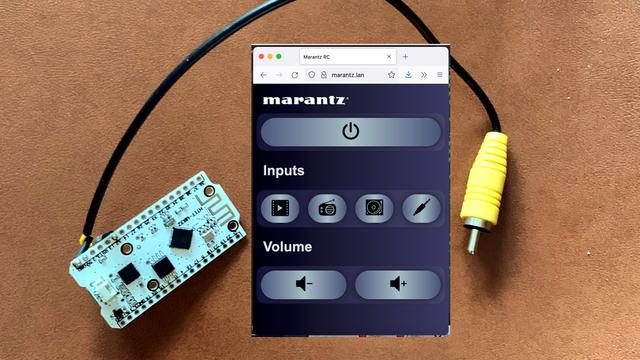
[Alex] recently gave a Marantz audio amplifier the ability to be remotely-controlled via WiFi by interfacing an ESP32 board to a handy port, but the process highlights how interfacing to existing hardware often runs into little, unforeseeable problems that can sink the project unless solved.
At its core, the project uses an ESP32 and the ESPAsyncWebServer project to create a handy web interface that is accessible over WiFi. Then, to actually control the amplifier, [Alex] decoded the IR-based remote signals by watching the unit's REMOTE ports, which are intended as a pass-through and repeater for IR signals to other Marantz units. This functionality can be exploited; by sending the right signals to the REMOTE IN port, the unit can be controlled by the ESP32. With the ESP32 itself accessible by just about any WiFi device, [Alex] gains the freedom to control his amplifier with much greater flexibility than just the IR remote would offer.
Sounds fairly straightforward, but as usual when interfacing to an existing piece of electronics, there were a few glitches. The first was that high and inconsistent latency (from 10 ms to 100 ms) made controlling the amplifier a sometimes frustrating experience, but that was solved by disabling power saving on the WiFi interface. Another issue was that sending signals by connecting a GPIO pin to the REMOTE IN port of the amplifier worked, but had the side effect of causing the amplifier to no longer listen to the IR remote. Apparently, current flowing from the REMOTE port to the ESP32's GPIO pin was to blame, because adding a diode in between fixed the problem.
The GitHub repository holds the design files and code. This kind of project can be pretty complex, because the existing hardware doesn't always play nice, and useful boards like a modern ESP32 aren't always available. Adding a wireless interface to vintage audio equipment has in the past involved etching circuit boards and considerably more parts.
#homeentertainmenthacks #wirelesshacks #amplifier #irremote #marantz #wifi #wirelessremote
An OSHW IR Remote Control Powered by the ATtiny13A
The new hotness in consumer electronics might be RF remotes based on protocols like Bluetooth Low Energy, but there's still plenty of life left in the classic infrared remote. Especially with projects like TinyRemoteXL from [Stefan Wagner], which let you build and program an IR "clicker" of your own. Whether you want to spin up your own custom universal remote or create a beefed up version of the TV-B-Gone, this open source effort is a great place to start.
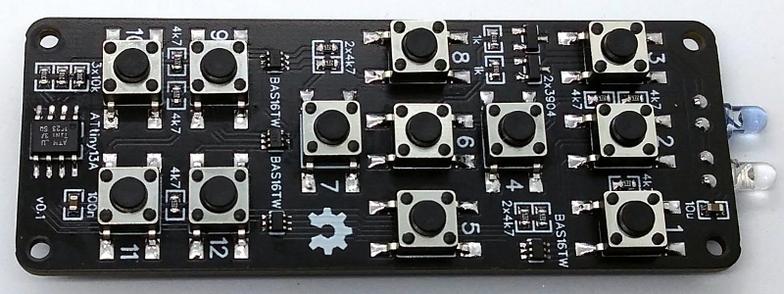
As you might have guessed from the name, this project is actually a larger version of the TinyRemote that [Stefan] put together previously. The documentation for that project goes a bit more into the nuts and bolts of talking IR, and is definitely worth a read if you're into the low level stuff. For the original five button TinyRemote, the hardware consists of little more than a ATtiny13A microcontroller, a pair of IR LEDs, and the transistors to drive them.
But on the XL, things are a bit trickier as there are now twelve buttons for the ATtiny13A to read. Obviously there aren't enough pins to read so many buttons directly, but with a combination of BAS16TW diode arrays and resistors, [Stefan] is able to detect what button was pressed using the chip's interrupt pin and ADC. Certainly a handy trick to have in the back of your mind, and the open source nature of this project gives you a great chance to see how it's implemented.
Between this project and the impressive development board [Djordje Mandic] released recently, it seems we're looking at something of an infrared hacking revival. Earlier this year we even saw the commercial release of an IR-equipped ESP8266 board.
#attinyhacks #ledhacks #attiny13a #infrared #irremote #remotecontrol
 fatuus
 Shankar 🇮🇳
 Siavash
 hackaday unofficial