
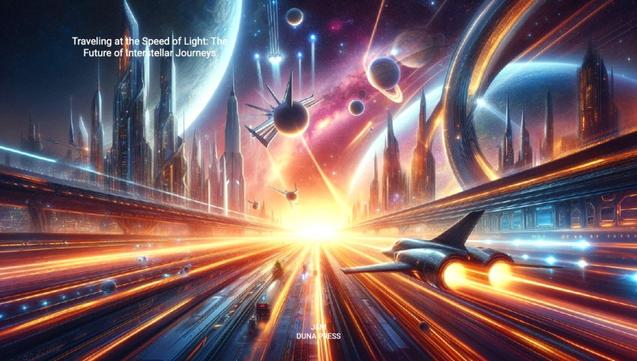
Traveling at the Speed of Light: The Future of Interstellar Journeys

Traveling at the speed of light has been one of humanity’s most captivating dreams. From the imaginative worlds of science fiction to the ambitious visions of physicists and space agencies, the idea of surpassing our cosmic limits sparks awe and curiosity. Yet, while the fantasy of cruising between the stars in mere moments is exhilarating, the reality of interstellar travel is bound by the laws of physics, human physiology, and technological innovation.

In this article, we will explore what traveling at the speed of light would mean for humanity, the challenges we face in reaching such speeds, and the possibilities of achieving interstellar journeys in the not-so-distant future.

Contents

  • The Speed of Light: A Cosmic Limit
  • What Happens at Light Speed?
  • Relativity and Time Dilation
  • The Human Experience of Light-Speed Travel
  • Technological Barriers to Light-Speed Travel
  • Alternative Paths: Near-Light Speed and Warp Concepts
  • Interstellar Journeys: The Next Frontier
  • The Human Spirit of Exploration

The Speed of Light: A Cosmic Limit

In physics, the speed of light—approximately 299,792 kilometers per second—is the ultimate speed limit of the universe. According to Einstein’s theory of relativity, no object with mass can reach or exceed this velocity. As a spacecraft accelerates closer to the speed of light, it requires exponentially more energy, approaching infinity at light speed. This makes the idea of a spaceship reaching that velocity seem impossible with our current understanding of physics.

What Happens at Light Speed?

If it were possible to reach light speed, the universe would appear radically different. From the traveler’s perspective, distances would contract dramatically due to Lorentz contraction. Stars ahead might blur into streaks of light, while cosmic radiation would intensify dangerously. The journey would feel instantaneous for those aboard, yet decades, centuries, or even millennia could pass on Earth.

Relativity and Time Dilation

Einstein’s special relativity tells us that time slows down for objects moving near the speed of light. This means astronauts traveling at such speeds could experience only a few years of aging while centuries unfold back on Earth. The emotional implications of this are profound: astronauts might return to a planet that has advanced far beyond recognition, where loved ones are long gone, and society has transformed completely.

The Human Experience of Light-Speed Travel

Beyond the physics, the human experience of such journeys is just as important. Imagine being one of the first explorers leaving Earth behind for an interstellar mission: the courage, isolation, and sense of destiny would be overwhelming. Traveling at or near light speed would not only test technology but also challenge our psychology, emotions, and ability to cope with the vastness of space.

For many, the journey itself would become a defining experience of human resilience and identity. Would we still feel connected to Earth when centuries pass in a heartbeat? Or would we evolve into a new kind of interstellar civilization?

Technological Barriers to Light-Speed Travel

Currently, the barriers to light-speed travel are immense. Some of the most critical include:

  • Energy Requirements: Accelerating a spacecraft to near-light speeds would require energy comparable to the total output of stars.
  • Radiation Hazards: At high speeds, even tiny particles of space dust could hit a spacecraft with the force of nuclear explosions.
  • Human Biology: The human body is not built to withstand extreme radiation and long-term exposure to microgravity.
  • Material Science: No known materials can endure the stresses of such travel without disintegrating.

Alternative Paths: Near-Light Speed and Warp Concepts

Since true light-speed travel appears unreachable with current science, researchers explore alternatives. These include:

  • Near-Light Speed Travel: Using concepts such as antimatter engines, nuclear pulse propulsion, or light sails powered by lasers, spacecraft could approach significant fractions of the speed of light.
  • Warp Drives: Inspired by science fiction, the idea of bending or warping spacetime itself could, in theory, allow faster-than-light travel without violating relativity. Though purely theoretical, the Alcubierre Drive concept continues to spark debate in scientific communities.

Interstellar Journeys: The Next Frontier

Even if we cannot reach the speed of light, humanity’s vision of interstellar travel is far from dead. Projects like Breakthrough Starshot aim to send small probes propelled by powerful lasers to nearby stars at up to 20% the speed of light. Such missions could reach Alpha Centauri within a human lifetime.

For larger spacecraft carrying people, slower but sustainable methods may be the solution—such as generation ships, where multiple generations live and die aboard the vessel before it reaches its destination.

The Human Spirit of Exploration

At its heart, the dream of light-speed travel is about more than science—it’s about the human spirit. We are explorers by nature, compelled to reach beyond horizons and imagine new worlds. Interstellar travel represents not only technological ambition but also a profound expression of hope: that humanity can survive, thrive, and spread its light among the stars.

Even if traveling at the speed of light remains out of reach, the journey toward that goal will drive innovation, inspire generations, and redefine our place in the cosmos.

Traveling at the speed of light is both a scientific challenge and a philosophical question. While the laws of physics may never allow us to truly achieve it, the pursuit of interstellar journeys will transform how we live, think, and imagine the future. What matters most is not whether we reach the speed of light, but how the quest itself will shape humanity’s destiny among the stars.

Share your thoughts in the comments, and explore more insights on our Journal and Magazine. Please consider becoming a subscriber, thank you: https://dunapress.org/subscriptions – Follow J&M Duna Press on social media. Join the Oslo Meet by connecting experiences and uniting solutions: https://oslomeet.org
#futureOfSpace #interstellarExploration #lightSpeedTravel

Optimism for interstellar exploration

There’s been some attention lately to a contest on designing an interstellar generation ship, a large scale ship that humans live in for generations while it crosses interstellar space to another solar system. As Paul Gilster at Centauri Dreams notes, generation ships are a long time staple in science fiction, albeit with the common trope of the crew forgetting that they’re on a ship, or other things going horribly wrong.

But even before science fiction got into them, the generation ship was explored by early space exploration thinkers like Robert Goddard and Konstantin Tsiolkovsky. Whenever I’m tempted to dismiss current thinking about how interstellar exploration might work, I think about people like Goddard, Tsiolkovsky, Walter Hohmann, and Hermann Oberth, guys working in the early 1900s who were able to predict a lot of the space age, just by carefully thinking through known physics.

Although I find it hard to be too enthusiastic for generation ships. It’s worth thinking about what might have to be true for us to consign a group of people, who would have to be highly skilled, to spending the rest of their lives and that of their descendants in a profoundly isolated environment. It seems like we wouldn’t want to do it unless a number of factors were true.

We would likely want to know that there was a desirable destination worth pursuing. So we probably would have already sent robotic probes to the destination and would have thorough information on the environment. Otherwise the chances of ship’s descendants finding worlds no better than the other planets in our solar system would be too high.

There would also need to be some kind of ideology or religion, some type of manifest destiny involved, something that convinces a society to spend the kind of resources that would be needed for building something like a mobile space colony and accelerating it away at a velocity that allows it to reach its destination in any kind of reasonable time frame. (The contest posits one percent lightspeed, which gets it to Proxima Centauri in four centuries, but would take over a millenia to get to somewhere like Tau Ceti.)

To me, the whole endeavor is easier to imagine, and much less ethically dire, if it isn’t actually a generation ship, but a long duration mission for humans who have achieved immortality, or at least much longer lifespans.

It’s worth noting that the energy to get that large a habitat to even one percent of light (3000 kilometers per second) would be staggering. Although we might imagine it being doable with several gigantic fusion rocket stages. In calculating things like this, we always run up against the tyranny of the rocket equation, which is pitiless in revealing that fuel requirements increase exponentially the heavier our payload and the faster we want to go. (And are even yet more exponentially worse if we need to use the same method to slow down at the destination.)

Earlier this year I did a post asking where the aliens are. At the end, I noted that one possibility to explain why they’re not here, is that maybe interstellar travel is impossible, even for robots. Putting that at the end of the post led a number of people to conclude that was my argument. But I’m actually pretty bullish on the idea of robotic interstellar exploration. (Although I do fear generation, long duration, or sleeper ships might be as good as it gets for sending biological humans.)

Years ago, Paul Gilster made a comment that stuck with me. He noted that the main obstacle to interstellar exploration is energy, but we have all the energy we need in the sun. The trick is to find a way to channel it.

One of the currently most promising options is to use a laser propelled light sail, where a ground based laser, or array of lasers, propel a light sail craft to some substantial percentage of lightspeed. The beauty of approaches like this is they get around the tyranny of the rocket equation by having the energy used for acceleration remain outside of the spacecraft. This is the method envisaged by Breakthrough Starshot.

There are also hybrid approaches involving beaming power to a spacecraft which uses it to accelerate propellant, but the added weight and acceleration times increase the amount of coordination needed and opportunities for things to go wrong.

Breakthrough Starshot is currently aiming for a flyby mission, but to get enough information to support a future human mission, the craft would have to slow down and be able to explore at its destination. Slowing down, which in space takes just as much energy as accelerating, is a non-trivial problem.

A possible solution comes from an old idea. The Bussard ramjet was originally conceived of as a way for a spacecraft to gather its fuel in flight from the interstellar medium using an electromagnetic ram scoop. The problem is that the scoop has been demonstrated to likely produce as much drag as thrust. However, it leads to the idea of using a magnetic sail to break against the interstellar medium, and maybe even switching to an electric sail in the final stages to get down to interplanetary speeds.

Of course, this means a multi-sail design, which adds considerable weight, requiring larger initial light sails and laser arrays. But if we put the lasers on Mercury (as Robert Forward suggested in one of his designs), where solar power would be much more plentiful, such laser arrays start to seem more plausible.

Looking further down the road, the rocket situation could be improved if we can find a way to harness antimatter, aside from black holes, the most dense energy storage mechanism currently known. Manufacturing antimatter is often thought to be the bottleneck here, but again, if the antimatter factories were in close orbit of the sun, utilizing the solar power available there, it might be easier to imagine it happening.

All of which is to say, I don’t think interstellar exploration is impossible. I do doubt it will be practical for humans for a long time. But we seem to have multiple potential approaches for doing it robotically. While some may fizzle along the way, it’s hard to imagine all of them failing.

At least that’s how it looks to me today. But maybe I’m missing something? Are there problems with these approaches I’m overlooking? Or solid reasons to be more optimistic for sending humans?

#Future #GenerationShip #Interstellar #interstellarExploration #Space #spaceExploration

Two Stars Tapestry by Jeremy Aiyadurai

Purchase a 50" x 61" wall tapestry featuring the painting "Two Stars" by Jeremy Aiyadurai. Tapestries are available in three different sizes. The artwork is printed on the front surface, and the back surface is white.

Jeremy Aiyadurai Official Website