What’s Up Swifties: How to celebrate “The Life of a Showgirl” release in style

Taylor Swift will release her twelfth studio album, “The Life of a Showgirl,” Friday. For swifties, members of Swift’s fanbase, on Ohio State’s campus, there are lots of ways to celebrate this event — with all the glitz and glam of the new era included.  Read on to learn more about the events being hosted […]

The Lantern
Plan for #ColumnShaft of #IonicColumn

The #shaft of an #Ionic column is not perfectly cylindrical but gradually tapers off in the top 2/3 of the shaft. As such, the #primaryProfileCurve is not a straight line, nor is it composed of regular arcs. Instead, it is a complex amalgam of straight lines, circular arcs, and #NURBS curves, where the fancy acronym stands for an even fancier name — "Non-Uniform Rational B-Splines."

So, the promise [https://pixelfed.social/p/Splines/789956327130679640] was that we were going to get through this by drawing just straight lines and arcs. How are we going to draw NURBS? The answer is that we won't. The #CAD program will, as long as we give it sufficient information to carry out the task.

There are three NURBS curves in the profile shown in the plan. The longest and the most important one is between the points marked C through J. There is a smaller one between B and C, and an even smaller one between J and K.

While all three NURBS curves are mathematically similar, the information we must provide to the CAD program for the longest one is different from the other two short ones, and the operations the CAD program carries out to construct the longest one and the other two curves is also different.

This brings us to two new operations — #interpolate or "fit through points," and #blend shapes (existing curves or surfaces). When you choose a CAD program, make sure it supports NURBS, #interpolation, and #blending.

Starting at the bottom of the shaft, point A is 144 units from the #columnAxis, and so is point B, which is also 768 units higher than A. Starting with C through J, the points gradually move closer to the axis until J is exactly µ * 5/6, or 120 units from the axis. These points are equidistant vertically — all 192 units apart. However the horizontal distance is non-uniform.

In the next post we will mark the 8 points C through J using using one arc and 8 straight lines — I will keep my promise.

Splines (@[email protected])

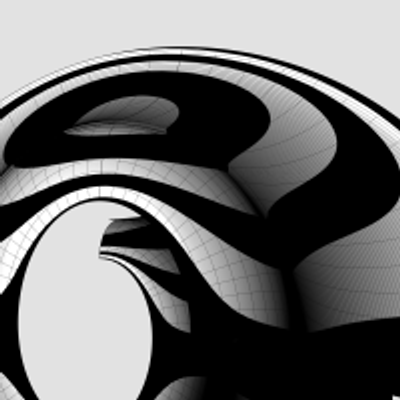
This sweeping shape is a timeless design that first appeared in the scrolls of the #IonicCapital as the most distinctive part of the #IonicOrder in classical Greco-Roman architecture more than 2500 years ago. Shown here with a zebra pattern on the wireframe of a CAD model to accentuate its features and attest to the smoothness of its 3-dimensional surface, the design has been refined many times since the original version over the last two millennia. The two most remarkable things about this design are that: — It can be recreated with modern CAD tools by drawing simple 2-dimensional straight lines and circular arcs exclusively. The end result is truly breathtaking and makes one wonder how architects visualized the result and put theory into practice. In the CAD model, the ultimate surface is a #NURBS surface that uses #BSplines extensively, but none of the B-splines or surfaces need to be created "by hand." One only has to draw straight lines and circular arcs with accurate measurements snapped to grids. — For a design that has survived the ages, it is lamentable how few authoritative sources that accurately describe fine details and exact reconstruction methodology remain accessible to the general public in the age of Internet. The most comprehensive is the 10-volume tome that Marcus #Vitruvius Pollio, a Roman architect and engineer, wrote for #JuliusCaesar and his successor Emperor #CaesarAugustus. [https://www.gutenberg.org/files/20239/20239-h/20239-h.htm] I frequently use two more authoritative sources: — "Regola delli cinque ordini d' architettura," or simply #RegolaArchitettura by Giacomo Barozzi da #Vignola [https://archive.org/details/gri_33125008229458/page/n3/mode/2up], and — "A Course in Theoretical and Practical Architecture," or simply #PracticalArchitecture by Francisco Salvatore #Scarlata (#Bordonaro), which documents #VignolaProportions in tabular form [https://babel.hathitrust.org/cgi/pt?id=mdp.39015031201190&view=1up&seq=5]

Pixelfed

Inkscape Interpolate Tutorial: Step-by-Step How to Create Retro 80s Perspective Grid

https://peervideo.ru/videos/watch/e1b6afb2-ff39-44d2-aab4-10b502956a0c

Inkscape Interpolate Tutorial: Step-by-Step How to Create Retro 80s Perspective Grid

PeerTube